1Department of Ecology and Evolutionary Biology, Yale University, New Haven, CT 06511 USA.
2Yale Systems Biology Institute, Yale University, West Haven, CT 06516 USA.
Commun Biol. 2019 May 3;2:160. doi: 10.1038/s42003-019-0417-3. eCollection 2019.
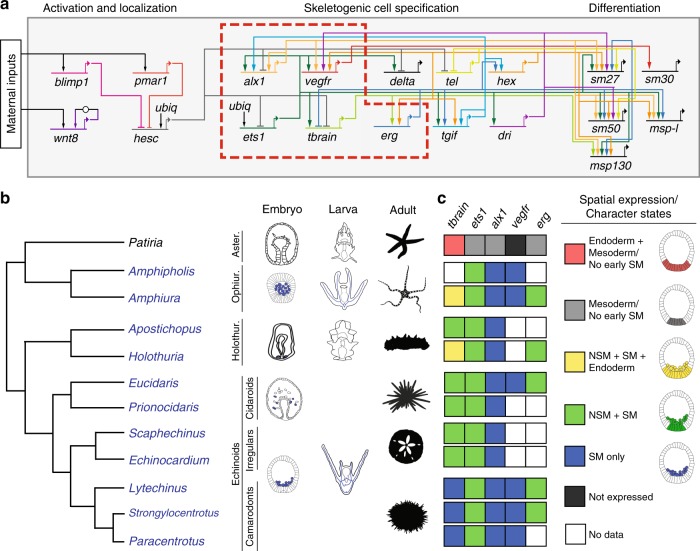
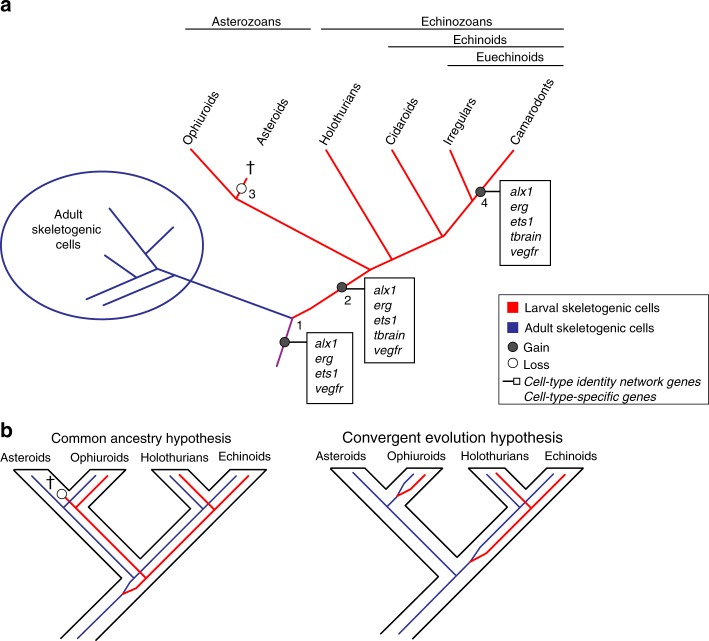
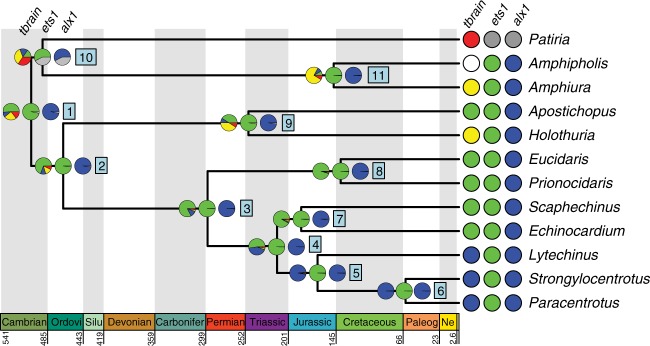
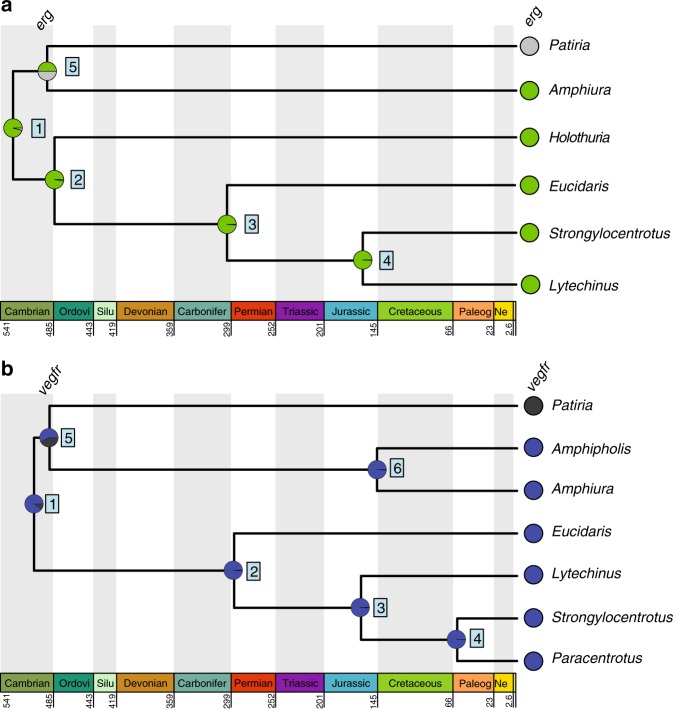
The multiplicity of cell types comprising multicellular organisms begs the question as to how cell type identities evolve over time. Cell type phylogenetics informs this question by comparing gene expression of homologous cell types in distantly related taxa. We employ this approach to inform the identity of larval skeletogenic cells of echinoderms, a clade for which there are phylogenetically diverse datasets of spatial gene expression patterns. We determined ancestral spatial expression patterns of , and , key components of the skeletogenic gene regulatory network driving identity of the larval skeletogenic cell. Here we show ancestral state reconstructions of spatial gene expression of extant eleutherozoan echinoderms support homology and common ancestry of echinoderm larval skeletogenic cells. We propose larval skeletogenic cells arose in the stem lineage of eleutherozoans during a cell type duplication event that heterochronically activated adult skeletogenic cells in a topographically distinct tissue in early development.
多细胞生物中细胞类型的多样性使得人们不禁要问,细胞类型的身份是如何随时间演变的。通过比较远缘分类群中同源细胞类型的基因表达,细胞类型系统发生学回答了这个问题。我们采用这种方法来确定棘皮动物幼虫骨骼生成细胞的身份,棘皮动物是一个具有多样化空间基因表达模式数据集的进化枝。我们确定了 、 和 的祖先空间表达模式,这些是驱动幼虫骨骼生成细胞身份的骨骼生成基因调控网络的关键组成部分。在这里,我们展示了现存的自由生活真后生动物棘皮动物的空间基因表达的祖先状态重建,支持棘皮动物幼虫骨骼生成细胞的同源性和共同祖先。我们提出,幼虫骨骼生成细胞是在真后生动物的茎系中通过细胞类型复制事件产生的,该事件在早期发育中使成年骨骼生成细胞在拓扑上不同的组织中发生异时性激活。