Key Laboratory of Cell Differentiation and Apoptosis of Chinese Ministry of Education, Clinical and Fundamental Research Center, Department of Pharmacy, Renji Hospital, Shanghai Jiao-Tong University School of Medicine (SJTU-SM), Shanghai 200127, China.
Research Center for Marine Drugs, State Key Laboratory of Oncogenes and Related Genes, Department of Pharmacy, Renji Hospital, Shanghai Jiao-Tong University School of Medicine (SJTU-SM), Shanghai 200127, China.
Nucleic Acids Res. 2019 Jul 2;47(W1):W315-W321. doi: 10.1093/nar/gkz350.
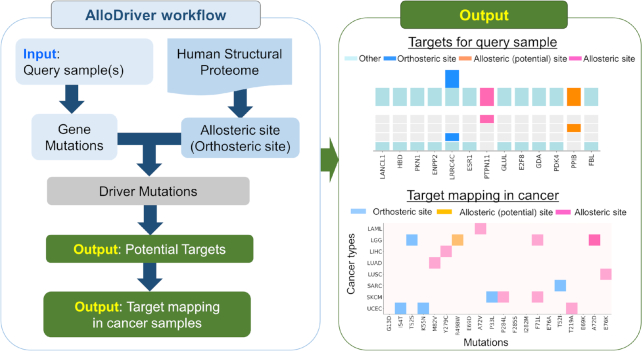
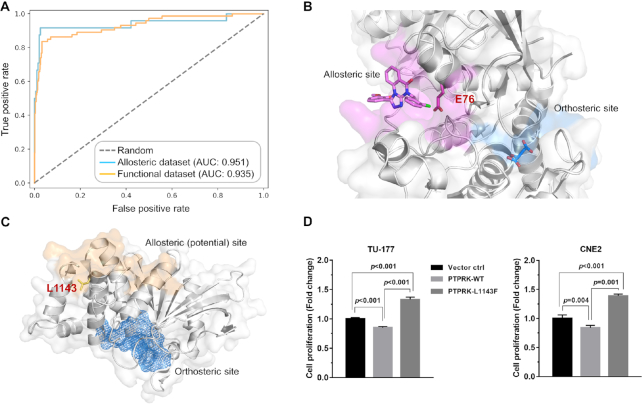
Identifying the variants that alter protein function is a promising strategy for deciphering the biological consequences of somatic mutations during tumorigenesis, which could provide novel targets for the development of cancer therapies. Here, based on our previously developed method, we present a strategy called AlloDriver that identifies cancer driver genes/proteins as possible targets from mutations. AlloDriver utilizes structural and dynamic features to prioritize potentially functional genes/proteins in individual cancers via mapping mutations generated from clinical cancer samples to allosteric/orthosteric sites derived from three-dimensional protein structures. This strategy exhibits desirable performance in the reemergence of known cancer driver mutations and genes/proteins from clinical samples. Significantly, the practicability of AlloDriver to discover novel cancer driver proteins in head and neck squamous cell carcinoma (HNSC) was tested in a real case of human protein tyrosine phosphatase, receptor type K (PTPRK) through a L1143F driver mutation located at the allosteric site of PTPRK, which was experimentally validated by cell proliferation assay. AlloDriver is expected to help to uncover innovative molecular mechanisms of tumorigenesis by perturbing proteins and to discover novel targets based on cancer driver mutations. The AlloDriver is freely available to all users at http://mdl.shsmu.edu.cn/ALD.
鉴定改变蛋白质功能的变异体是解析肿瘤发生过程中体细胞突变的生物学后果的一种有前途的策略,这可为癌症治疗的发展提供新的靶点。在这里,基于我们之前开发的方法,我们提出了一种称为 AlloDriver 的策略,该策略可将癌症驱动基因/蛋白识别为可能的突变靶点。AlloDriver 利用结构和动态特征,通过将来自临床癌症样本的突变映射到源自三维蛋白质结构的变构/正构位点,来优先考虑个体癌症中潜在的功能基因/蛋白。该策略在重新出现已知的癌症驱动突变和来自临床样本的基因/蛋白方面表现出良好的性能。值得注意的是,通过位于 PTPRK 变构位点的 L1143F 驱动突变,对头颈鳞状细胞癌 (HNSC) 中新型癌症驱动蛋白的发现进行了 AlloDriver 的实用性测试,该突变通过细胞增殖实验得到了实验验证。AlloDriver 有望通过干扰蛋白质来帮助揭示肿瘤发生的创新分子机制,并基于癌症驱动突变发现新的靶点。AlloDriver 可供所有用户在 http://mdl.shsmu.edu.cn/ALD 免费使用。