Immunology & Respiratory Diseases Research, Boehringer Ingelheim Pharma GmbH & Co. KG, Birkendorfer Straße 65, 88397, Biberach an der Riss, Germany.
Medicinal Chemistry, Boehringer Ingelheim Pharma GmbH & Co. KG, Birkendorfer Straße 65, 88397, Biberach an der Riss, Germany.
Respir Res. 2019 May 9;20(1):87. doi: 10.1186/s12931-019-1058-2.
Idiopathic pulmonary fibrosis (IPF) is a fatal respiratory disease characterized by aberrant fibroblast activation and progressive fibrotic remodelling of the lungs. Though the exact pathophysiological mechanisms of IPF remain unknown, TGF-β1 is thought to act as a main driver of the disease by mediating fibroblast-to-myofibroblast transformation (FMT). Recent reports have indicated that a metabolic shift towards aerobic glycolysis takes place during FMT and that metabolic shifts can directly influence aberrant cell function. This has led to the hypothesis that inhibition of lactate dehydrogenase 5 (LDH5), an enzyme responsible for converting pyruvate into lactate, could constitute a therapeutic concept for IPF.
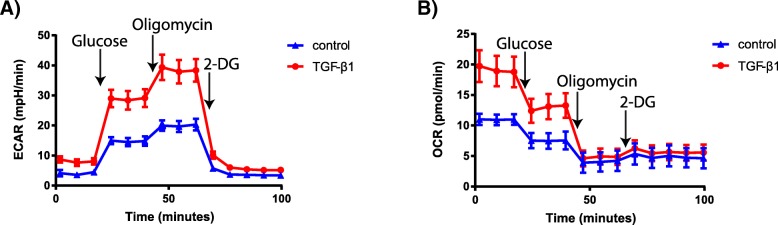
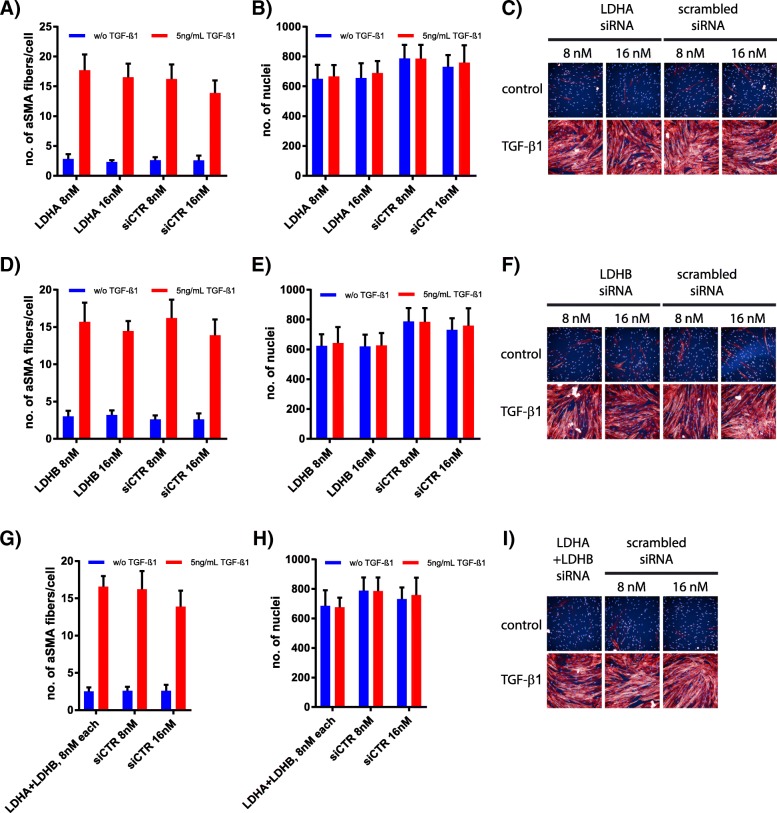
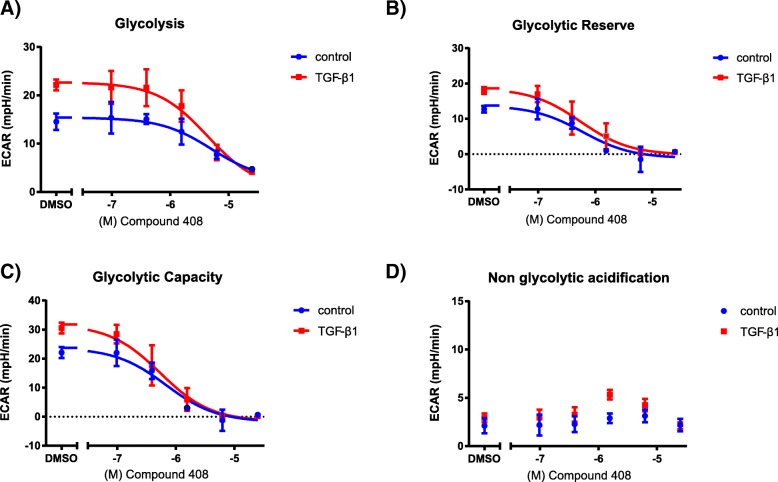
In this study, we investigated the potential link between aerobic glycolysis and FMT using a potent LDH5 inhibitor (Compound 408, Genentech). Seahorse analysis was performed to determine the effect of Compound 408 on TGF-β1-driven glycolysis in WI-38 fibroblasts. TGF-β1-mediated FMT was measured by quantifying α-smooth muscle actin (α-SMA) and fibronectin in primary human lung fibroblasts following treatment with Compound 408. Lactate and pyruvate levels in the cell culture supernatant were assessed by LC-MS/MS. In addition to pharmacological LDH5 inhibition, the effect of siRNA-mediated knockdown of LDHA and LDHB on FMT was examined.
We show that treatment of lung fibroblasts with Compound 408 efficiently inhibits LDH5 and attenuates the TGF-β1-mediated metabolic shift towards aerobic glycolysis. Additionally, we demonstrate that LDH5 inhibition has no significant effect on TGF-β1-mediated FMT in primary human lung fibroblasts by analysing α-SMA fibre formation and fibronectin expression.
Our data strongly suggest that while LDH5 inhibition can prevent metabolic shifts in fibroblasts, it has no influence on FMT and therefore glycolytic dysregulation is unlikely to be the sole driver of FMT.
特发性肺纤维化(IPF)是一种致命的呼吸系统疾病,其特征是成纤维细胞异常激活和肺进行性纤维化重塑。尽管 IPF 的确切病理生理机制尚不清楚,但 TGF-β1 被认为是通过介导成纤维细胞向肌成纤维细胞转化(FMT)来驱动疾病的主要因素。最近的报告表明,在 FMT 过程中会发生向有氧糖酵解的代谢转变,并且代谢转变可以直接影响异常细胞功能。这导致了这样一种假设,即抑制负责将丙酮酸转化为乳酸的乳酸脱氢酶 5(LDH5)可能成为 IPF 的一种治疗概念。
在这项研究中,我们使用一种有效的 LDH5 抑制剂(罗氏的 Compound 408)研究了有氧糖酵解与 FMT 之间的潜在联系。通过测定 WI-38 成纤维细胞中 TGF-β1 驱动的糖酵解作用,来进行 Seahorse 分析,以确定 Compound 408 对其的影响。用 LC-MS/MS 评估细胞培养上清液中的乳酸和丙酮酸水平。除了药理 LDH5 抑制作用外,还研究了 siRNA 介导的 LDHA 和 LDHB 敲低对 FMT 的影响。
我们表明,用 Compound 408 处理肺成纤维细胞可有效抑制 LDH5,并减弱 TGF-β1 介导的向有氧糖酵解的代谢转变。此外,我们通过分析α-平滑肌肌动蛋白(α-SMA)纤维形成和纤维连接蛋白表达,证明 LDH5 抑制对原代人肺成纤维细胞中 TGF-β1 介导的 FMT 没有显著影响。
我们的数据强烈表明,虽然 LDH5 抑制可以防止成纤维细胞中的代谢转变,但它对 FMT 没有影响,因此糖酵解失调不太可能是 FMT 的唯一驱动因素。