Cancer Institute (a Key Laboratory For Cancer Prevention & Intervention, China National Ministry of Education), The Second Affiliated Hospital, Zhejiang University School of Medicine, 88 Jiefang Road, Hangzhou, China.
Key Laboratory of Organosilicon Chemistry and Material Technology, Hangzhou Normal University, Hangzhou, China.
Sci Rep. 2017 Aug 16;7(1):8489. doi: 10.1038/s41598-017-08277-3.
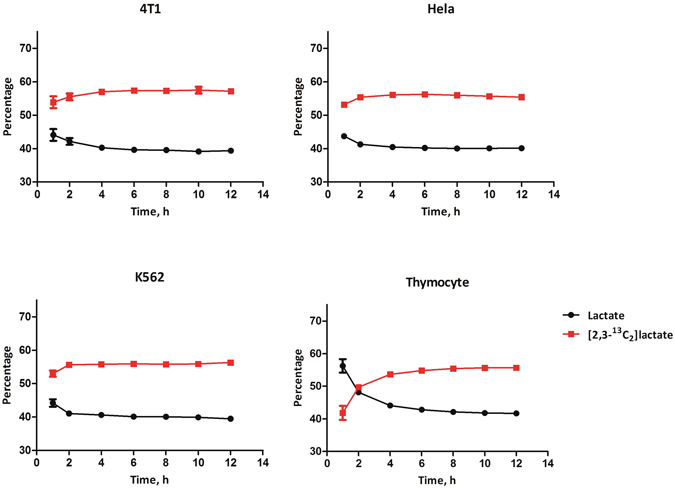
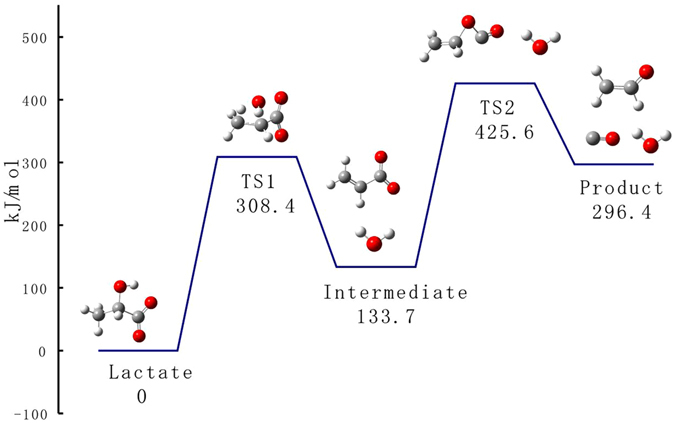
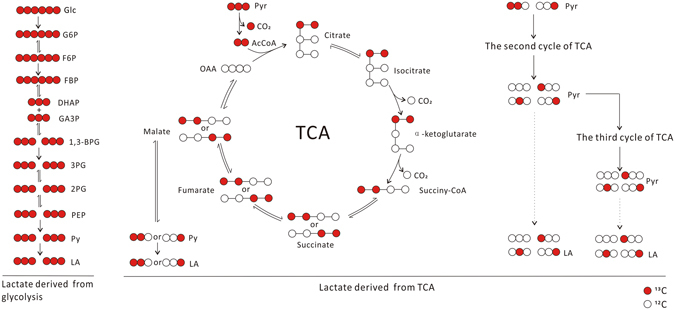
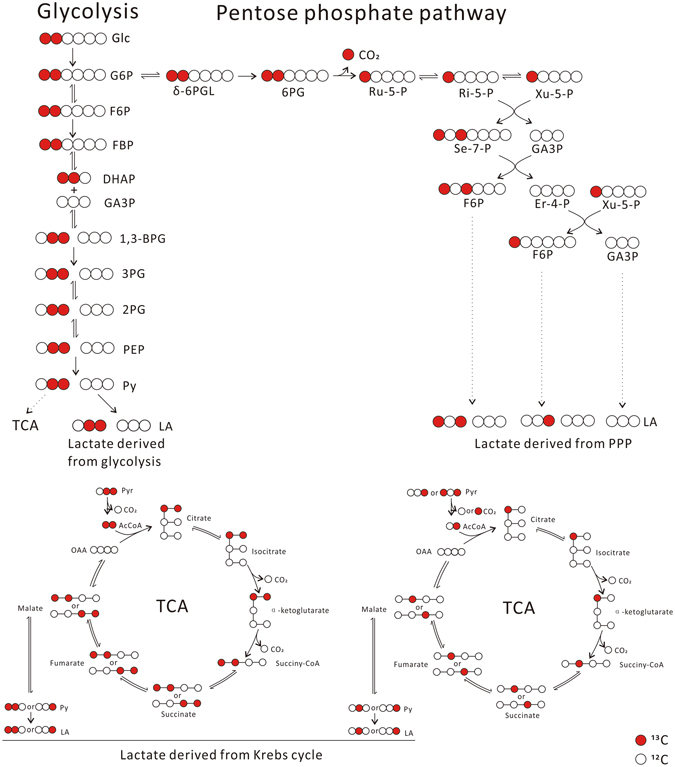
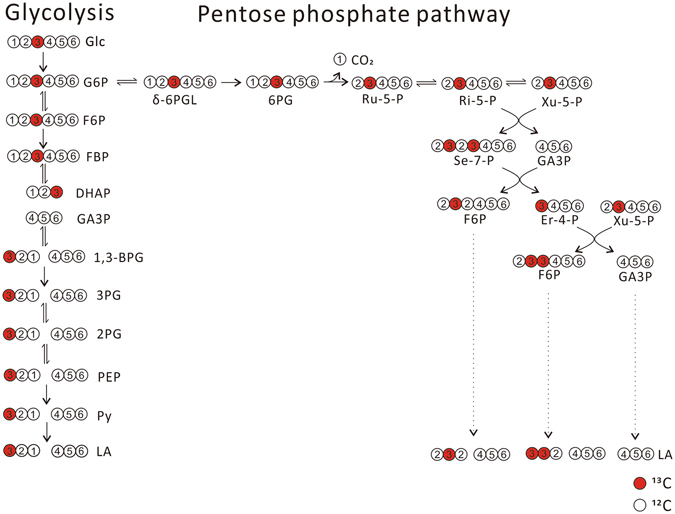
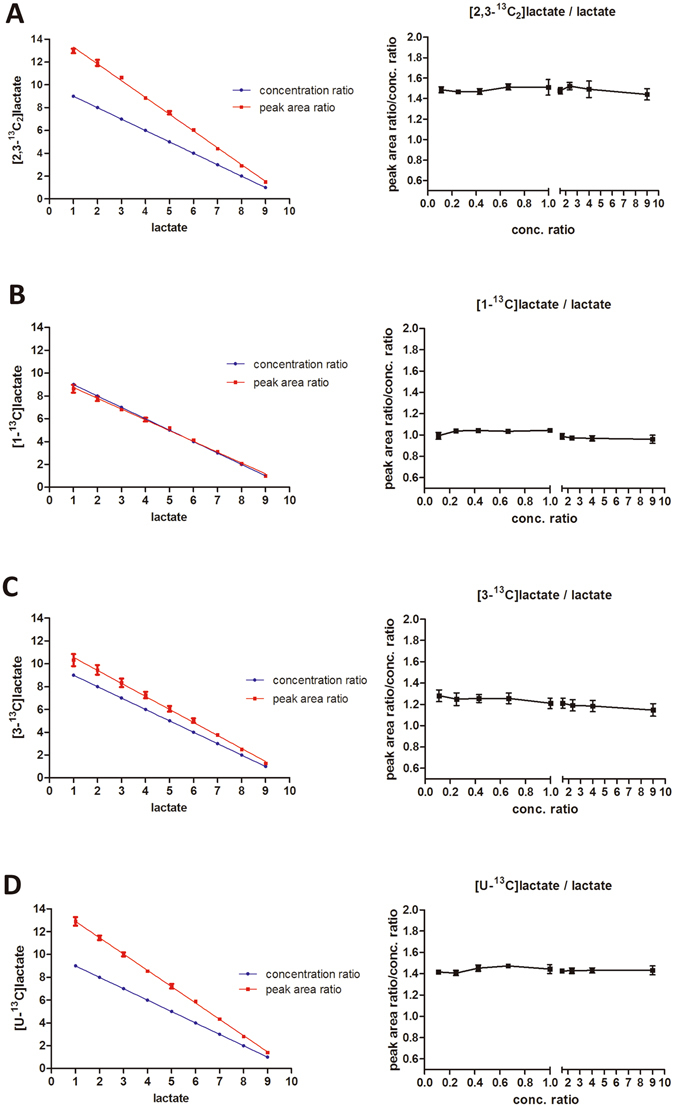
C-labeled glucose combined with chromatography and mass spectrometry enables us to decipher the percentage of lactate generated from various metabolic pathways. We showed that lactate derived from glycolysis, pentose phosphate pathway, Krebs cycle, and other sources accounted for 82-90%, 6.0-11%, 0.67-1.8% and 1.5-7.9%, respectively, depending on different types of cells. When using glucose isotopomers ([1-C]-, [3-C]-, [4-C]-, and [6-C]glucose) or isotopologues ([1,2-C]- and [1,2,3-C]glucose) for tracing, the ratio of lactate derived from glucose carbon 1, 2, 3 over 4, 5, 6 via glycolysis varied significantly, ranging from 1.6 (traced with [1,2-C]glucose) to 0.85 (traced with [6-C]glucose), but the theoretical ratio should be 1. The odd results might be caused by intramolecular C, which may significantly affect lactate fragmentation under tandem mass spectrometry condition, leading to erroneous quantification. Indeed, the fragmentation efficiency of [U-C]lactate, [2,3-C]lactate, and [3-C]lactate were 1.4, 1.5 and 1.2 folds higher than lactate, respectively, but [1-C]lactate was similar to lactate, suggesting that carbon-13 at different positions could differentially influence lactate fragmentation. This observed phenomenon was inconsistent with the data based on theoretical calculation, according to which activation energies for all lactate isotopomers and isotopologues are nearly identical. The inconsistency suggested a need for further investigation. Our study suggests that calibration is required for quantifying metabolite isotopolugues and isotopomers.
C 标记的葡萄糖与色谱和质谱相结合,使我们能够破译来自各种代谢途径的乳酸生成的百分比。我们表明,来自糖酵解、磷酸戊糖途径、三羧酸循环和其他来源的乳酸分别占 82-90%、6.0-11%、0.67-1.8%和 1.5-7.9%,具体取决于不同类型的细胞。当使用葡萄糖同位素([1-C]-、[3-C]-、[4-C]-和[6-C]-葡萄糖)或同位素([1,2-C]-和[1,2,3-C]-葡萄糖)进行示踪时,通过糖酵解从葡萄糖碳 1、2、3 衍生的乳酸与从 4、5、6 衍生的乳酸的比例差异很大,范围从 1.6(用[1,2-C]-葡萄糖追踪)到 0.85(用[6-C]-葡萄糖追踪),但理论比例应为 1。奇怪的结果可能是由于分子内的 C 引起的,它可能会在串联质谱条件下显著影响乳酸的碎片化,从而导致错误的定量。事实上,[U-C]乳酸、[2,3-C]乳酸和[3-C]乳酸的碎片化效率分别是乳酸的 1.4、1.5 和 1.2 倍,而[1-C]乳酸与乳酸相似,这表明不同位置的碳-13 可能会对乳酸碎片化产生不同的影响。这种观察到的现象与基于理论计算的数据不一致,根据该理论,所有乳酸同位素和同位素的活化能几乎相同。这种不一致表明需要进一步研究。我们的研究表明,需要对代谢物同位素和同位素进行定量校准。