Department of Pathology and Molecular Pathology, Centre Jean Perrin, Clermont-Ferrand, France
UMR INSERM 1240, Universite Clermont Auvergne, Clermont-Ferrand, France.
J Clin Pathol. 2019 Jul;72(7):460-467. doi: 10.1136/jclinpath-2018-205679. Epub 2019 May 9.
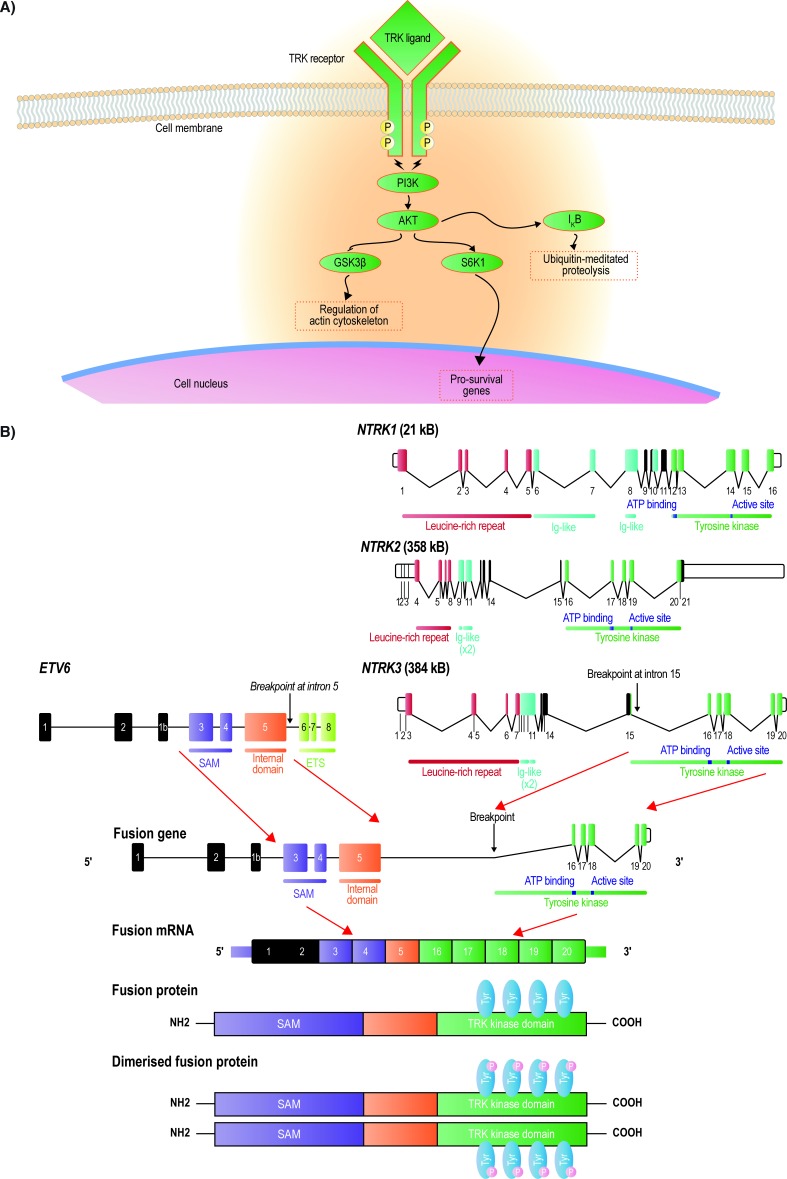
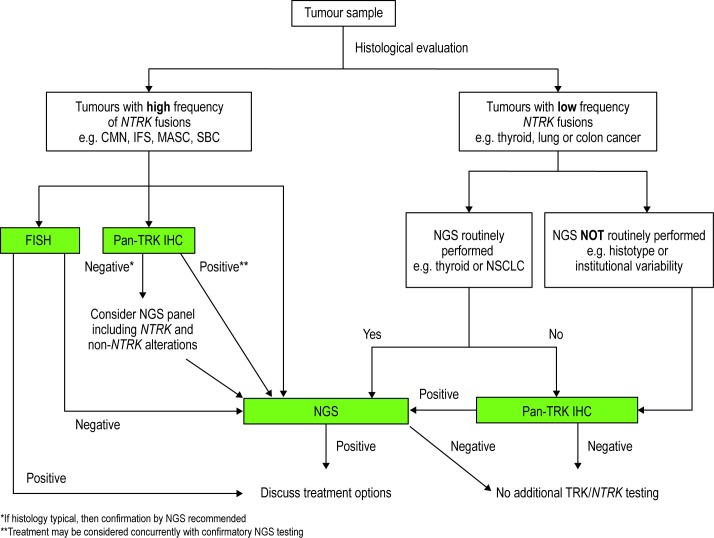
The neurotrophic tyrosine receptor kinase () gene family encodes three tropomyosin receptor kinases (TRKA, TRKB, TRKC) that contribute to central and peripheral nervous system development and function. gene fusions are oncogenic drivers of various adult and paediatric tumours. Several methods have been used to detect gene fusions including immunohistochemistry, fluorescence in situ hybridisation, reverse transcriptase polymerase chain reaction, and DNA- or RNA-based next-generation sequencing. For patients with TRK fusion cancer, TRK inhibition is an important therapeutic target. Following the FDA approval of the selective TRK inhibitor, larotrectinib, as well as the ongoing development of multi-kinase inhibitors with activity in TRK fusion cancer, testing for gene fusions should become part of the standard diagnostic process. In this review we discuss the biology of gene fusions, and we present a testing algorithm to aid detection of these gene fusions in clinical practice and guide treatment decisions.
神经营养酪氨酸受体激酶()基因家族编码三个原肌球蛋白受体激酶(TRKA、TRKB、TRKC),它们有助于中枢和周围神经系统的发育和功能。基因融合是各种成人和儿科肿瘤的致癌驱动因素。已经使用了几种方法来检测基因融合,包括免疫组织化学、荧光原位杂交、逆转录聚合酶链反应,以及基于 DNA 或 RNA 的下一代测序。对于具有 TRK 融合癌症的患者,TRK 抑制是一个重要的治疗靶点。在 FDA 批准选择性 TRK 抑制剂拉罗替尼(larotrectinib)之后,以及正在开发具有 TRK 融合癌症活性的多激酶抑制剂,检测基因融合应该成为标准诊断过程的一部分。在这篇综述中,我们讨论了基因融合的生物学,并提出了一个检测算法,以帮助在临床实践中检测这些基因融合,并指导治疗决策。