Howard Hughes Medical Institute, The Rockefeller University, New York, NY 10065;
Laboratory of Sensory Neuroscience, The Rockefeller University, New York, NY 10065.
Proc Natl Acad Sci U S A. 2019 May 28;116(22):11048-11056. doi: 10.1073/pnas.1902163116. Epub 2019 May 9.
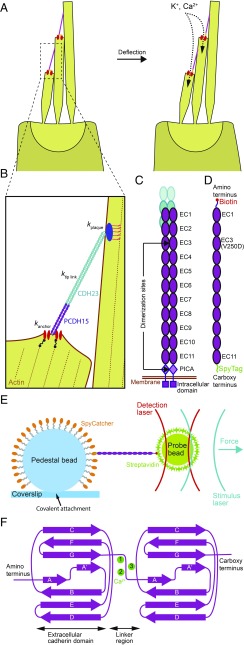
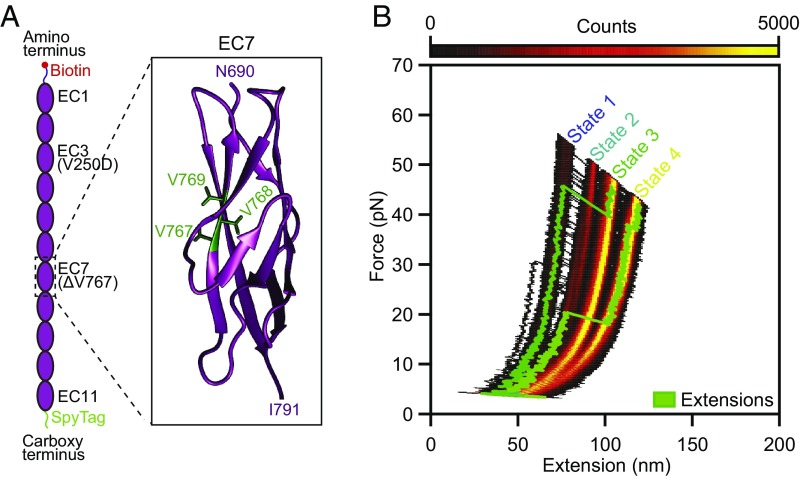
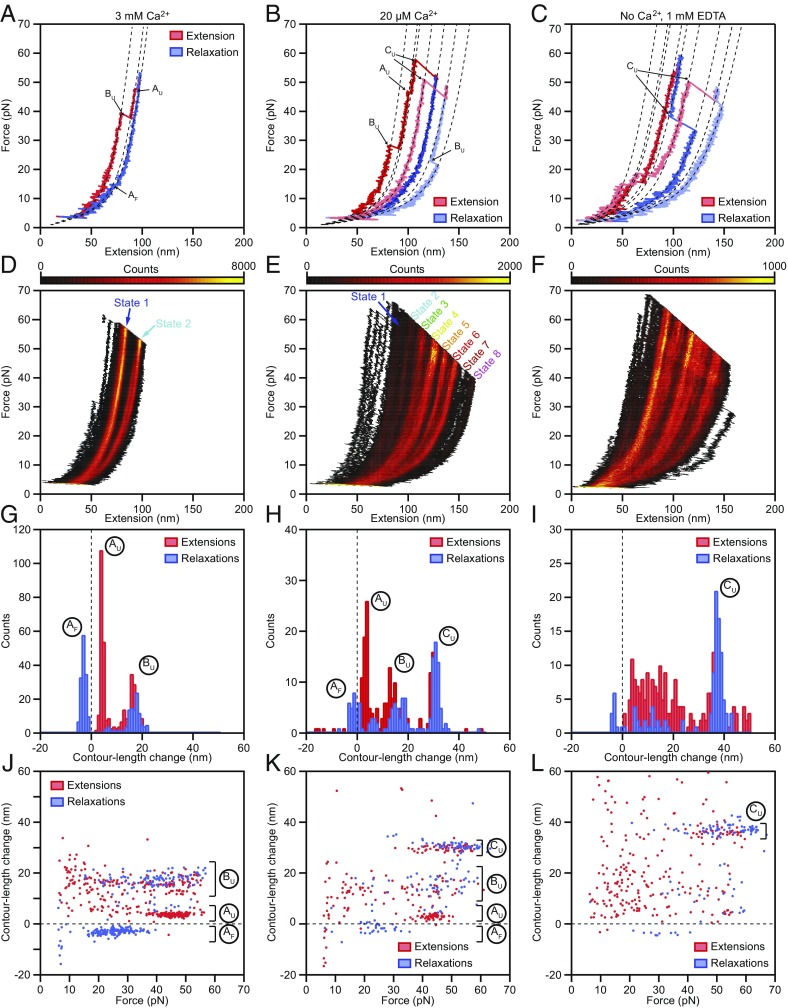
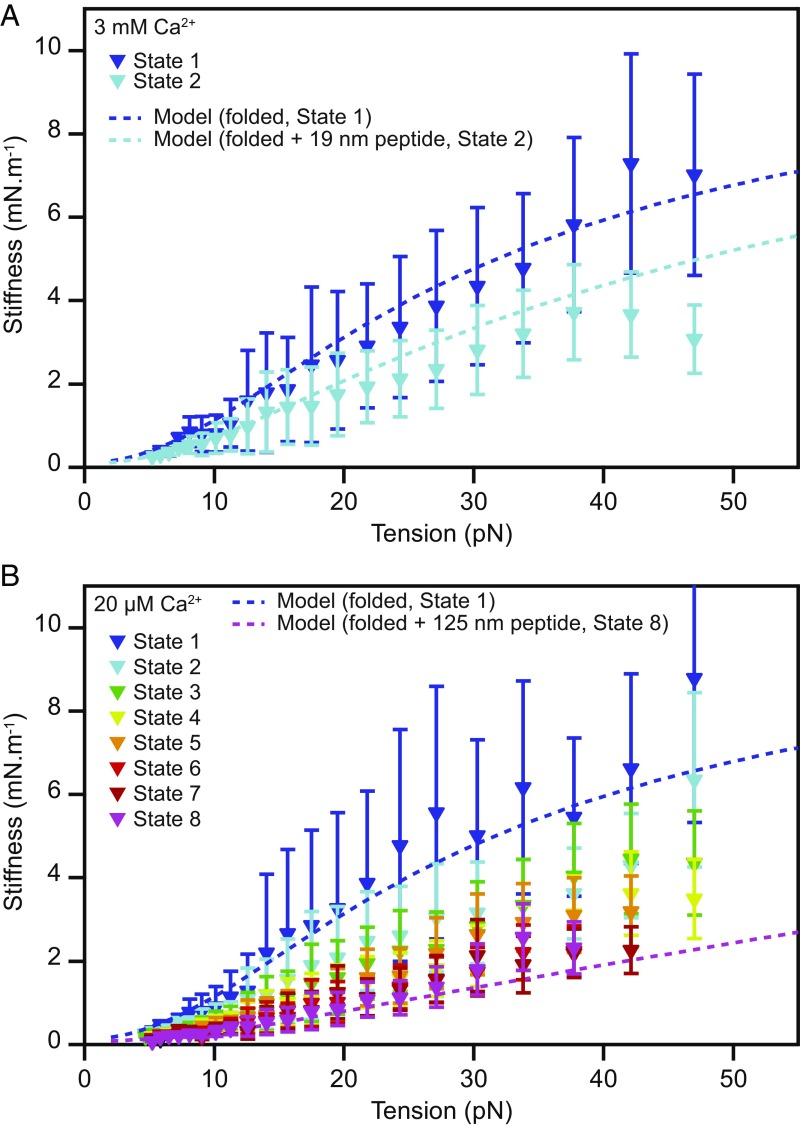
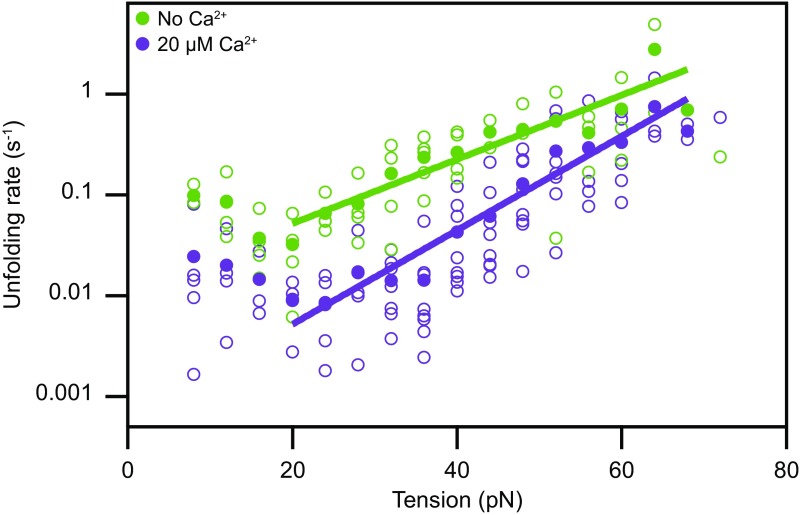
Hair cells, the sensory receptors of the inner ear, respond to mechanical forces originating from sounds and accelerations. An essential feature of each hair cell is an array of filamentous tip links, consisting of the proteins protocadherin 15 (PCDH15) and cadherin 23 (CDH23), whose tension is thought to directly gate the cell's transduction channels. These links are considered far too stiff to represent the gating springs that convert hair bundle displacement into forces capable of opening the channels, and no mechanism has been suggested through which tip-link stiffness could be varied to accommodate hair cells of distinct frequency sensitivity in different receptor organs and animals. Consequently, the gating spring's identity and mechanism of operation remain central questions in sensory neuroscience. Using a high-precision optical trap, we show that an individual monomer of PCDH15 acts as an entropic spring that is much softer than its enthalpic stiffness alone would suggest. This low stiffness implies that the protein is a significant part of the gating spring that controls a hair cell's transduction channels. The tip link's entropic nature then allows for stiffness control through modulation of its tension. We find that a PCDH15 molecule is unstable under tension and exhibits a rich variety of reversible unfolding events that are augmented when the Ca concentration is reduced to physiological levels. Therefore, tip link tension and Ca concentration are likely parameters through which nature tunes a gating spring's mechanical properties.
内耳的感觉受体毛细胞对源自声音和加速度的机械力作出反应。每个毛细胞的一个重要特征是一系列丝状的顶端连接,由原钙黏蛋白 15(PCDH15)和钙黏蛋白 23(CDH23)组成,其张力被认为直接门控细胞的转导通道。这些连接被认为太硬,无法代表将毛束位移转换为能够打开通道的力的门控弹簧,并且没有提出任何机制来改变顶端连接的刚度,以适应不同受体器官和动物中具有不同频率敏感性的毛细胞。因此,门控弹簧的身份和操作机制仍然是感觉神经科学的核心问题。使用高精度光学陷阱,我们表明单个 PCDH15 单体充当熵弹簧,其柔软度远超过其焓刚度单独所暗示的。这种低刚度意味着该蛋白是控制毛细胞转导通道的门控弹簧的重要组成部分。顶端连接的熵性质然后允许通过其张力的调节来控制刚度。我们发现,PCDH15 分子在张力下不稳定,并表现出丰富的可逆展开事件,当 Ca 浓度降低到生理水平时,这些事件会增加。因此,顶端连接张力和 Ca 浓度可能是通过其调节门控弹簧的机械性能的参数。