Laboratory of Neuronal Cell Signaling, EBRI Rita Levi-Montalcini Foundation, Rome, 00161, Italy.
Laboratory of Neurobiology in Translational Medicine, Department of Neurorehabilitation Sciences, Casa Cura Policlinico, Milan, 20144, Italy.
Sci Rep. 2019 May 9;9(1):7146. doi: 10.1038/s41598-019-43709-2.
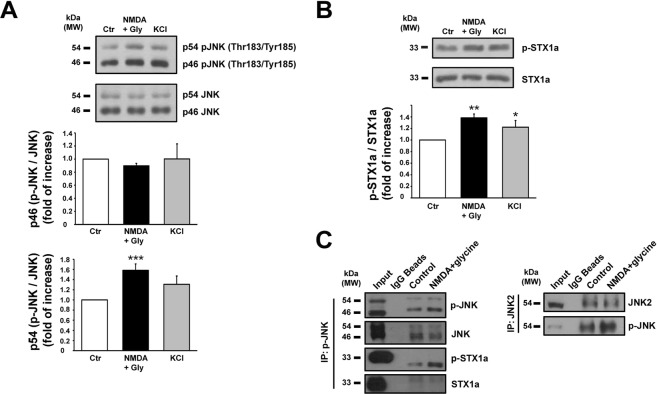
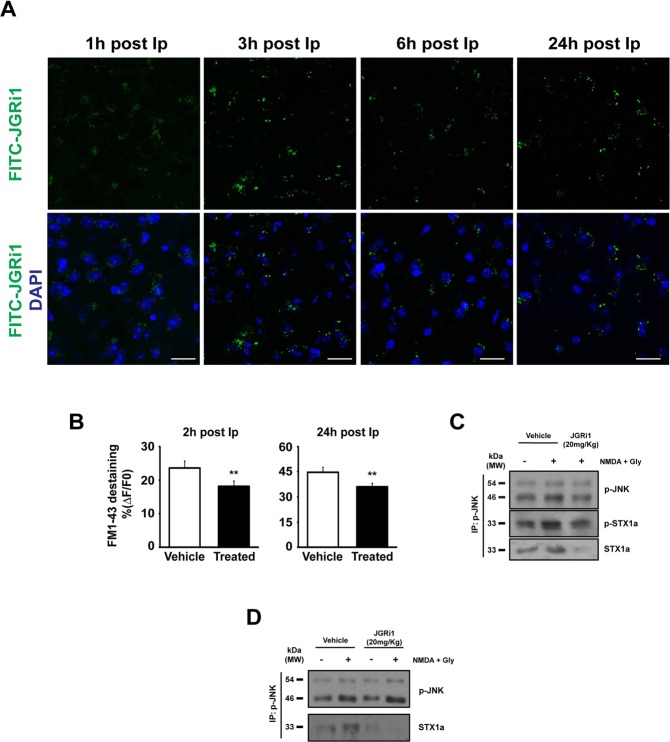
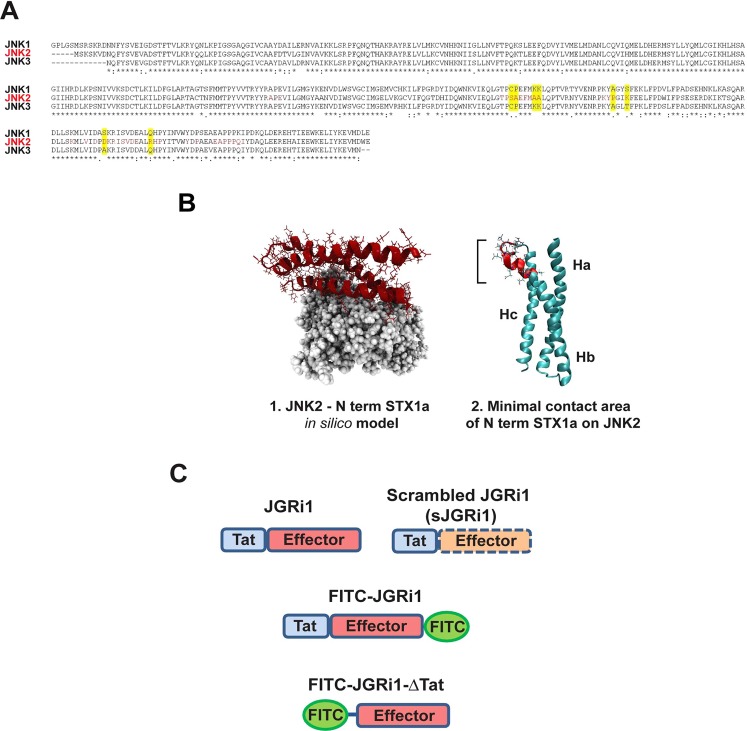
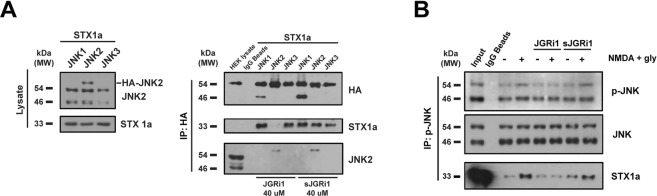
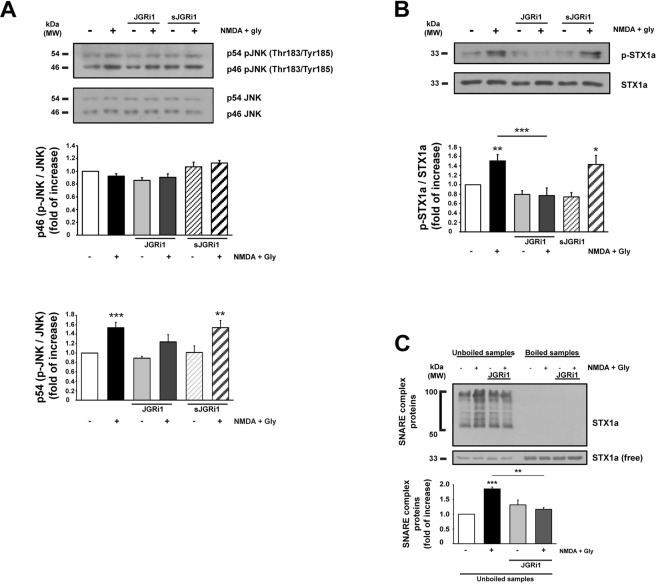
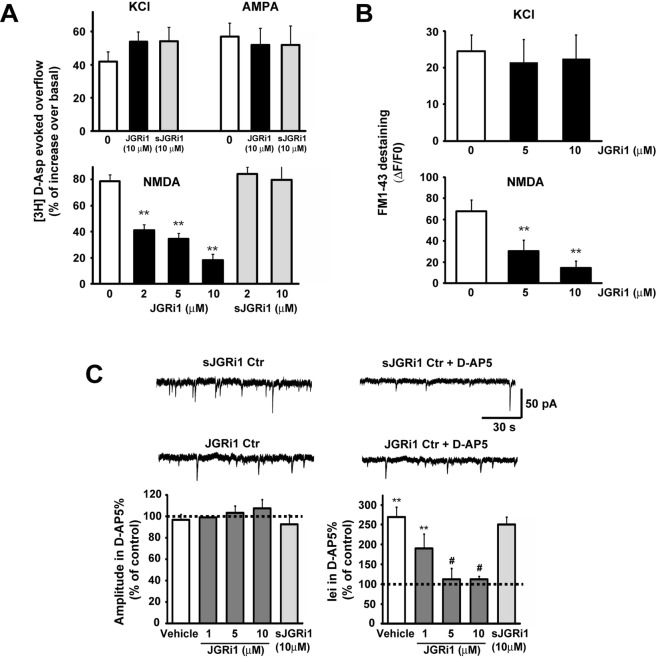
The neuronal loss caused by excessive glutamate release, or 'excitotoxicity', leads to several pathological conditions, including cerebral ischemia, epilepsy, and neurodegenerative diseases. Over-stimulation of presynaptic N-methyl-D-aspartate (NMDA) receptors is known to trigger and support glutamate spillover, while postsynaptic NMDA receptors are responsible for the subsequent apoptotic cascade. Almost all molecules developed so far are unable to selectively block presynaptic or postsynaptic NMDA receptors, therefore a deeper knowledge about intracellular NMDA pathways is required to design more specific inhibitors. Our previous work showed that presynaptic c-Jun N-terminal kinase 2 (JNK2) specifically regulates NMDA-evoked glutamate release and here we demonstrate that an interaction between Syntaxin-1a and JNK2 is fundamental to this mechanism. Based on this evidence, a new cell permeable peptide (CPP), "JGRi1", has been developed to disrupt the JNK2/STX1a interaction to indirectly, but specifically, inhibit presynaptic NMDA receptor signaling. JGRi1 reduces the NMDA-evoked release of glutamate both in in-vitro and ex-vivo experiments while also being able to widely diffuse throughout brain tissue via intraperitoneal administration. In conclusion, the JNK2/STX1 interaction is involved in presynaptic NMDA-evoked glutamate release and the novel CPP, JGRi1, acts as a pharmacological tool that promotes neuroprotection.
过量谷氨酸释放引起的神经元丢失,或“兴奋性毒性”,导致多种病理状况,包括脑缺血、癫痫和神经退行性疾病。已知,过度刺激突触前 N-甲基-D-天冬氨酸 (NMDA) 受体可引发并支持谷氨酸溢出,而突触后 NMDA 受体负责随后的细胞凋亡级联反应。迄今为止开发的几乎所有分子都无法选择性地阻断突触前或突触后 NMDA 受体,因此需要更深入地了解细胞内 NMDA 途径,以设计更具特异性的抑制剂。我们之前的工作表明,突触前 c-Jun N 末端激酶 2 (JNK2) 特异性调节 NMDA 诱导的谷氨酸释放,而在这里我们证明Syntaxin-1a 和 JNK2 之间的相互作用是这种机制的基础。基于这一证据,开发了一种新的细胞穿透肽 (CPP)“JGRi1”,以破坏 JNK2/STX1a 相互作用,从而间接但特异性地抑制突触前 NMDA 受体信号。JGRi1 减少了体外和离体实验中 NMDA 诱导的谷氨酸释放,并且还能够通过腹腔内给药广泛扩散到脑组织中。总之,JNK2/STX1 相互作用参与了突触前 NMDA 诱导的谷氨酸释放,新型 CPP JGRi1 可作为一种促进神经保护的药理学工具。