Laboratório de Imunologia, Instituto do Coração (InCor), Faculdade de Medicina, Universidade de São Paulo, São Paulo, Brazil.
Instituto de Investigação em Imunologia - Instituto Nacional de Ciências e Tecnologia (iii-INCT), São Paulo, Brazil.
Front Immunol. 2019 Apr 25;10:740. doi: 10.3389/fimmu.2019.00740. eCollection 2019.
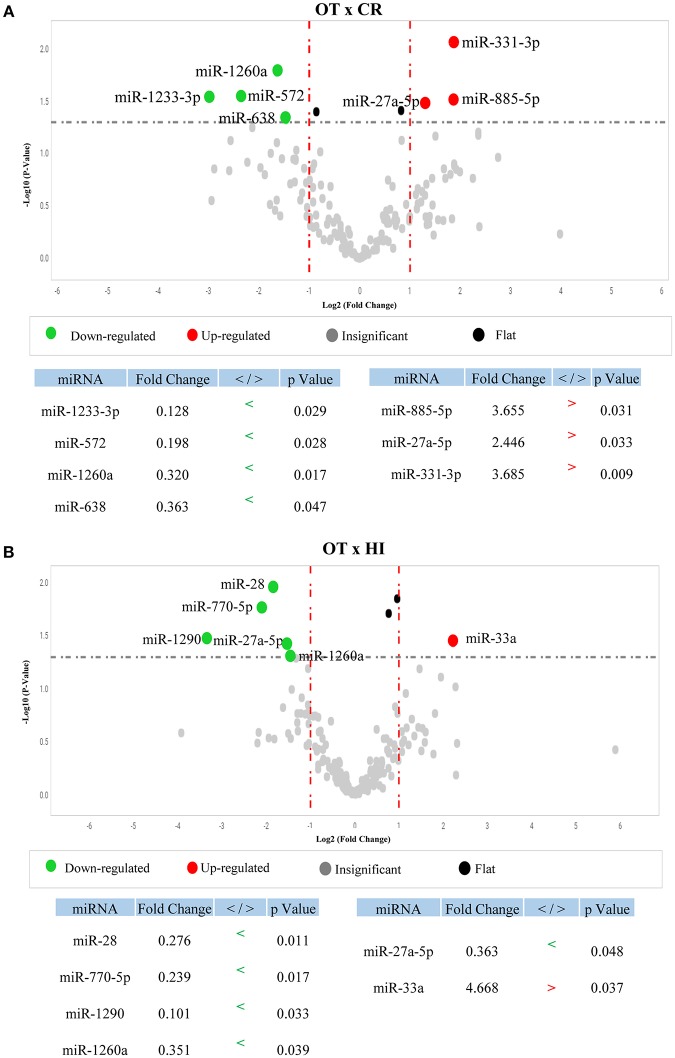
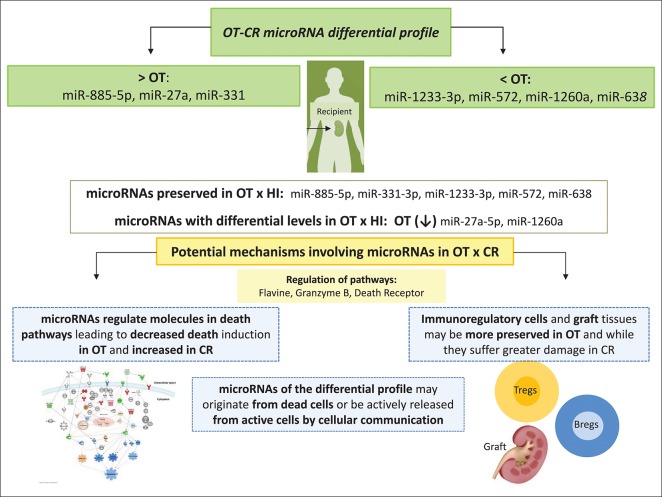
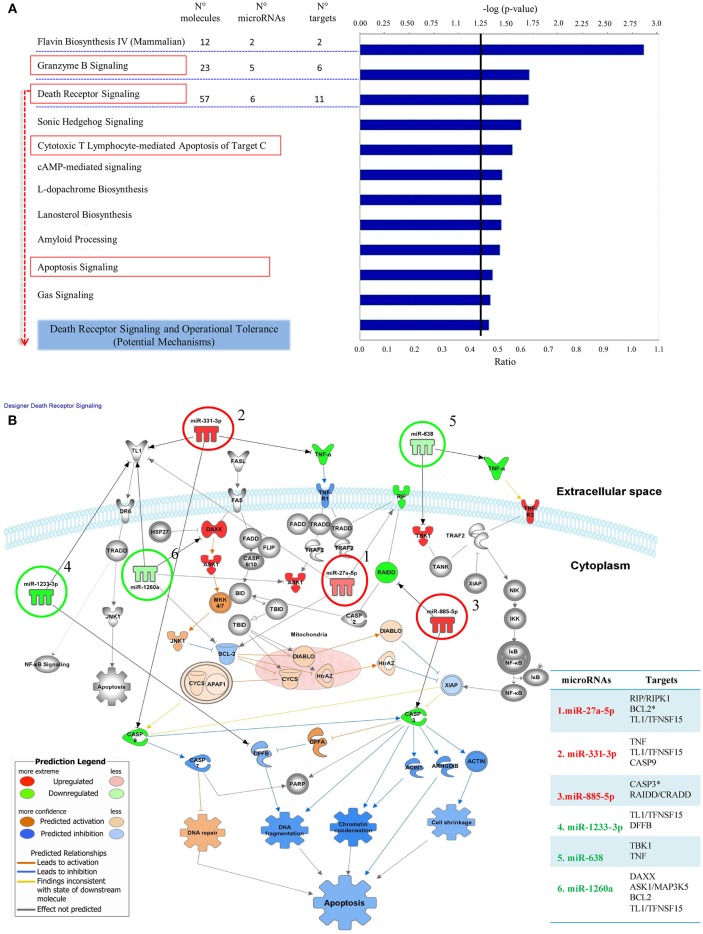
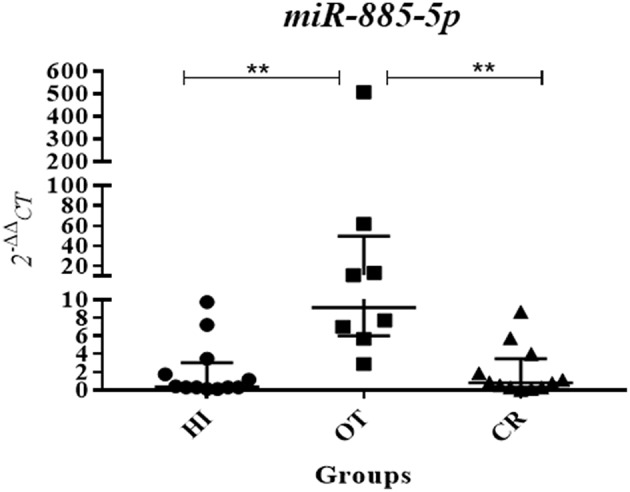
Operational tolerance (OT) is a state of graft functional stability that occurs after at least 1 year of immunosuppressant withdrawal. MicroRNAs () are small non-coding RNAs that downregulate messenger RNA/protein expression of innumerous molecules and are critical for homeostasis. We investigated whether OT in kidney transplantation displays a differential microRNA profile, which would suggest that microRNAs participate in Operational Tolerance mechanisms, and may reveal potential molecular pathways. We first compared serum in OT ( = 8) with chronic rejection (CR) ( = 5) and healthy individuals (HI) ( = 5), using a 768- qPCR-panel. We used the Thermo Fisher Cloud computing platform to compare the levels of s in the OT group in relation to the other study groups. We performed validation experiments for , by q-PCR, in a larger number of study subjects (OT = 8, CR = 12, HI = 12), as individual samples. We detected a differential profile in OT vs. its opposing clinical outcome-CR-suggesting that microRNAs may integrate transplantation tolerance mechanisms. Some miRNAs were detected at higher levels in OT: , miR-27a-5p . CR; others, we found at lower levels: miR-1233-3p, miR-572, miR-638, miR-1260a. Considering highly predicted/experimentally demonstrated targets of these miRNAs, bioinformatics analysis revealed that the granzyme B, and death receptor pathways are dominant, suggesting that cell death regulation integrates transplantation tolerance mechanisms. We confirmed higher levels in OT vs. CR, and vs. HI, in a larger number of subjects. We propose that epigenetics mechanisms involving microRNAs may integrate human transplantation tolerance mechanisms, and regulate key members of the cell death/survival signaling. miR-885-5p could favor cell survival in OT by diminishing the levels of CRADD/RAIDD and CASP3. Nonetheless, given the nature of any complex phenomenon in humans, only cumulative data will help to determine whether this microRNA differential profile may be related to the cause or consequence of operational tolerance.
免疫抑制剂停药 1 年后,移植物功能稳定即出现免疫耐受(operational tolerance,OT)。微小 RNA(miRNA)是一种非编码小分子 RNA,通过下调信使 RNA/蛋白表达调控无数分子的功能,对维持内环境稳定至关重要。我们研究了肾移植患者的 OT 是否具有差异表达 miRNA 谱,提示 miRNA 可能参与 OT 机制,为揭示潜在的分子通路提供线索。我们首先利用 768 个 qPCR 探针检测了 8 例 OT 患者、5 例慢性排斥反应(chronic rejection,CR)患者和 5 例健康对照者(healthy individuals,HI)的血清 miRNA 谱。利用 Thermo Fisher Cloud 计算平台分析了 OT 患者与其他两组的血清 miRNA 差异。然后,我们通过 qPCR 对更多 OT 患者(8 例)、CR 患者(12 例)和 HI (12 例)的血清 miRNA 进行了验证实验。我们发现,与临床排斥反应相反的 OT 患者的 miRNA 表达谱存在差异,提示 miRNA 可能整合了移植耐受机制。在 OT 患者中,部分 miRNA 水平升高,如 miR-27a-5p、miR-483-5p;部分 miRNA 水平降低,如 miR-1233-3p、miR-572、miR-638、miR-1260a。基于这些 miRNA 的高度预测/实验验证靶点,生物信息学分析显示颗粒酶 B 和死亡受体信号通路可能占主导地位,提示细胞死亡调控整合了移植耐受机制。我们在更多的患者中证实了 OT 患者的 miRNA 水平显著高于 CR 患者和 HI 患者。我们推测,涉及 miRNA 的表观遗传学机制可能整合了人类移植耐受机制,调控细胞死亡/存活信号通路的关键成员。miR-885-5p 可能通过降低 CRADD/RAIDD 和 CASP3 的水平,促进 OT 患者的细胞存活。然而,鉴于人类复杂现象的本质,只有累积数据才能确定这种 miRNA 差异谱是否与 OT 的发生或结果有关。