1Diagnosis and Development, Murdoch Children's Research Institute, Royal Children's Hospital, 50 Flemington Rd, Parkville, VIC 3052 Australia.
2Department of Paediatrics, Faculty of Medicine, Dentistry and Health Sciences, University of Melbourne, Parkville, Australia.
Mol Autism. 2019 May 3;10:21. doi: 10.1186/s13229-019-0271-7. eCollection 2019.
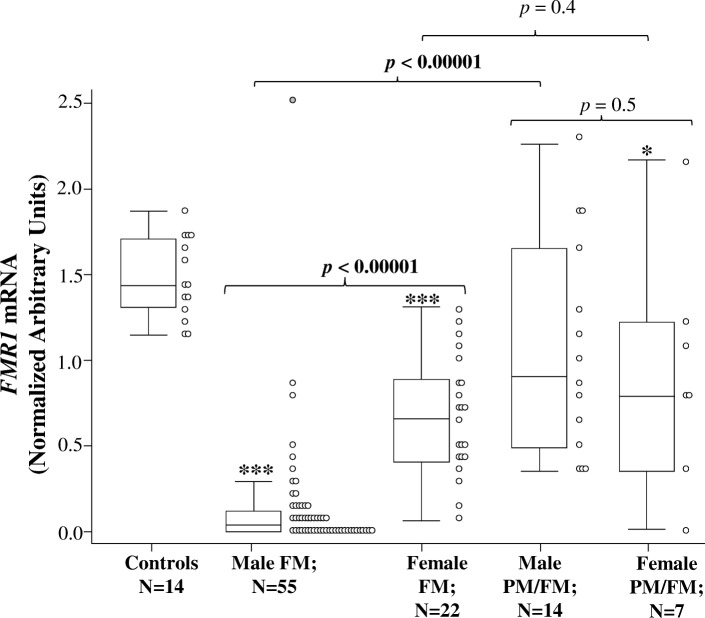
Fragile X syndrome (FXS) is a common monogenic cause of intellectual disability with autism features. While it is caused by loss of the 1 product (FMRP), mosaicism for active and inactive alleles, including alleles termed premutation (PM: 55-199 CGGs), is not uncommon. Importantly, both PM and active full mutation (FM: ≥ 200 CGGs) alleles often express elevated levels of mRNA that are thought to be toxic. This study determined if complete mRNA silencing from FM alleles and/or levels of mRNA (if present) in blood are associated with intellectual functioning and autism features in FXS.
The study cohort included 98 participants (70.4% male) with FXS (FM-only and PM/FM mosaic) aged 1-43 years. A control group of 14 females were used to establish control mRNA reference range. Intellectual functioning and autism features were assessed using the Mullen Scales of Early Learning or an age-appropriate Wechsler Scale and the Autism Diagnostic Observation Schedule-2nd Edition (ADOS-2), respectively. mRNA was analysed in venous blood collected at the time of assessments, using the real-time PCR relative standard curve method.
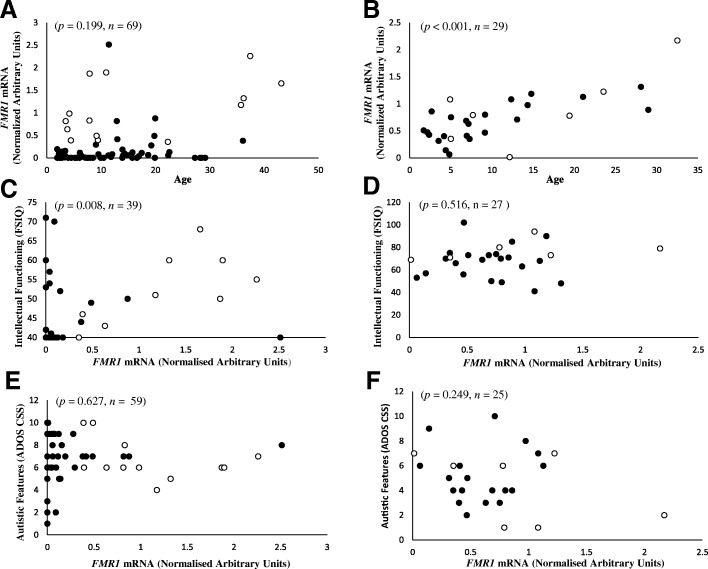
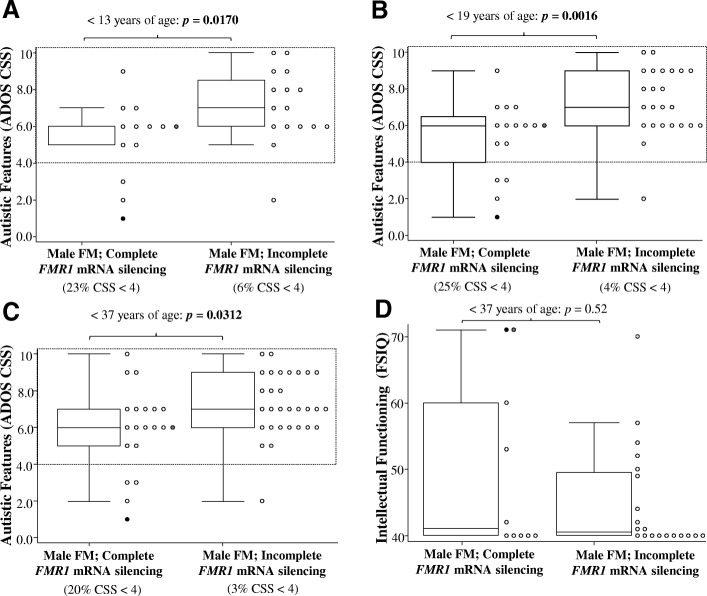
Females with FXS had significantly higher levels of mRNA ( < 0.001) than males. mRNA levels were positively associated with age ( < 0.001), but not with intellectual functioning and autistic features in females. FM-only males (aged < 19 years) expressing FM mRNA had significantly higher ADOS calibrated severity scores compared to FM-only males with completely silenced ( = 0.011). However, there were no significant differences between these subgroups on intellectual functioning. In contrast, decreased levels of mRNA were associated with decreased intellectual functioning in FXS males ( = 0.029), but not autism features, when combined with the PM/FM mosaic group.
Incomplete silencing of toxic FM RNA may be associated with autistic features, but not intellectual functioning in FXS males. While decreased levels of mRNA may be more predictive of intellectual functioning than autism features. If confirmed in future studies, these findings may have implications for patient stratification, outcome measure development, and design of clinical and pre-clinical trials in FXS.
脆性 X 综合征(FXS)是一种常见的以智力障碍为特征的单基因疾病,其病因是 1 个产物(FMRP)缺失。然而,活性和非活性等位基因的嵌合现象并不少见,包括被称为前突变(PM:55-199 CGGs)的等位基因。重要的是,PM 和活性全突变(FM:≥200 CGGs)等位基因通常表达高水平的被认为有毒的 mRNA。本研究旨在确定 FXS 中 FM 等位基因的完全 mRNA 沉默和/或血液中存在的(如果有)mRNA 水平是否与智力功能和自闭症特征有关。
研究队列包括 98 名 FXS 患者(70.4%为男性),年龄 1-43 岁,包括 FM 纯合子和 PM/FM 嵌合子;同时纳入 14 名女性作为对照组,以建立对照组 mRNA 参考范围。使用 Mullen 早期学习量表或年龄匹配的韦氏量表分别评估智力功能和自闭症特征,使用实时 PCR 相对标准曲线法分析静脉血中的 mRNA。
FXS 女性的 mRNA 水平明显高于男性( < 0.001)。mRNA 水平与年龄呈正相关( < 0.001),但与女性的智力功能和自闭症特征无关。表达 FM mRNA 的 FM 纯合子男性(年龄<19 岁)的 ADOS 校准严重程度评分明显高于完全沉默的 FM 纯合子男性( = 0.011)。然而,这些亚组之间在智力功能上没有显著差异。相比之下,FXS 男性中 mRNA 水平降低与智力功能降低有关( = 0.029),但与自闭症特征无关,当与 PM/FM 嵌合组结合时。
不完全沉默的毒性 FM RNA 可能与 FXS 男性的自闭症特征有关,但与智力功能无关。虽然降低的 mRNA 水平可能比自闭症特征更能预测智力功能。如果在未来的研究中得到证实,这些发现可能对 FXS 患者的分层、结局测量的发展以及临床和临床前试验的设计具有重要意义。