Department of Medical Immunology and Molecular Biology, School of Biomedical and Laboratory Sciences, University of Gondar, Gondar, Ethiopia.
Department of Pediatrics and Child Health Nursing, School of Nursing, College of Medicine and Health Sciences, University of Gondar, Gondar, Ethiopia.
BMC Infect Dis. 2019 May 10;19(1):405. doi: 10.1186/s12879-019-4031-2.
Tuberculosis (TB) and HIV makeup a deadly synergy of infectious disease, and the combined effect is apparent in resource limited countries like Ethiopia. Previous studies have demonstrated inconsistent results about the protective effect of isoniazid preventive therapy (IPT) on active TB incidence among HIV positive patients receiving ART. Therefore, the aim of this meta-analysis was, first, to determine the protective effect of IPT on active tuberculosis incidence, and second, to assess the pooled incidence of active TB among HIV positive patients taking ART with and without IPT intervention in Ethiopia.
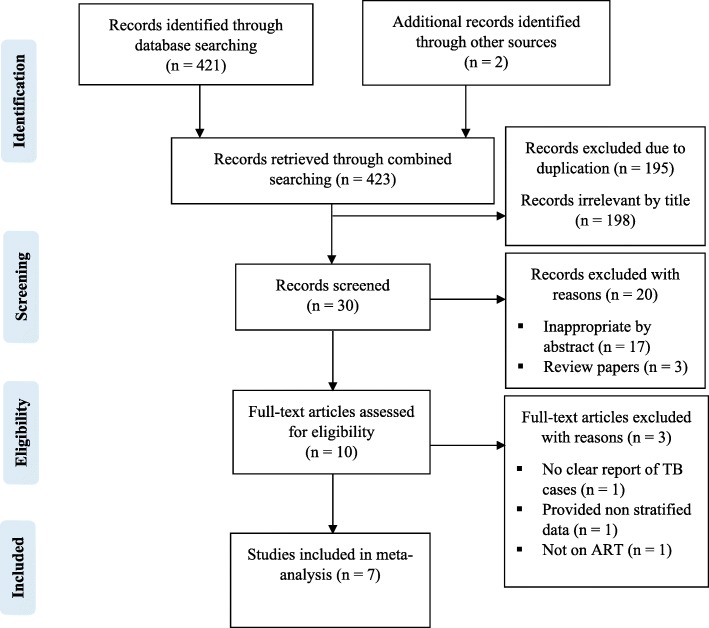
PubMed, Google scholar and Cochran library databases were searched from April 1 to 30, 2018. Two independent authors explored and assessed studies for eligibility, and extracted data based on predefined criteria. Studies that reported TB incidence among HIV positive patients taking ART in Ethiopia with and without IPT concomitant intervention, and with a clear stratified data on the incidence of TB based on the duration of IPT intervention were selected. A random effects model was used to estimate risk ratios and the pooled incident TB with the respective 95% confidence intervals.
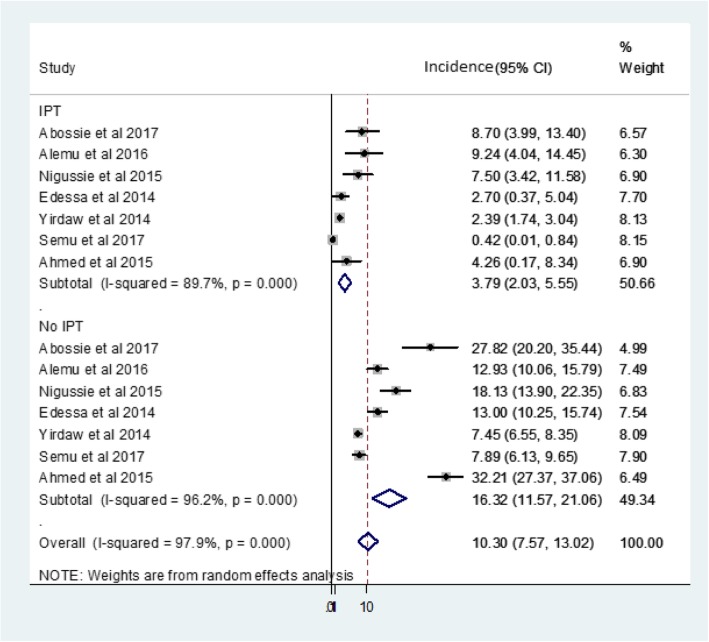
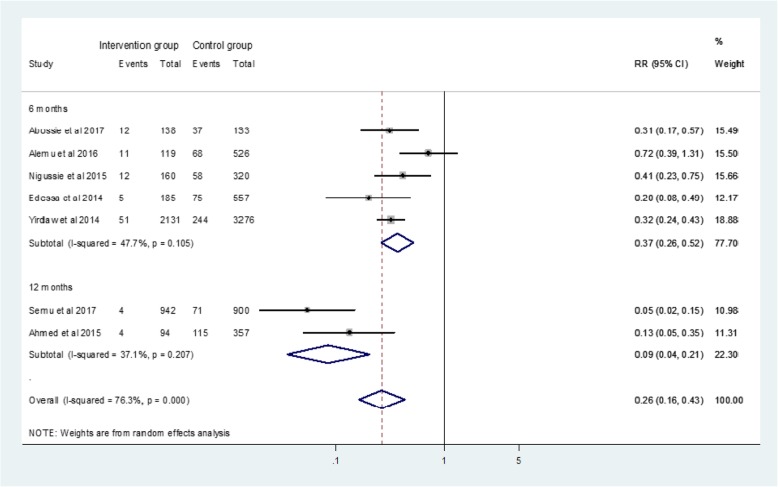
We identified 7 suitable studies in this analysis. Accordingly, IPT reduced the risk of TB incidence by 74%, risk ratio (RR) 0.26 (95% CI; 0.16-0.43%), compared to no IPT group. Moreover, IPT for 12 months reduced incident TB by 91% (RR: 0.09, 95% CI: 0.04 to 0.21), whereas 6 months IPT averted TB incidence by 63% (RR: 0.37, 95% CI: 0.26 to 0.52). The overall pooled incident TB among HIV infected patients receiving ART was 10.30% (95% CI; 7.57-13.02%). Specifically, incident TB among study cohorts with and without IPT was 3.79% (95% CI; 2.03-5.55%) and 16.32% (95% CI; 11.57-21.06%) respectively.
IPT reduced the risk of incident TB among HIV positive patients receiving ART in Ethiopian settings. Moreover, the duration of IPT intervention has effect on its protective role. Thus, scaling up the isoniazid preventive therapy program and its strict compliance is necessary to avert HIV fueled tuberculosis.
CRD42018090804.
结核病(TB)和艾滋病毒构成了致命的传染病协同作用,在埃塞俄比亚等资源有限的国家,这种联合效应显而易见。先前的研究表明,在接受抗逆转录病毒疗法(ART)的艾滋病毒阳性患者中,异烟肼预防治疗(IPT)对活动性结核病发病率的保护作用不一致。因此,本荟萃分析的目的首先是确定 IPT 对活动性肺结核发病率的保护作用,其次是评估在埃塞俄比亚接受 ART 治疗的艾滋病毒阳性患者中,有和没有 IPT 干预的情况下,活性结核病的总发病率。
我们于 2018 年 4 月 1 日至 30 日检索了 PubMed、Google scholar 和 Cochrane 图书馆数据库。两名独立的作者根据既定标准评估了研究的合格性,并提取了数据。选择了在埃塞俄比亚接受 ART 治疗的艾滋病毒阳性患者中报告了 IPT 伴随干预和不伴随干预的 TB 发病率,并根据 IPT 干预持续时间的分层数据明确报告了 TB 发病率的研究。采用随机效应模型估计风险比和汇总发病率,并相应地计算 95%置信区间。
我们在这项分析中确定了 7 项合适的研究。因此,与无 IPT 组相比,IPT 将 TB 发病率降低了 74%,风险比(RR)为 0.26(95%CI;0.16-0.43%)。此外,IPT 持续 12 个月可使 TB 发病率降低 91%(RR:0.09,95%CI:0.04 至 0.21),而 6 个月 IPT 可使 TB 发病率降低 63%(RR:0.37,95%CI:0.26 至 0.52)。接受 ART 的 HIV 感染患者的总 TB 发病率为 10.30%(95%CI;7.57-13.02%)。具体而言,IPT 组和无 IPT 组的研究队列中,TB 的发病率分别为 3.79%(95%CI;2.03-5.55%)和 16.32%(95%CI;11.57-21.06%)。
IPT 降低了埃塞俄比亚接受 ART 的 HIV 阳性患者发生结核病的风险。此外,IPT 干预的持续时间对其保护作用有影响。因此,有必要扩大异烟肼预防治疗方案并严格遵守该方案,以防止艾滋病毒引发的结核病。
CRD42018090804。