Wolaita Zone Health Department, Wolaita Sodo, Wolaita Zone, Ethiopia.
Departemt of Public Health, College of Medicine and Health Sciences, Hawassa University, Hawassa, Ethiopia.
PLoS One. 2023 Sep 21;18(9):e0291502. doi: 10.1371/journal.pone.0291502. eCollection 2023.
Tuberculosis is the leading cause of morbidity and mortality among children living with the human immunodeficiency virus (HIV), mainly in sub-Saharan Africa, including Ethiopia. Tuberculosis remains a significant health concern for HIV-positive children in Ethiopia. There is a paucity of data on the incidence and predictors of tuberculosis among children living with HIV on antiretroviral therapy in the Wolaita zone. Hence, this study aimed to assess the incidence and predictors of tuberculosis among children living with HIV on antiretroviral therapy in the Wolaita zone between January 2010 to December 2020.
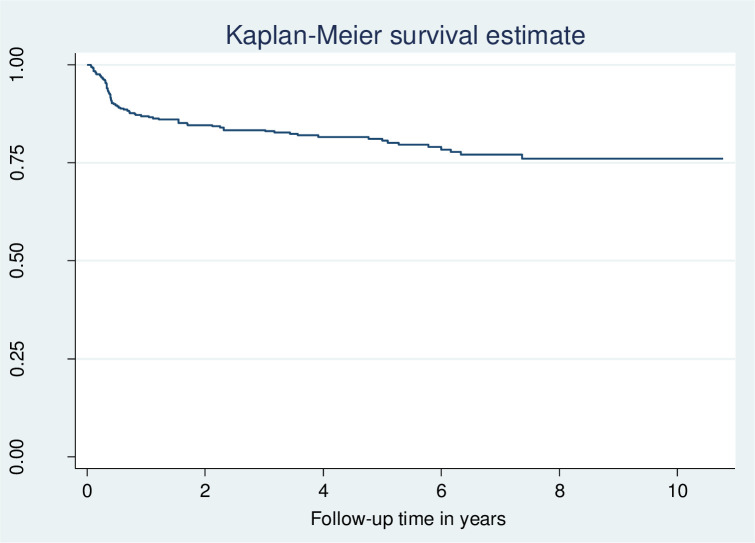
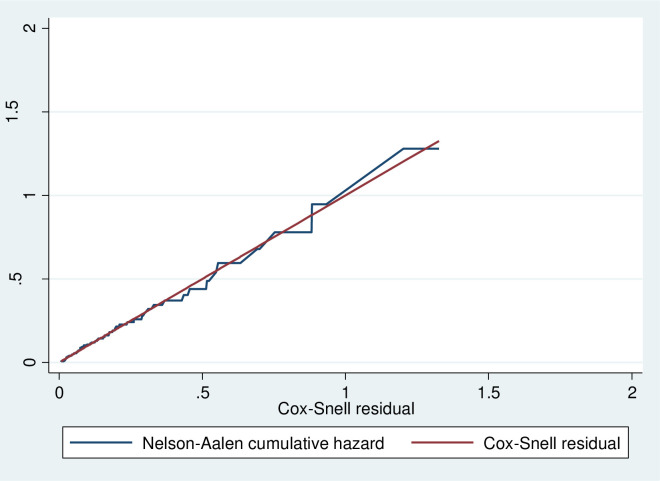
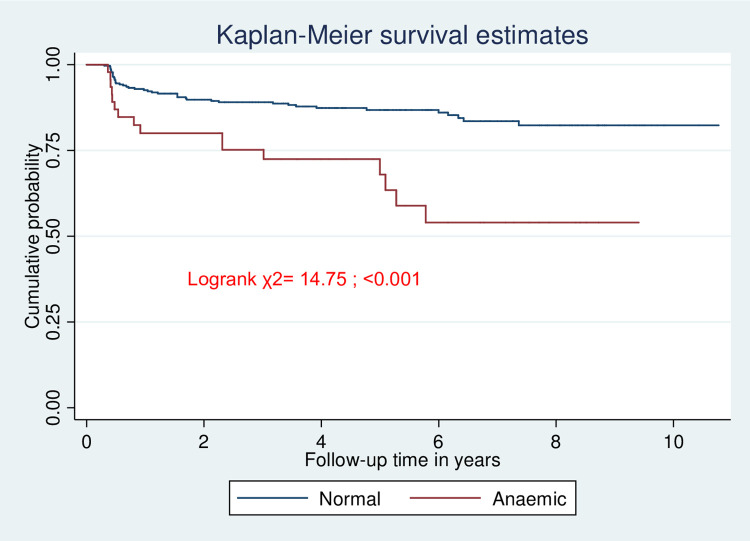
A retrospective cohort study was conducted among 389 children receiving antiretroviral therapy in Wolaita zone health facilities between January 2010 to December 2020. The checklist was adapted from the standardized antiretroviral treatment (ART) follow-up form currently used by the institutions' ART clinics. The Kaplan-Meier survival function and Log-rank were used to estimate the survival for each categorical variable to compare the survival between different exposure groups. Both bivariable and multivariable parametric survival Gompertz models were fitted to identify predictors of tuberculosis among HIV-positive children. The association was summarized using an adjusted hazard ratio (AHR), and statistical significance was declared at 95% CI and p-value < 0.05. The goodness of the model fit was assessed using a Cox-Snell residual plot.
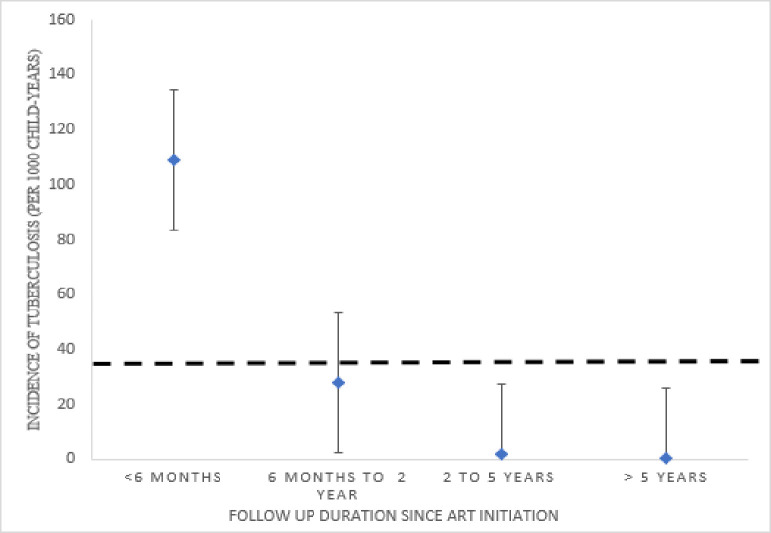
The incidence rate of tuberculosis among children living with HIV was 3.5 (95% CI 2.7-4.5) per 100 child years. World Health Organization clinical stage III or IV (AHR = 2.31, 95% CI [1.26, 4.22]), hemoglobin level <10 g/dL (AHR = 2.87, 95% CI [1.51, 5.45]), fair or poor ART adherence (AHR = 4.4, 95% CI[2.18, 9.05]), underweight (AHR = 2.55, 95% CI [1.45, 4.51]), age >10 years (AHR = 3.62; 95% CI [1.29, 10.0]), and cotrimoxazole preventive therapy (AHR = 0.23; 95% CI [0.08, 0.60]) were among the independent predictors of TB occurrence.
The incidence of tuberculosis among children on ART was high. HIV-positive children presenting with advanced disease staging (III and IV), anemia, "fair" and "poor" ART adherence, underweight, age above ten years, and not receiving cotrimoxazole preventive therapy were at higher risk of TB. Therefore, counseling on ART adherence, early diagnosis, and prompt treatment of anemia and malnutrition are recommended to avert tuberculosis.
结核病是导致感染人类免疫缺陷病毒(HIV)的儿童发病和死亡的主要原因,特别是在撒哈拉以南非洲地区,包括埃塞俄比亚。结核病仍然是埃塞俄比亚 HIV 阳性儿童的一个重大健康问题。在沃莱塔地区接受抗逆转录病毒治疗的 HIV 阳性儿童中,结核病的发病率和预测因素的数据很少。因此,本研究旨在评估 2010 年 1 月至 2020 年 12 月期间在沃莱塔地区接受抗逆转录病毒治疗的 HIV 阳性儿童中结核病的发病率和预测因素。
对 2010 年 1 月至 2020 年 12 月期间在沃莱塔地区卫生机构接受抗逆转录病毒治疗的 389 名儿童进行了回顾性队列研究。该检查表是根据目前机构内抗逆转录病毒治疗(ART)诊所使用的标准化抗逆转录病毒治疗(ART)随访表改编的。Kaplan-Meier 生存函数和 Log-rank 用于估计每个分类变量的生存,以比较不同暴露组之间的生存。使用单变量和多变量参数生存 Gompertz 模型来确定 HIV 阳性儿童中结核病的预测因素。使用调整后的危险比(AHR)总结关联,95%CI 和 p 值 < 0.05 表示统计学意义。使用 Cox-Snell 残差图评估模型拟合的好坏。
HIV 阳性儿童结核病的发病率为每 100 儿童年 3.5 例(95%CI 2.7-4.5)。世界卫生组织临床分期 III 或 IV 期(AHR=2.31,95%CI [1.26,4.22])、血红蛋白水平<10g/dL(AHR=2.87,95%CI [1.51,5.45])、中等或差的 ART 依从性(AHR=4.4,95%CI[2.18,9.05])、体重不足(AHR=2.55,95%CI [1.45,4.51])、年龄>10 岁(AHR=3.62;95%CI [1.29,10.0])和复方磺胺甲噁唑预防治疗(AHR=0.23;95%CI [0.08,0.60])是结核病发生的独立预测因素。
ART 治疗的儿童结核病发病率较高。出现晚期疾病分期(III 和 IV 期)、贫血、“中等”和“差”的 ART 依从性、体重不足、年龄超过 10 岁和未接受复方磺胺甲噁唑预防治疗的 HIV 阳性儿童患结核病的风险更高。因此,建议进行 ART 依从性咨询、早期诊断和及时治疗贫血和营养不良,以预防结核病。