Department of Ecosystem and Public Health, Faculty of Veterinary Medicine, University of Calgary, 3280 Hospital Drive NW, Calgary, AB, T2N 4Z6, Canada.
Syst Rev. 2019 May 10;8(1):111. doi: 10.1186/s13643-019-1013-9.
An estimated four million and 43 million people in Canada and the USA use private water supplies. Private water supplies are vulnerable to waterborne disease outbreaks. Private water supplies in Canada and the USA are often unregulated and private water management is often a choice left to the owner. Perceptions of water quality become important in influencing the adoption of private water stewardship practices, therefore safeguarding public health.
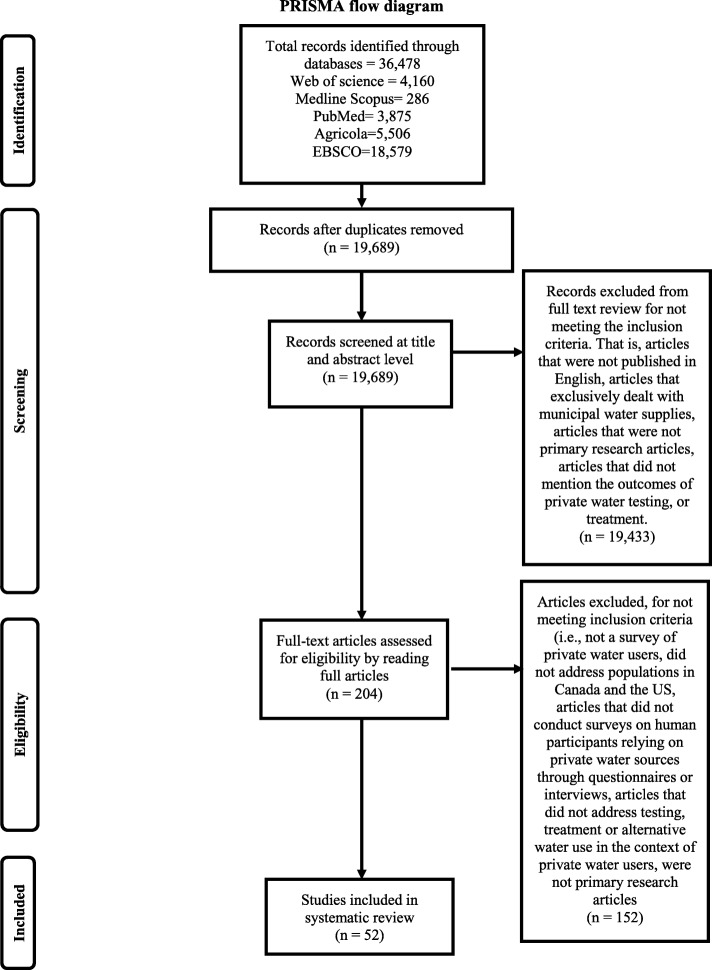
We conducted a systematic literature review to understand factors that shape perceptions of water quality among private water users. We searched six computer databases (Web of science, Medline, Scopus, EBSCO, PubMed and Agricola). The search was limited to primary peer-reviewed publications, grey literature and excluded conference proceedings, review articles, and non-peer review articles. We restricted the search to papers published in English and to articles which published data on surveys of private water users within Canada and the USA. The search was also restricted to publications from 1986 to 2017. The literature search generated 36,478 records. Two hundred and four full text were reviewed.
Fifty-two articles were included in the final review. Several factors were found to influence perceptions of water quality including organoleptic preferences, chemical and microbiological contaminants, perceived risks, water well infrastructure, past experience with water quality, external information, demographics, in addition to the values, attitudes, and beliefs held by well owners.
Understanding the factors that shape perceptions of water quality among private water users is an important step in developing private water management policies to increase compliance towards water testing and treatment in Canada and the USA. As many jurisdictions in Canada and the USA do not have mandatory private water testing or treatment guidelines, delineating these factors is an important step in informing future research and guiding policy on the public health of private water systems.
估计有 400 万至 4300 万人在加拿大和美国使用私人供水。私人供水容易发生水源性疾病暴发。加拿大和美国的私人供水往往不受监管,私人水管理通常是所有者的选择。对水质的看法对于影响私人水管理实践的采用变得重要,从而保障公众健康。
我们进行了系统的文献综述,以了解影响私人用水者对水质看法的因素。我们在六个计算机数据库(Web of science、Medline、Scopus、EBSCO、PubMed 和 Agricola)中进行了搜索。该搜索仅限于主要同行评议出版物、灰色文献,并排除了会议记录、综述文章和非同行评审文章。我们将搜索范围限于在加拿大和美国出版的英文论文和发表关于私人用水者调查数据的论文。搜索还限于 1986 年至 2017 年期间发表的出版物。文献搜索共产生 36478 条记录。审查了 204 篇全文。
最终综述包括 52 篇文章。发现有几个因素影响水质感知,包括感官偏好、化学和微生物污染物、感知风险、水井基础设施、过去的水质经验、外部信息、人口统计学,以及水井所有者持有的价值观、态度和信念。
了解影响私人用水者水质感知的因素是制定加拿大和美国私人水管理政策以提高对水测试和处理的遵守率的重要步骤。由于加拿大和美国的许多司法管辖区没有强制性的私人水测试或处理指南,因此确定这些因素对于告知未来的研究和指导关于私人水系统公共卫生的政策非常重要。