Center for Atmospheric Particle Studies, Department of Mechanical Engineering, Carnegie Mellon University, Pittsburgh, PA 15213, USA.
Int J Environ Res Public Health. 2019 May 10;16(9):1632. doi: 10.3390/ijerph16091632.
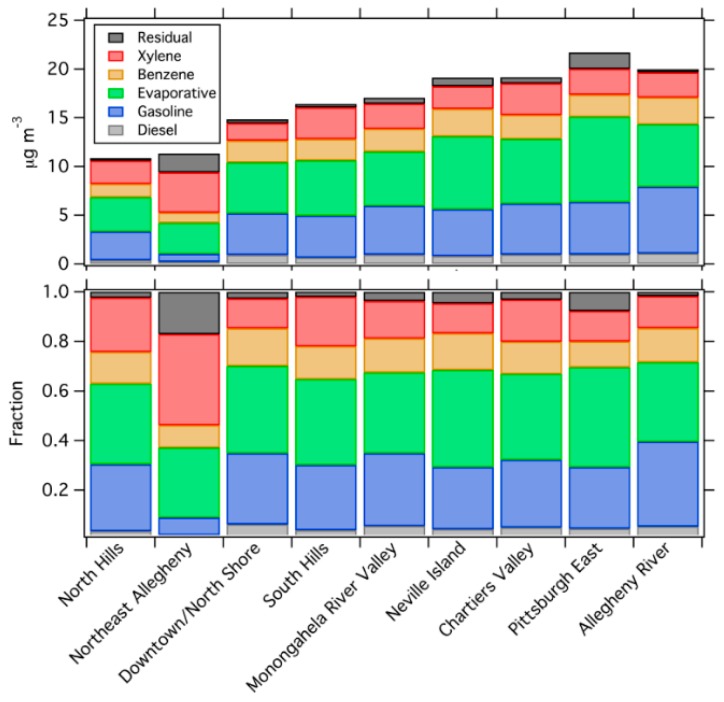
Volatile organic compounds (VOCs) are important atmospheric constituents because they contribute to formation of ozone and secondary aerosols, and because some VOCs are toxic air pollutants. We measured concentrations of a suite of anthropogenic VOCs during summer and winter at 70 locations representing different microenvironments around Pittsburgh, PA. The sampling sites were classified both by land use (e.g., high versus low traffic) and grouped based on geographic similarity and proximity. There was roughly a factor of two variation in both total VOC and single-ring aromatic VOC concentrations across the site groups. Concentrations were roughly 25% higher in winter than summer. Source apportionment with positive matrix factorization reveals that the major VOC sources are gasoline vehicles, solvent evaporation, diesel vehicles, and two factors attributed to industrial emissions. While we expected to observe significant spatial variability in the source impacts across the sampling domain, we instead found that source impacts were relatively homogeneous.
挥发性有机化合物(VOCs)是重要的大气成分,因为它们有助于臭氧和二次气溶胶的形成,而且一些 VOCs 是有毒的空气污染物。我们在宾夕法尼亚州匹兹堡周围的 70 个不同微环境的地点测量了一系列人为 VOC 的浓度。采样地点不仅按土地使用(例如,高流量与低流量)进行了分类,而且还根据地理相似性和接近度进行了分组。在各站点组之间,总 VOC 和单环芳烃 VOC 浓度的变化大致相差一个因子。浓度在冬季比夏季高约 25%。利用正定矩阵因子分解进行源解析表明,主要的 VOC 来源是汽油车辆、溶剂蒸发、柴油车辆以及两个归因于工业排放的因素。虽然我们预计会在采样区域内观察到源影响的显著空间变异性,但实际上我们发现源影响相对均匀。