Arias-de la Torre Jorge, Pons-Cabrafiga Miquel, Valderas Jose M, Evans Jonathan P, Martín Vicente, Molina Antonio J, Pallisó Francesc, Smith Kayla, Martinez Olga, Espallargues Mireia
Agency for Heath Quality and Assessment of Catalonia (AQuAS), 08005 Barcelona, Spain.
CIBER Epidemiology and Public Health (CIBERESP), 28029 Madrid, Spain.
J Clin Med. 2019 May 13;8(5):670. doi: 10.3390/jcm8050670.
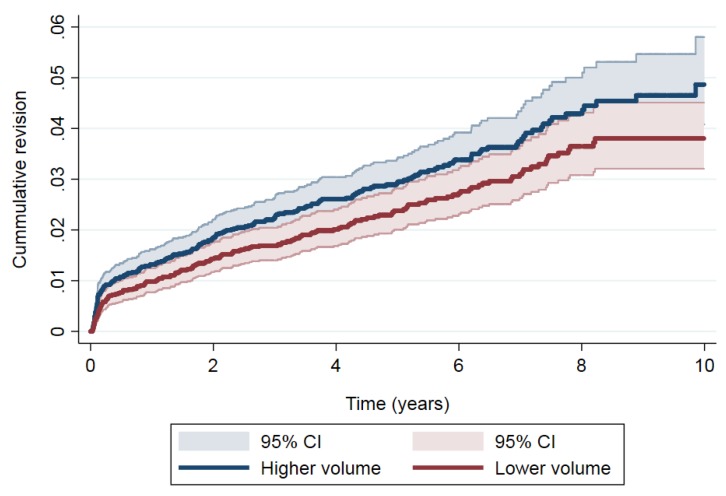
The volume of total hip (THA) and knee arthroplasties (TKA) performed in a hospital per year could be an influential factor on the revision of these procedures. The aims of this study were: To obtain comparable cohorts in higher- and lower-volume hospitals; and to assess the association between the hospital volume and the incidence of revision. Data from patients undergoing THA and TKA caused by osteoarthritis and recorded in the Catalan Arthroplasty Register (RACat) between January 2005 and December 2016 were used. The main explanatory variable was hospital volume by year (higher/lower). The cut-off point was fixed, based on previous research, at 50 THA and 125 TKA procedures/year. To obtain comparable populations, a propensity-score matching method (1:1) was used. Patient characteristics prior to and after matching were compared. To assess differences by volume, subhazard ratios (SHRs) from competing risks models were obtained. After matching, 13,772 THA and 36,316 TKA patients remained in the study. Prior to matching, in both joints, significant differences in all confounders were observed between volume groups. After matching, none of them remained significant. Both in THA and TKA, a higher risk of revision in higher-volume hospitals was observed (THA SHR: 1.25, 95%CI: 1.02-1.53; and TKA SHR: 1.29, 95%CI: 1.16-1.44). Unlike other contexts, currently in Catalonia, higher-volume hospitals have a greater risk of revision than lower-volume hospitals. Further research could be valuable to define context-dependent measures to reduce the incidence of revision.
一家医院每年进行的全髋关节置换术(THA)和膝关节置换术(TKA)的数量可能是影响这些手术翻修的一个因素。本研究的目的是:在高手术量和低手术量的医院中获得可比队列;并评估医院手术量与翻修发生率之间的关联。使用了2005年1月至2016年12月期间在加泰罗尼亚关节置换登记处(RACat)记录的因骨关节炎接受THA和TKA手术的患者数据。主要解释变量是每年的医院手术量(高/低)。根据先前的研究,每年50例THA手术和125例TKA手术的切点被确定下来。为了获得可比人群,采用了倾向得分匹配法(1:1)。比较了匹配前后的患者特征。为了评估手术量的差异,从竞争风险模型中获得了亚风险比(SHR)。匹配后,13772例THA患者和36316例TKA患者留在研究中。匹配前,在两个关节中,手术量组之间在所有混杂因素上均观察到显著差异。匹配后,这些差异均不再显著。在THA和TKA中,均观察到高手术量医院的翻修风险更高(THA的SHR:1.25,95%CI:1.02 - 1.53;TKA的SHR:1.29,95%CI:1.16 - 1.44)。与其他情况不同,目前在加泰罗尼亚,高手术量医院的翻修风险比低手术量医院更大。进一步的研究对于确定依赖于具体情况的措施以降低翻修发生率可能是有价值的。