Department of Pediatric Cardiology, West China Second University Hospital, Sichuan University, Chengdu, Sichuan, China.
West China Medical School of Sichuan University, Chengdu, Sichuan, China.
PLoS One. 2019 May 14;14(5):e0214873. doi: 10.1371/journal.pone.0214873. eCollection 2019.
Reducing toxicants transplacental rates could contribute to the prevention of congenital heart defects (CHDs). Placental P-glycoprotein (P-gp) plays a vital role in fetal toxicants exposure and subsequently affects the risk of toxicants-induced birth defects. However, data on the role of placental P-gp in decreasing toxicants-induced cardiac anomalies is extremely limited. This study aimed to explore the protective role of placental P-gp in reducing the risk of Di-(2-ethylhexyl)-phthalate (DEHP) induced cardiac anomalies in mice.
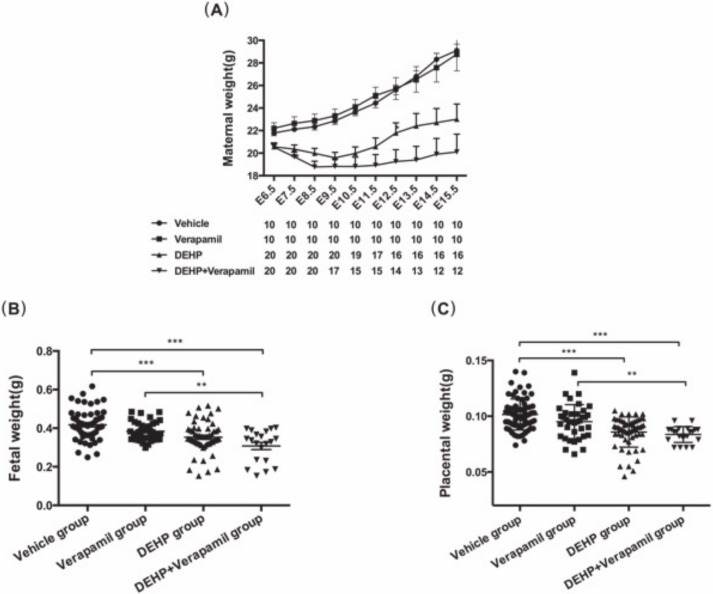
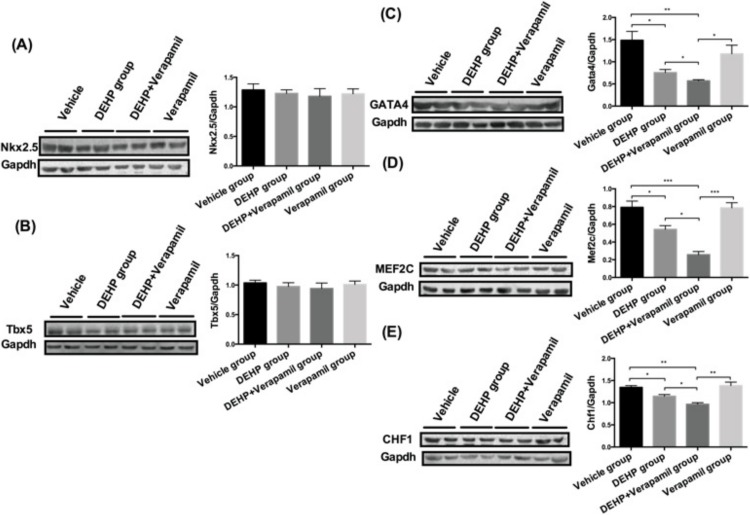
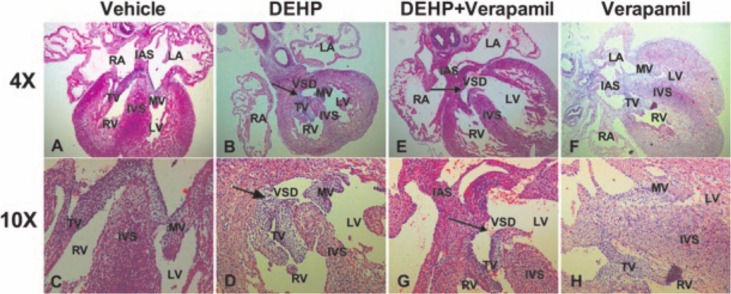
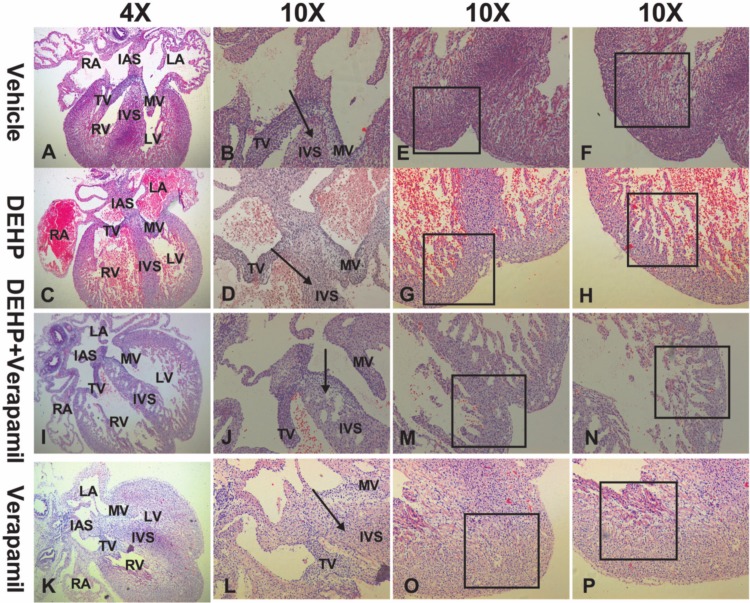
The C57BL mice were randomly divided into four groups: the vehicle group (corn oil, n = 10), 500mg/Kg DEHP group (n = 15), 3mg/Kg verapamil group (n = 10) and 500mg/Kg DEHP & 3mg/Kg verapamil group (n = 20). Pregnant dams in different group received respective intervention by gavage once daily from E6.5-14.5. Maternal weights were monitored every day and samples were collected at E15.5. HE staining was used to examine fetal cardiac malformations. Real-time quantitative PCR (RT-qPCR) and Western-Blot were applied to detect Nkx2.5/Gata4/Tbx5/Mef2c/Chf1 mRNA and protein expression, respectively. The mRNA expression of peroxisome proliferator-activated receptor γ (PPARγ) was also determined using RT-qPCR.
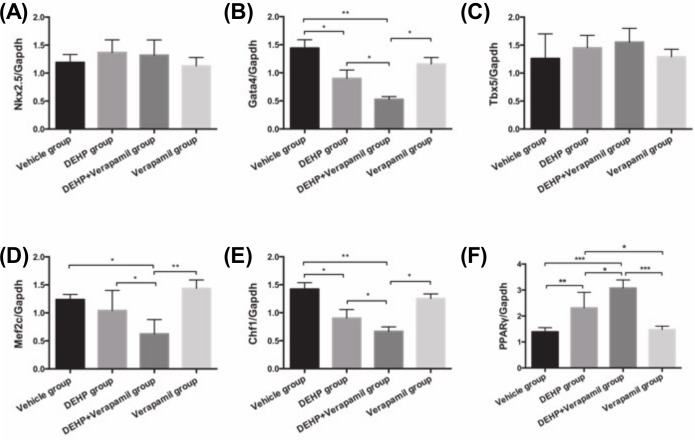
Co-administration of verapamil and DEHP significantly elevated fetal cardiac malformation rates, in comparison with the DEHP group, the verapamil group and the vehicle group. Different phenotypes of cardiac anomalies, including septal defects and ventricular myocardium noncompaction, were noted both in the DEHP group and the DEHP & verapamil group. The ventricular myocardium noncompaction appeared to be more severe in the DEHP & verapamil group. Fetal cardiac PPARγ mRNA expression was notably increased and Gata4/Mef2c/Chf1 expression was markedly decreased in the DEHP & verapamil group.
Placental P-gp inhibition enhances susceptibility to DEHP induced cardiac malformations in mice.
降低胎儿暴露于毒物的概率有助于预防先天性心脏缺陷(CHD)。胎盘 P-糖蛋白(P-gp)在胎儿暴露于毒物中起着至关重要的作用,进而影响毒物诱导的出生缺陷的风险。然而,关于胎盘 P-gp 在降低毒物诱导的心脏畸形风险中的作用的数据极为有限。本研究旨在探讨胎盘 P-gp 在减少二-(2-乙基己基)邻苯二甲酸酯(DEHP)诱导的小鼠心脏畸形中的保护作用。
将 C57BL 小鼠随机分为四组:玉米油对照组(n=10)、500mg/Kg DEHP 组(n=15)、3mg/Kg 维拉帕米组(n=10)和 500mg/Kg DEHP+3mg/Kg 维拉帕米组(n=20)。不同组别的妊娠母鼠每天通过灌胃接受相应的干预,从 E6.5 至 E14.5。每天监测母鼠体重,在 E15.5 时收集样本。通过 HE 染色观察胎儿心脏畸形。实时定量 PCR(RT-qPCR)和 Western-Blot 分别用于检测 Nkx2.5/Gata4/Tbx5/Mef2c/Chf1 mRNA 和蛋白表达。使用 RT-qPCR 还测定过氧化物酶体增殖物激活受体 γ(PPARγ)的 mRNA 表达。
与 DEHP 组相比,维拉帕米与 DEHP 共同给药显著增加了胎儿心脏畸形率,与 DEHP 组和对照组相比,维拉帕米组和对照组的心脏畸形率显著增加。在 DEHP 组和 DEHP+维拉帕米组中均观察到不同表型的心脏畸形,包括室间隔缺损和心室心肌非致密化。在 DEHP+维拉帕米组中,心室心肌非致密化的程度似乎更为严重。DEHP+维拉帕米组胎儿心脏 PPARγ mRNA 表达显著增加,Gata4/Mef2c/Chf1 表达明显减少。
胎盘 P-gp 抑制增强了小鼠对 DEHP 诱导的心脏畸形的易感性。