Reza-Zaldivar Edwin E, Hernández-Sapiéns Mercedes A, Gutiérrez-Mercado Yanet K, Sandoval-Ávila Sergio, Gomez-Pinedo Ulises, Márquez-Aguirre Ana L, Vázquez-Méndez Estefanía, Padilla-Camberos Eduardo, Canales-Aguirre Alejandro A
Unidad de Evaluación Preclínica, Unidad de Biotecnología Médica y Farmacéutica, Centro de Investigación y Asistencia en Tecnología y Diseño del Estado de Jalisco, Guadalajara, Mexico.
Regenerative Medicine Unit, Neuroscience Institute, Department of Neurosurgery and Neurology, IdISSC Health Research Institute of the Hospital Clínico San Carlos, Madrid, Spain.
Neural Regen Res. 2019 Sep;14(9):1626-1634. doi: 10.4103/1673-5374.255978.
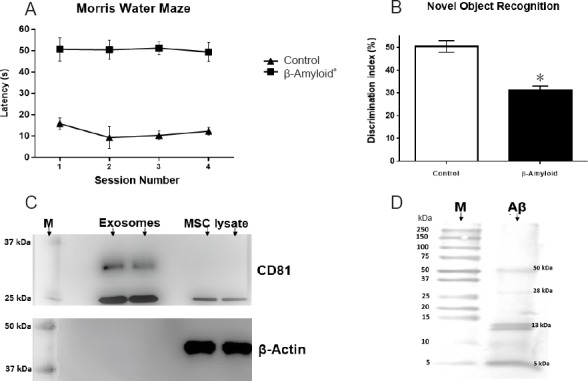
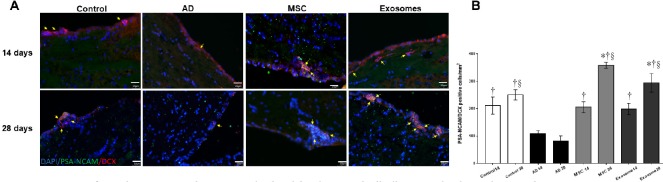
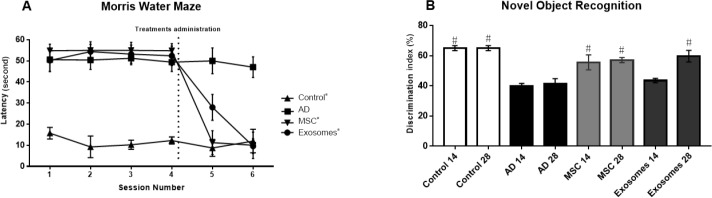
Studies have shown that mesenchymal stem cell-derived exosomes can enhance neural plasticity and improve cognitive impairment. The purpose of this study was to investigate the effects of mesenchymal stem cell-derived exosomes on neurogenesis and cognitive capacity in a mouse model of Alzheimer's disease. Alzheimer's disease mouse models were established by injection of beta amyloid 1-42 aggregates into dentate gyrus bilaterally. Morris water maze and novel object recognition tests were performed to evaluate mouse cognitive deficits at 14 and 28 days after administration. Afterwards, neurogenesis in the subventricular zone was determined by immunofluorescence using doublecortin and PSA-NCAM antibodies. Results showed that mesenchymal stem cells-derived exosomes stimulated neurogenesis in the subventricular zone and alleviated beta amyloid 1-42-induced cognitive impairment, and these effects are similar to those shown in the mesenchymal stem cells. These findings provide evidence to validate the possibility of developing cell-free therapeutic strategies for Alzheimer's disease. All procedures and experiments were approved by Institutional Animal Care and Use Committee (CICUAL) (approval No. CICUAL 2016-011) on April 25, 2016.
研究表明,间充质干细胞衍生的外泌体可增强神经可塑性并改善认知障碍。本研究的目的是探讨间充质干细胞衍生的外泌体对阿尔茨海默病小鼠模型神经发生和认知能力的影响。通过双侧齿状回注射β淀粉样蛋白1-42聚集体建立阿尔茨海默病小鼠模型。在给药后14天和28天进行莫里斯水迷宫和新物体识别测试,以评估小鼠的认知缺陷。之后,使用双皮质素和PSA-NCAM抗体通过免疫荧光法测定脑室下区的神经发生。结果表明,间充质干细胞衍生的外泌体刺激脑室下区的神经发生并减轻β淀粉样蛋白1-42诱导的认知障碍,这些作用与间充质干细胞所显示的作用相似。这些发现为验证开发用于阿尔茨海默病的无细胞治疗策略的可能性提供了证据。所有程序和实验均于2016年4月25日获得机构动物护理和使用委员会(CICUAL)批准(批准号:CICUAL 2016-011)。