Miura Kouichi, Ishioka Mitsuaki, Iijima Katsunori
Department of Gastroenterology, Akita University Graduate School of Medicine, Akita, Japan.
J Obes Metab Syndr. 2017 Jun;26(2):86-96. doi: 10.7570/jomes.2017.26.2.86. Epub 2017 Jun 30.
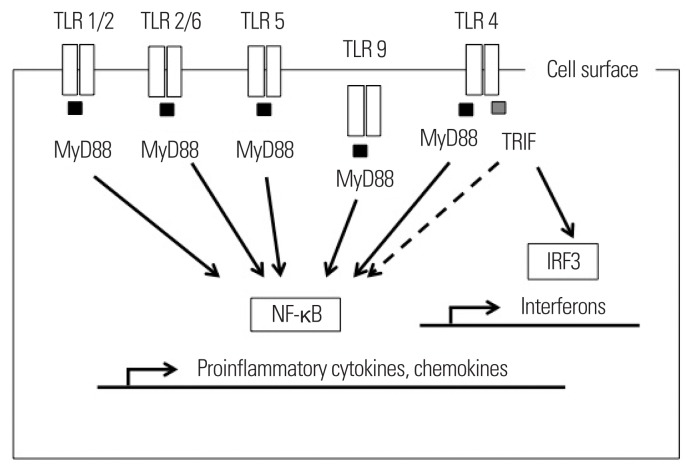
Obesity is characterized by low-grade chronic inflammation and is closely associated with the cardiovascular diseases, diabetes, and nonalcoholic fatty liver disease. Emerging data demonstrate that the gut microbiota contributes to the development of obesity by regulating the innate immune system, including the Toll-like receptors (TLRs): an altered gut microbiota composition and elevated TLR ligands are observed in obese mice and humans. The changes in the gut microbiota include an increased abundance of phylum and a decreased abundance of phylum. The population of beneficial bacteria that function as probiotics is decreased whereas harmful bacteria that can produce lipopolysaccharide, a TLR4 ligand, are increased in the obese state. In addition, the gut permeability is increased in obesity, which allows the delivery of larger amounts of bacterial components to the liver through the portal vein. Immune cells recognize these bacterial components through TLRs and produce diverse cytokines that kill invading pathogens. However, the sustained activation of TLR signaling induces host damage due to chronic exposure to harmful cytokines, which are produced from TLR expressing cells, including monocytes/macrophages. In the obese state, the expression of TLR is increased in several organs, including the adipose tissue and the liver. At the cell level, negative regulators of TLR signaling are suppressed, leading to activation of TLR signaling. These alterations promote inflammation in many organs. Thus, the gut microbiota and TLR signaling are therapeutic targets in patients with obesity and its related diseases.
肥胖的特征是低度慢性炎症,并且与心血管疾病、糖尿病和非酒精性脂肪性肝病密切相关。新出现的数据表明,肠道微生物群通过调节包括Toll样受体(TLRs)在内的固有免疫系统,促进肥胖的发展:在肥胖小鼠和人类中观察到肠道微生物群组成改变以及TLR配体升高。肠道微生物群的变化包括某一门类丰度增加而另一门类丰度降低。作为益生菌发挥作用的有益细菌数量减少,而在肥胖状态下可产生TLR4配体脂多糖的有害细菌增加。此外,肥胖时肠道通透性增加,这使得大量细菌成分通过门静脉输送至肝脏。免疫细胞通过TLRs识别这些细菌成分并产生多种杀死入侵病原体的细胞因子。然而,由于长期暴露于由表达TLR的细胞(包括单核细胞/巨噬细胞)产生的有害细胞因子,TLR信号的持续激活会导致宿主损伤。在肥胖状态下,包括脂肪组织和肝脏在内的多个器官中TLR的表达增加。在细胞水平上,TLR信号的负调节因子受到抑制,导致TLR信号激活。这些改变会促进许多器官的炎症反应。因此,肠道微生物群和TLR信号是肥胖及其相关疾病患者的治疗靶点。