Nam Ga Eun, Park Hye Soon
Department of Family Medicine, Sahmyook Medical Center, Seoul, Korea.
Department of Family Medicine, Asan Medical Center, University of Ulsan College of Medicine, Seoul, Korea.
J Obes Metab Syndr. 2018 Sep 30;27(3):134-142. doi: 10.7570/jomes.2018.27.3.134.
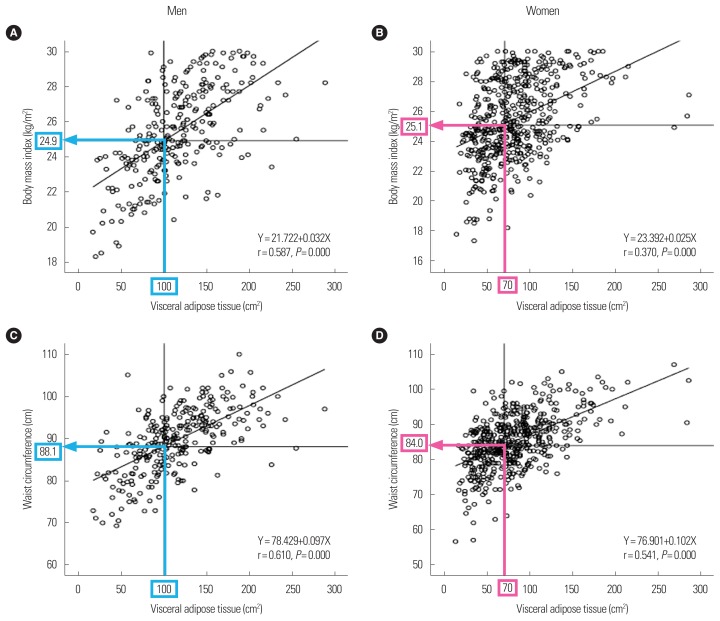
Excessive body weight is associated with increased health risks in humans. In general, the risk of mortality increases with greater obesity. The 2018 guideline for the management of obesity by the Korean Society for the Study of Obesity proposed the body mass index (BMI) cut-off levels of 25 kg/m and 23 kg/m as diagnostic criteria for obesity and overweight (pre-obese) in Korean adults, respectively. Abdominal obesity has been defined as waist circumference (WC) ≥90 cm in men and WC ≥85 cm in women. In this review, the validity of these criteria for Korean adults was examined based on the evidence regarding the associations of obesity index with mortality and morbidity. The American Association of Clinical Endocrinologists/American College of Endocrinology algorithm and American Diabetes Association guideline for the medical care of obese and overweight patients support a BMI of 25 kg/m and 23 kg/m, respectively, as the cut-off levels for Asians (and some ethnicities) corresponding to the BMI values of 30 kg/m and 25 kg/m, respectively, for Caucasians. In the future, the optimal cut-off levels for obesity and abdominal obesity may require adjustment as the demographic characteristics of the Korean population change. In addition, development of more valid indicators that better reflect health risks of obesity is needed.
超重与人类健康风险增加相关。一般来说,肥胖程度越高,死亡风险越高。韩国肥胖研究学会2018年发布的肥胖管理指南提出,韩国成年人肥胖和超重(肥胖前期)的诊断标准分别为体重指数(BMI)≥25kg/m²和≥23kg/m²。腹型肥胖的定义为男性腰围(WC)≥90cm,女性腰围≥85cm。在本综述中,基于肥胖指数与死亡率和发病率之间关联的证据,对这些标准在韩国成年人中的有效性进行了检验。美国临床内分泌医师协会/美国内分泌学会算法以及美国糖尿病协会肥胖和超重患者医疗护理指南分别支持将BMI 25kg/m²和23kg/m²作为亚洲人(以及一些种族)的临界值,分别对应于白种人的BMI值为≥30kg/m²和≥25kg/m²。未来,随着韩国人口的人口统计学特征发生变化,肥胖和腹型肥胖的最佳临界值可能需要调整。此外,需要开发能更好反映肥胖健康风险的更有效指标。