Wessler Benjamin S, Paulus Jessica, Lundquist Christine M, Ajlan Muhammad, Natto Zuhair, Janes William A, Jethmalani Nitin, Raman Gowri, Lutz Jennifer S, Kent David M
1Division of Cardiology, Tufts Medical Center, Boston, USA.
2Predictive Analytics and Comparative Effectiveness (PACE) Center, Institute for Clinical Research and Health Policy Studies (ICRHPS), Tufts Medical Center/Tufts University School of Medicine, 800 Washington Street, Box 63, Boston, MA 02111 USA.
Diagn Progn Res. 2017 Dec 21;1:20. doi: 10.1186/s41512-017-0021-2. eCollection 2017.
Clinical predictive models (CPMs) estimate the probability of clinical outcomes and hold the potential to improve decision-making and individualize care. The Tufts Predictive Analytics and Comparative Effectiveness (PACE) CPM Registry is a comprehensive database of cardiovascular disease (CVD) CPMs. The Registry was last updated in 2012, and there continues to be substantial growth in the number of available CPMs.
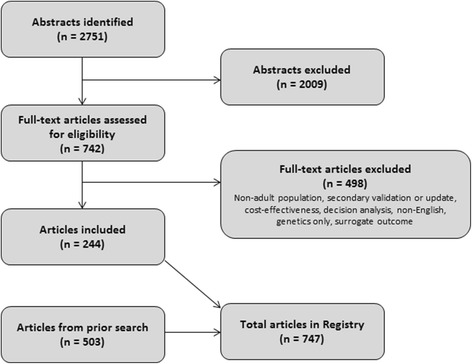
We updated a systematic review of CPMs for CVD to include articles published from January 1990 to March 2015. CVD includes coronary artery disease (CAD), congestive heart failure (CHF), arrhythmias, stroke, venous thromboembolism (VTE), and peripheral vascular disease (PVD). The updated Registry characterizes CPMs based on population under study, model performance, covariates, and predicted outcomes.
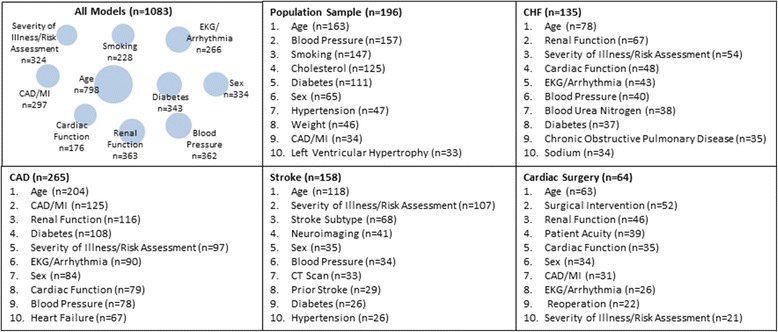
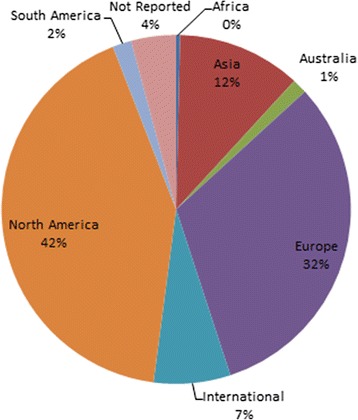
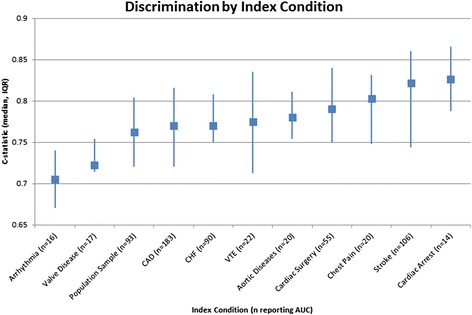
The Registry includes 747 articles presenting 1083 models, including both prognostic ( = 1060) and diagnostic ( = 23) CPMs representing 183 distinct index condition/outcome pairs. There was a threefold increase in the number of CPMs published between 2005 and 2014, compared to the prior 10-year interval from 1995 to 2004. The majority of CPMs were derived from either North American ( = 455, 42%) or European ( = 344, 32%) populations. The database contains 265 CPMs predicting outcomes for patients with coronary artery disease, 196 CPMs for population samples at risk for incident CVD, and 158 models for patients with stroke. Approximately two thirds ( = 701, 65%) of CPMs report a statistic, with a median reported statistic of 0.77 (IQR, 0.05). Of the CPMs reporting validations, only 333 (57%) report some measure of model calibration. Reporting of discrimination but not calibration is improving over time ( for trend < 0.0001 and 0.39 respectively).
There is substantial redundancy of CPMs for a wide spectrum of CVD conditions. While the number of CPMs continues to increase, model performance is often inadequately reported and calibration is infrequently assessed. More work is needed to understand the potential impact of this literature.
临床预测模型(CPMs)可估计临床结局的概率,具有改善决策制定和实现个性化医疗的潜力。塔夫茨预测分析与比较效果(PACE)CPM注册库是心血管疾病(CVD)CPM的综合数据库。该注册库上次更新于2012年,可用CPM的数量仍在大幅增长。
我们更新了对CVD的CPM的系统评价,纳入1990年1月至2015年3月发表的文章。CVD包括冠状动脉疾病(CAD)、充血性心力衰竭(CHF)、心律失常、中风、静脉血栓栓塞(VTE)和外周血管疾病(PVD)。更新后的注册库根据研究人群、模型性能、协变量和预测结局对CPM进行了描述。
该注册库包括747篇文章,呈现了1083个模型,包括预后(=1060)和诊断(=23)CPM,代表183个不同的索引疾病/结局对。与1995年至2004年的前10年间隔相比,2005年至2014年发表的CPM数量增加了两倍。大多数CPM来自北美(=455,42%)或欧洲(=344,32%)人群。该数据库包含265个预测冠状动脉疾病患者结局的CPM、196个针对有发生CVD风险的人群样本的CPM以及158个针对中风患者的模型。大约三分之二(=701,65%)的CPM报告了一个统计量,报告的统计量中位数为0.77(四分位间距,0.05)。在报告验证情况的CPM中,只有333个(57%)报告了某种模型校准措施。随着时间的推移,歧视报告而非校准报告有所改善(趋势分别为<0.0001和0.39)。
针对广泛的CVD病症,CPM存在大量冗余。虽然CPM的数量持续增加,但模型性能的报告往往不充分,校准也很少被评估。需要开展更多工作来了解该文献的潜在影响。