Sharma Varun, Zivic Fatima, Grujovic Nenad, Babcsan Norbert, Babcsan Judith
Faculty of Engineering, University of Kragujevac, Kragujevac 34000, Serbia.
ALUINVENT, Felsőzsolcai Industrial Park, Miskolc H-3561, Hungary.
Materials (Basel). 2019 May 15;12(10):1582. doi: 10.3390/ma12101582.
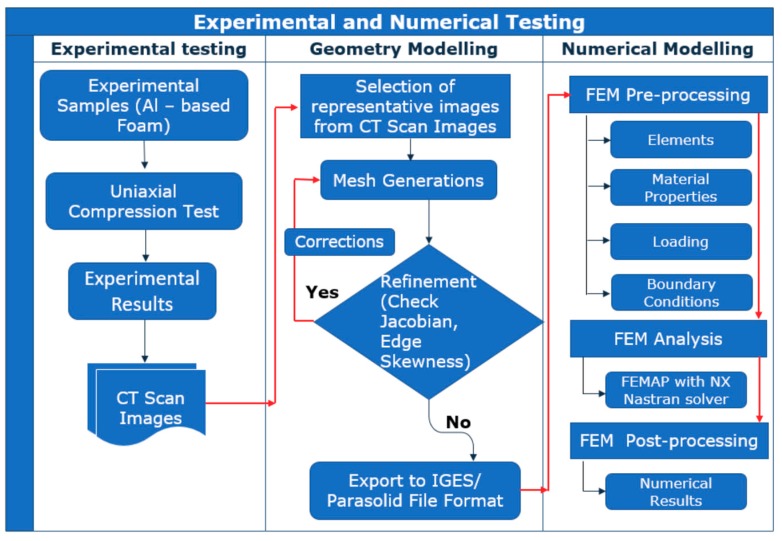
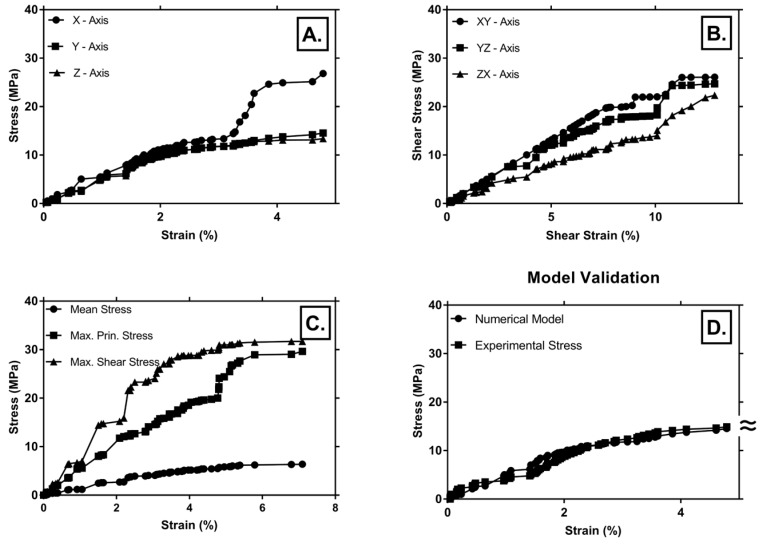
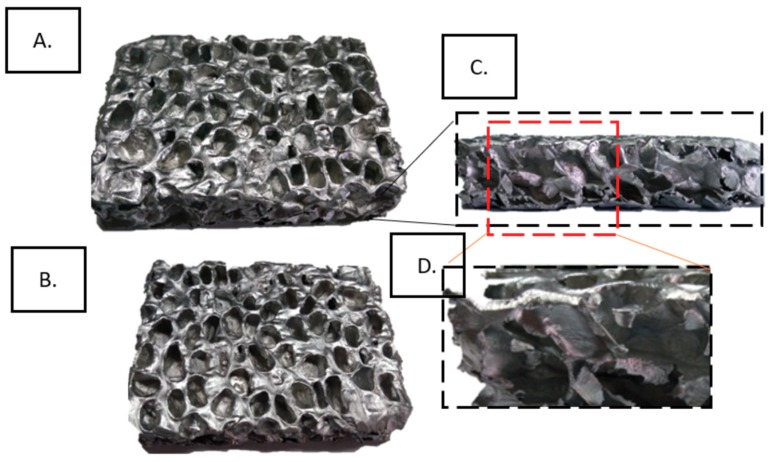
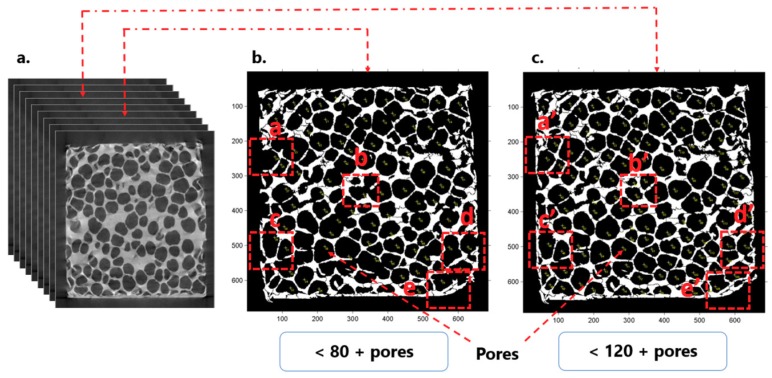
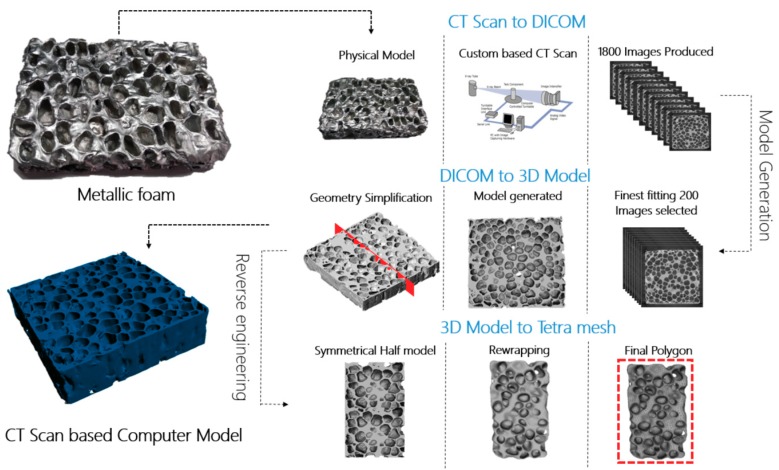
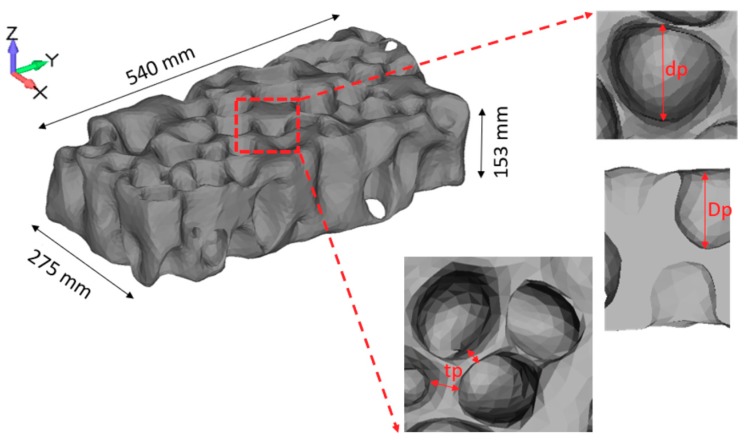
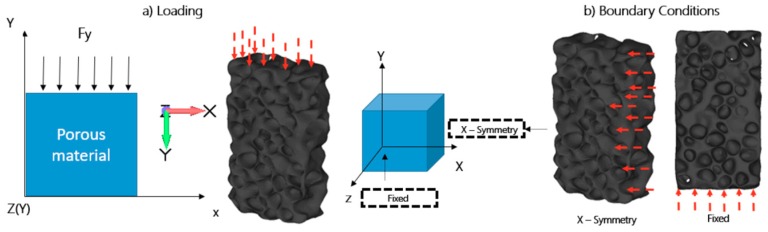
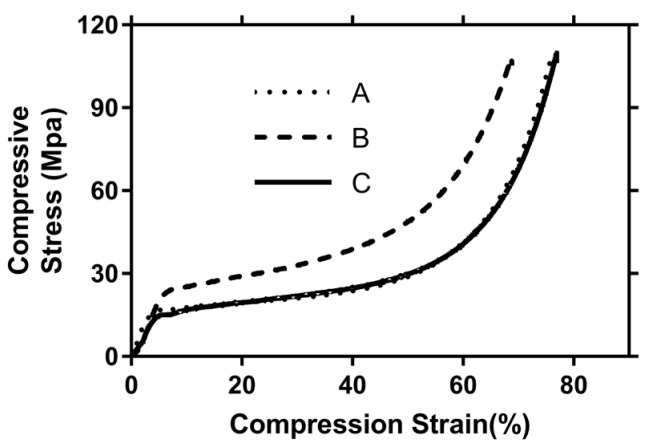
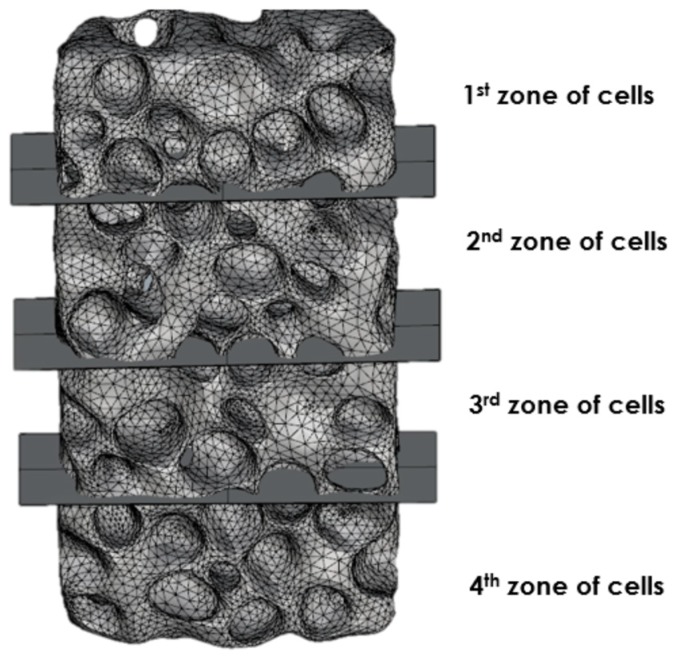
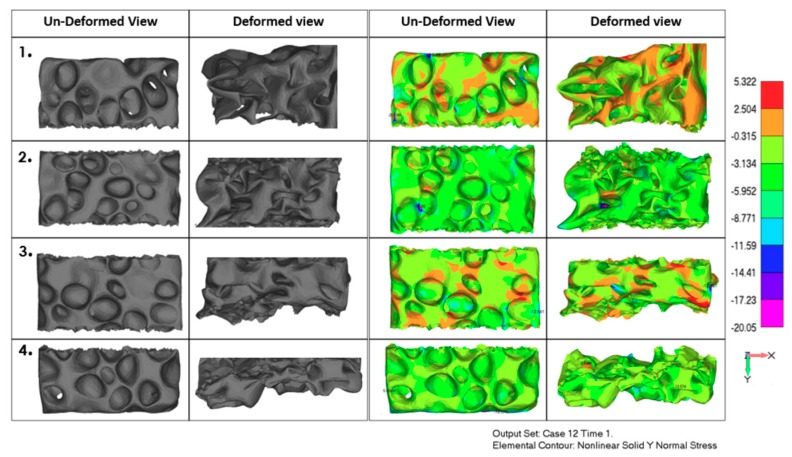
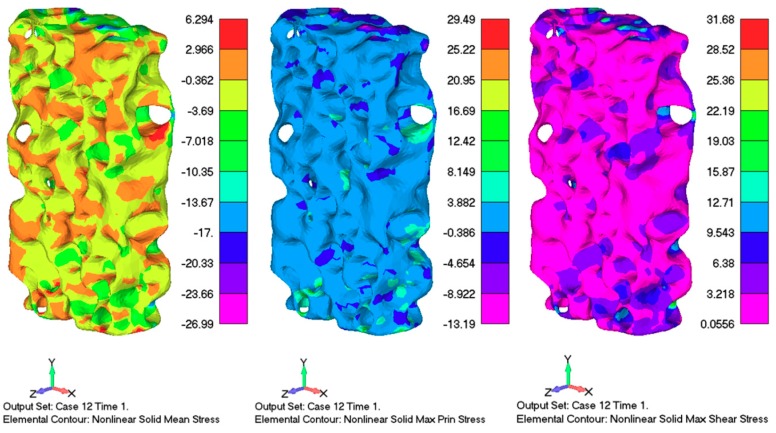
This paper deals with the experimental and numerical study of closed-cell aluminum-based foam under compressive loading. Experimental samples were produced by the gas blowing method. Foam samples had an average cell size of around 1 mm, with sizes in the range 0.5-5 mm, and foam density of 0.6 g/cm. Foam samples were subjected to a uniaxial compression test, at a displacement rate of 0.001 mm/s. Load and stress were monitored as the functions of extension and strain, respectively. For numerical modeling, CT scan images of experimental samples were used to create a volume model. Solid 3D quadratic tetrahedron mesh with TETRA 10-node elements was applied, with isotropic material behavior. A nonlinear static test with an elasto-plastic model was used in the numerical simulation, with von Mises criteria, and strain was kept below 10% by the software. Uniform compressive loading was set up over the top sample surface, in the y-axis direction only. Experimental tests showed that a 90 kN load produced complete failure of the sample, and three zones were exhibited: an elastic region, a rather uniform plateau region (around 23 MPa) and a densification region that started around 35 MPa. Yielding, or collapse stress, was achieved around 20 MPa. The densification region and a rapid rise in stress began at around 52% of sample deformation. The numerical model showed both compressive and tensile stresses within the complex stress field, indicating that shear also had a prominent role. Mainly compressive stresses were exhibited in the zones of the larger cells, whereas tensile stresses occurred in zones with an increased number of small cells and thin cell walls.
本文研究了闭孔铝基泡沫材料在压缩载荷作用下的实验与数值模拟。实验样品采用气体发泡法制备。泡沫样品的平均泡孔尺寸约为1mm,尺寸范围在0.5 - 5mm之间,泡沫密度为0.6g/cm³。泡沫样品进行单轴压缩试验,位移速率为0.001mm/s。分别监测载荷和应力随伸长和应变的变化。对于数值建模,使用实验样品的CT扫描图像创建体积模型。应用具有TETRA 10节点单元的实体3D二次四面体网格,材料行为为各向同性。数值模拟采用弹塑性模型的非线性静态试验,使用von Mises准则,软件将应变保持在10%以下。仅在y轴方向在样品顶部表面施加均匀压缩载荷。实验测试表明,90kN的载荷使样品完全失效,呈现出三个区域:弹性区域、相当均匀的平台区域(约23MPa)和从35MPa左右开始的致密化区域。屈服应力或坍塌应力在20MPa左右达到。致密化区域和应力的快速上升在样品变形约52%时开始。数值模型显示了复杂应力场中的压缩应力和拉伸应力,表明剪切也起到了重要作用。在较大泡孔区域主要表现为压缩应力,而在小泡孔数量增加和泡孔壁较薄的区域出现拉伸应力。