Hospital General "Dr. Manuel Gea González", Secretaría de Salud, Mexico City, Mexico.
Departamento de Ecología Evolutiva, Instituto de Ecología, Universidad Nacional Autónoma de México, Mexico City, Mexico.
Parasit Vectors. 2019 May 16;12(1):240. doi: 10.1186/s13071-019-3489-5.
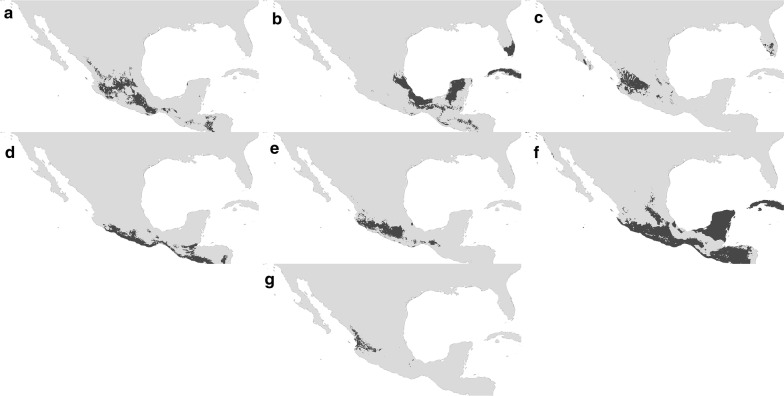
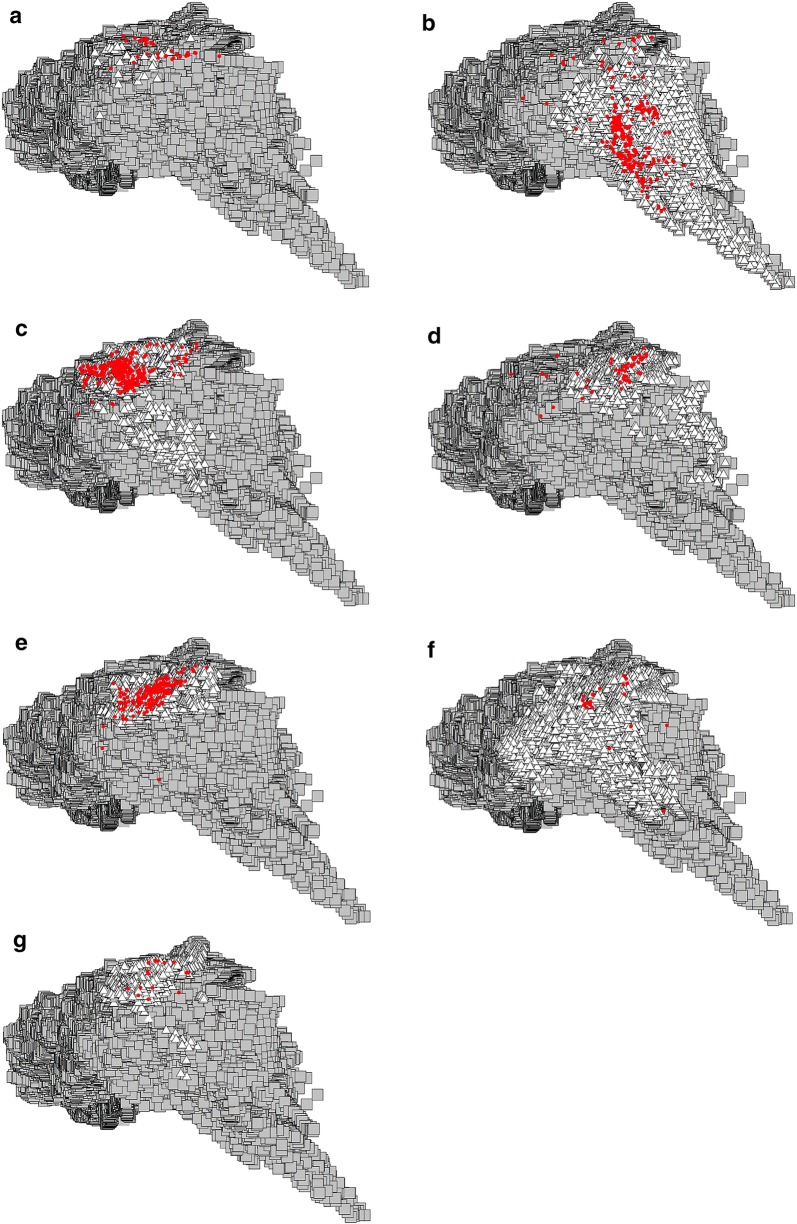
Theory predicts that parasites can affect and thus drive their hosts' niche. Testing this prediction is key, especially for vector-borne diseases including Chagas disease. Here, we examined the niche use of seven triatomine species that occur in Mexico, based on whether they are infected or not with Trypanosoma cruzi, the vectors and causative parasites of Chagas disease, respectively. Presence data for seven species of triatomines (Triatoma barberi, T. dimidiata, T. longipennis, T. mazzottii, T. pallidipennis, T. phyllosoma and T. picturata) were used and divided into populations infected and not infected by T. cruzi. Species distribution models were generated with Maxent 3.3.3k. Using distribution models, niche analysis tests of amplitude and distance to centroids were carried out for infected vs non-infected populations within species.
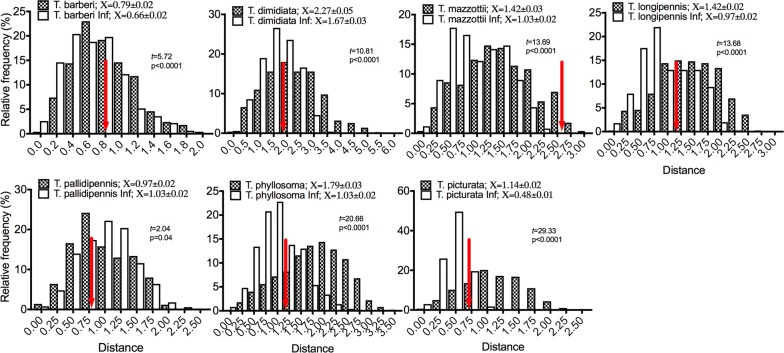
Infected populations of bugs of six out of the seven triatomine species showed a reduced ecological space compared to non-infected populations. In all but one case (T. pallidipennis), the niche used by infected populations was close to the niche centroid of its insect host.
Trypanosoma cruzi may have selected for a restricted niche amplitude in triatomines, although we are unaware of the underlying reasons. Possibly the fact that T. cruzi infection bears a fitness cost for triatomines is what narrows the niche breadth of the insects. Our results imply that Chagas control programmes should consider whether bugs are infected in models of triatomine distribution.
理论预测寄生虫可以影响并因此驱动其宿主的生态位。检验这一预测是关键,特别是对于包括恰加斯病在内的虫媒传染病。在这里,我们根据是否感染克氏锥虫(恰加斯病的传播媒介和病原体),检查了在墨西哥发生的七种锥蝽的生态位利用情况。使用了七种锥蝽(T. barberi、T. dimidiata、T. longipennis、T. mazzottii、T. pallidipennis、T. phyllosoma 和 T. picturata)的存在数据,并将其分为感染和未感染 T. cruzi 的种群。使用 Maxent 3.3.3k 生成物种分布模型。使用分布模型,对物种内感染和未感染种群进行了幅度和距离到中心点的生态位分析测试。
七种锥蝽中的六种感染种群的生态空间与未感染种群相比有所减少。除了一种情况(T. pallidipennis)外,感染种群所利用的生态位都接近其昆虫宿主的生态位中心。
克氏锥虫可能选择了锥蝽受限的生态位幅度,尽管我们不知道其潜在原因。可能是 T. cruzi 感染对锥蝽有适应成本,从而缩小了昆虫的生态位宽度。我们的研究结果表明,在锥蝽分布模型中,恰加斯病控制项目应考虑到虫子是否被感染。