Medical Research Council ConDuCT-II Hub for Trials Methodology Research, National Institute for Health Research Bristol Biomedical Research Centre, Bristol Centre for Surgical Research, Bristol Medical School, Population Health Sciences, University of Bristol, 39 Whatley Road, Bristol, BS8 2PS, UK.
Medical Research Council ConDuCT-II Hub for Trials Methodology Research, Bristol Centre for Surgical Research, Bristol Medical School, Population Health Sciences, University of Bristol, 39 Whatley Road, Bristol, BS8 2PS, UK.
BMC Cancer. 2019 May 17;19(1):463. doi: 10.1186/s12885-019-5657-6.
Patients undergoing major cancer surgery frequently require post-acute care for complications and adverse effects. Enhanced recovery after surgery programmes mean that patients are increasingly discharged home earlier. Symptom/complication detection post-discharge is sub-optimal. Systematic patient monitoring post-discharge following surgery may be optimally achieved through routine electronic patient-reported outcome (ePRO) data capture. ePRO systems that employ clinical algorithms to guide management of patients and automatically alert clinicians of clinically-concerning symptoms can improve patient outcomes and decrease hospital admissions. ePRO systems that provide individually-tailored self-management advice and integrate live ePRO data into electronic health records (EHR) may also advance personalised health and patient-centred care. This study aims to develop a hospital EHR-integrated ePRO system to improve detection and management of complications post-discharge following cancer-related surgery.
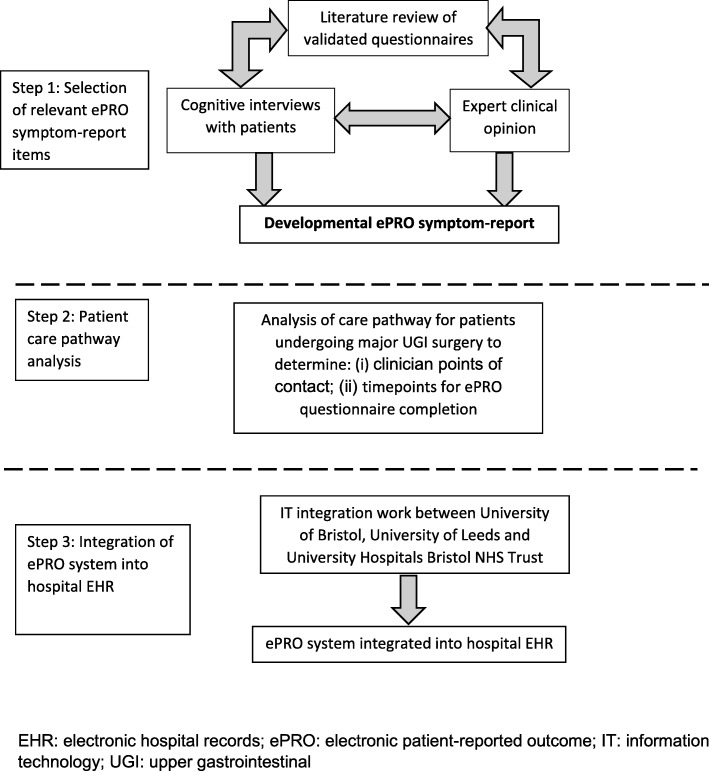
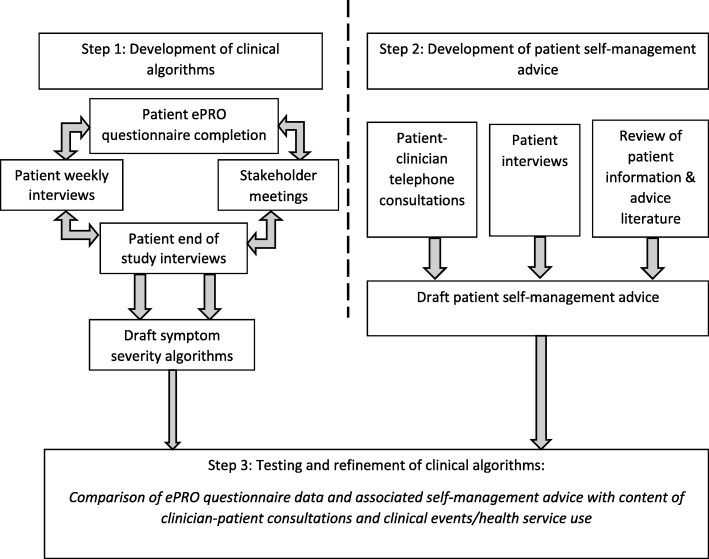
The ePRO system was developed in two phases: (1) Development of a web-based ePRO symptom-report from validated European Organisation for Research and Treatment of Cancer (EORTC) questionnaires, clinical opinion and patient interviews, followed by hospital EHR integration; (2) Development of clinical algorithms triggering symptom severity-dependent patient advice and clinician alerts from: (i) prospectively-collected patient-completed ePRO symptom-report data; (ii) stakeholder meetings; (iii) patient interviews. Patient advice was developed from: (i) clinician-patient telephone consultations and patient interviews; (ii) review of hospital patient information leaflets (PIL) and patient support websites.
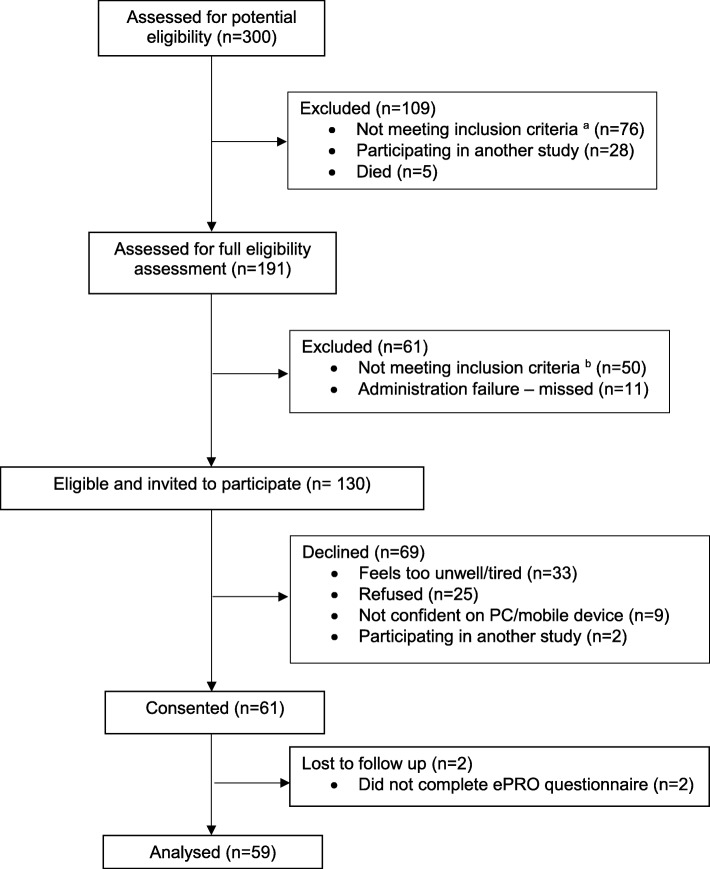
Phase 1, including interviews with 18 patients, identified 35 symptom-report items. In phase 2, 130/300 (43%) screened patients were eligible. 61 (47%) consented to participate and 59 (97%) provided 444 complete self-reports. Stakeholder meetings (9 clinicians, 1 patient/public representative) and patient interviews (n = 66) refined advice/alert accuracy. 15 telephone consultations, 7 patient interviews and review of 28 PILs and 3 patient support websites identified 4 themes to inform self-management advice. Comparisons between ePRO symptom-report data, telephone consultations and clinical events/outcomes (n = 27 patients) further refined clinical algorithms.
A hospital EHR-integrated ePRO system that alerts clinicians and provides patient self-management advice has been developed to improve the detection and management of problems and complications after discharge following surgery. An ongoing pilot study will inform a multicentre randomised trial to evaluate the effectiveness of the ePRO system compared to usual care.
接受重大癌症手术的患者经常需要接受急性后护理以应对并发症和不良反应。手术后康复增强计划意味着患者出院时间越来越早。出院后的症状/并发症检测效果不佳。通过常规电子患者报告结果(ePRO)数据采集,可能可以实现手术后患者出院后的系统监测。使用临床算法来指导患者管理并自动向临床医生发出临床关注症状警报的 ePRO 系统可以改善患者预后并减少住院人数。提供个性化自我管理建议并将实时 ePRO 数据集成到电子健康记录(EHR)中的 ePRO 系统也可以推进个性化健康和以患者为中心的护理。本研究旨在开发一种医院 EHR 集成的 ePRO 系统,以改善癌症相关手术后出院后的并发症检测和管理。
该 ePRO 系统分两个阶段开发:(1)从经过验证的欧洲癌症研究与治疗组织(EORTC)问卷、临床意见和患者访谈中开发基于网络的 ePRO 症状报告,然后与医院 EHR 集成;(2)从:(i)前瞻性收集的患者完成的 ePRO 症状报告数据;(ii)利益相关者会议;(iii)患者访谈,开发触发症状严重程度相关患者建议和临床医生警报的临床算法。患者建议来自:(i)临床医生与患者的电话咨询和患者访谈;(ii)审查医院患者信息传单(PIL)和患者支持网站。
第 1 阶段包括对 18 名患者的访谈,确定了 35 个症状报告项目。在第 2 阶段,对 300 名筛查患者中的 130 名进行了筛选,符合条件的患者有 130 名。61 名(47%)同意参与,59 名(97%)提供了 444 份完整的自我报告。利益相关者会议(9 名临床医生、1 名患者/公众代表)和患者访谈(n=66)完善了建议/警报的准确性。15 次电话咨询、7 次患者访谈以及对 28 份 PIL 和 3 个患者支持网站的审查确定了 4 个主题,为自我管理建议提供信息。对 27 名患者的 ePRO 症状报告数据、电话咨询和临床事件/结果的比较进一步完善了临床算法。
开发了一种与医院 EHR 集成的 ePRO 系统,用于提醒临床医生并提供患者自我管理建议,以改善手术后出院后的问题和并发症的检测和管理。正在进行的试点研究将为评估 ePRO 系统与常规护理相比的有效性的多中心随机试验提供信息。