Gillis Chelsia, Gill Marlyn, Marlett Nancy, MacKean Gail, GermAnn Kathy, Gilmour Loreen, Nelson Gregg, Wasylak Tracy, Nguyen Susan, Araujo Edamil, Zelinsky Sandra, Gramlich Leah
Department of Community Health Sciences, Cumming School of Medicine, University of Calgary, Calgary, Alberta, Canada.
PaCER Innovates, University of Calgary, Calgary, Alberta, Canada.
BMJ Open. 2017 Jun 24;7(6):e017002. doi: 10.1136/bmjopen-2017-017002.
Explore the experience of patients undergoing colorectal surgery within an Enhanced Recovery After Surgery (ERAS) programme. Use these experiential data to inform the development of a framework to support ongoing, meaningful patient engagement in ERAS.
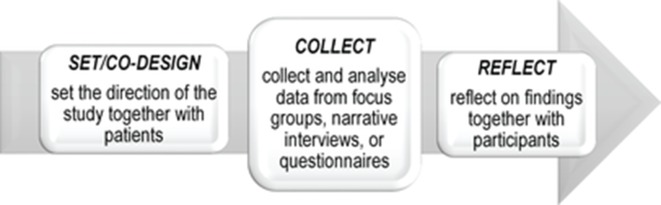
Qualitative patient-led study using focus groups and narrative interviews. Data were analysed iteratively using a Participatory Grounded Theory approach.
Five tertiary care centres in Alberta, Canada, following the ERAS programme.
Twenty-seven patients who had undergone colorectal surgery in the last 12 months were recruited through purposive sampling. Seven patients participated in a codesign focus group to set and prioritise the research direction. Narrative interviews were conducted with 20 patients.
Patients perceived that an ERAS programme should not be limited to the perioperative period, but should encompass the journey from diagnosis to recovery. Practical recommendations to improve the patient experience across the surgical continuum, and enhance patient engagement within ERAS included: (1) fully explain every protocol, and the purpose of the protocol, both before surgery and while in-hospital, so that patients can become knowledgeable partners in their recovery; (2) extend ERAS guidelines to the presurgery phase, so that patients can be ready emotionally, psychologically and physically for surgery; (3) extend ERAS guidelines to the recovery period at home to avoid stressful situations for patients and families; (4) consider activating a programme where experienced patients can provide peer support; (5) one size does not fit all; personalised adaptations within the standardised pathway are required.Drawing upon these data, and through consultation with ERAS Alberta stakeholders, the ERAS team developed a matrix to guide sustained patient involvement and action throughout the surgical care continuum at three levels: individual, unit and ERAS system.
This patient-led study generated new insights into the needs of ERAS patients and informed the development of a framework to improve patient experiences and outcomes.
探讨接受结直肠手术的患者在术后加速康复(ERAS)计划中的体验。利用这些经验数据为一个框架的制定提供信息,以支持患者在ERAS中持续、有意义地参与。
采用焦点小组和叙事访谈的以患者为主导的定性研究。使用参与式扎根理论方法对数据进行迭代分析。
加拿大艾伯塔省遵循ERAS计划的五个三级护理中心。
通过目的抽样招募了27名在过去12个月内接受过结直肠手术的患者。7名患者参加了一个共同设计焦点小组,以确定研究方向并确定优先事项。对20名患者进行了叙事访谈。
患者认为ERAS计划不应局限于围手术期,而应涵盖从诊断到康复的整个过程。改善整个手术连续过程中的患者体验并增强患者在ERAS中的参与度的实际建议包括:(1)在手术前和住院期间充分解释每一项方案及其目的,以便患者能够成为康复过程中有知识的伙伴;(2)将ERAS指南扩展到术前阶段,以便患者在情感、心理和身体上为手术做好准备;(3)将ERAS指南扩展到在家康复阶段,以避免给患者及其家人带来压力;(4)考虑启动一个项目,让有经验的患者提供同伴支持;(5)一刀切并不适用;在标准化路径内需要进行个性化调整。基于这些数据,并通过与艾伯塔省ERAS利益相关者的协商,ERAS团队制定了一个矩阵,以指导患者在手术护理连续过程的三个层面(个人、科室和ERAS系统)持续参与并采取行动。
这项以患者为主导的研究对ERAS患者的需求产生了新的见解,并为改善患者体验和结局的框架的制定提供了信息。