Department of Surgical Oncology, Second Affiliated Hospital, Zhejiang University School of Medicine, Hangzhou, Zhejiang, 310009, China.
Cancer Institute (Key Laboratory of Cancer Prevention and Intervention, China National Ministry of Education), The Second Affiliated Hospital, Zhejiang University School of Medicine, Hangzhou, Zhejiang, 310009, China.
Cell Commun Signal. 2019 May 17;17(1):47. doi: 10.1186/s12964-019-0362-2.
Radiotherapy is one of the most important therapeutic strategies for treating cancer. For decades, studies concerning the outcomes of radiotherapy mainly focused on the biological effects of radiation on tumor cells. Recently, we have increasingly recognized that the complex cellular interactions within the tumor microenvironment (TME) are closely related to treatment outcomes.
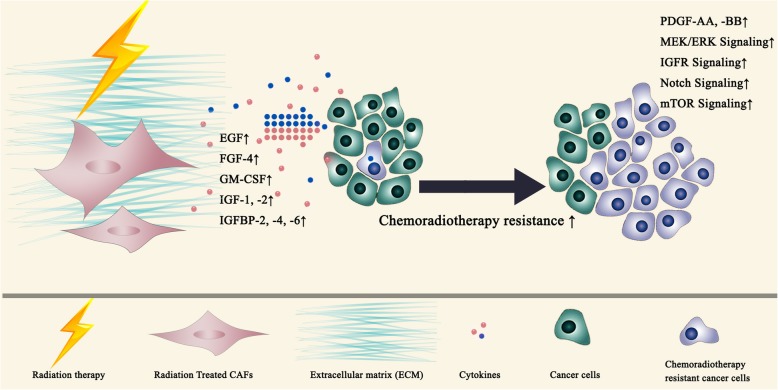
As a critical component of the TME, fibroblasts participate in all stages of cancer progression. Fibroblasts are able to tolerate harsh extracellular environments, which are usually fatal to all other cells. They play pivotal roles in determining the treatment response to chemoradiotherapy. Radiotherapy activates the TME networks by inducing cycling hypoxia, modulating immune reaction, and promoting vascular regeneration, inflammation and fibrosis. While a number of studies claim that radiotherapy affects fibroblasts negatively through growth arrest and cell senescence, others argue that exposure to radiation can induce an activated phenotype in fibroblasts. These cells take an active part in constructing the tumor microenvironment by secreting cytokines and degradative enzymes. Current strategies that aim to inhibit activated fibroblasts mainly focus on four aspects: elimination, normalization, paracrine signaling blockade and extracellular matrix inhibition. This review will describe the direct cellular effects of radiotherapy on fibroblasts and the underlying genetic changes. We will also discuss the impact of fibroblasts on cancer cells during radiotherapy and the potential value of targeting fibroblasts to enhance the clinical outcome of radiotherapy.
This review provides good preliminary data to elucidate the biological roles of CAFs in radiotherapy and the clinical value of targeting CAFs as a supplementary treatment to conventional radiotherapy. Further studies to validate this strategy in more physiological models may be required before clinical trial.
放射疗法是治疗癌症的最重要治疗策略之一。几十年来,关于放射治疗结果的研究主要集中在辐射对肿瘤细胞的生物学影响上。最近,我们越来越认识到肿瘤微环境(TME)内复杂的细胞相互作用与治疗结果密切相关。
作为 TME 的重要组成部分,成纤维细胞参与癌症进展的所有阶段。成纤维细胞能够耐受恶劣的细胞外环境,而这种环境通常对所有其他细胞都是致命的。它们在确定化学放射治疗的治疗反应方面起着关键作用。放射疗法通过诱导循环缺氧、调节免疫反应以及促进血管再生、炎症和纤维化来激活 TME 网络。虽然许多研究声称放射疗法通过生长停滞和细胞衰老对成纤维细胞产生负面影响,但也有其他研究认为,辐射暴露可以诱导成纤维细胞的激活表型。这些细胞通过分泌细胞因子和降解酶积极参与构建肿瘤微环境。目前旨在抑制激活成纤维细胞的策略主要集中在四个方面:消除、正常化、旁分泌信号阻断和细胞外基质抑制。本综述将描述放射疗法对成纤维细胞的直接细胞作用以及潜在的遗传变化。我们还将讨论成纤维细胞在放射治疗过程中对癌细胞的影响以及靶向成纤维细胞以增强放射治疗临床效果的潜在价值。
本综述提供了良好的初步数据,阐明了 CAFs 在放射治疗中的生物学作用以及将 CAFs 作为常规放射治疗的补充治疗的临床价值。在进行临床试验之前,可能需要在更生理的模型中进一步验证该策略。