Department of Dermatology, Ghent University Hospital, Ghent, Belgium.
Department of Dermatology, Amsterdam UMC, University of Amsterdam, Amsterdam, the Netherlands.
Ther Drug Monit. 2019 Oct;41(5):634-639. doi: 10.1097/FTD.0000000000000646.
Ustekinumab for the treatment of psoriasis is currently administered in a standard dosing regimen. However, some patients tend to benefit from alternative dosing regimens, a step toward personalized medicine.
To investigate the role of ustekinumab serum concentrations, anti-ustekinumab antibodies [AUA] and HLA-Cw6 status as tools for optimizing ustekinumab treatment, a multicenter prospective cohort study was conducted at an academic hospital with affiliated nonacademic hospitals in Belgium (cohort 1) and 2 academic hospitals in the Netherlands (cohort 2 and 3). Patients with plaque-type psoriasis were eligible if treated with ustekinumab for ≥16 weeks. Serum samples and Psoriasis Area and Severity Index scores were obtained at baseline, week 16, 28, 40, 52, and/or ≥64 of ustekinumab treatment.
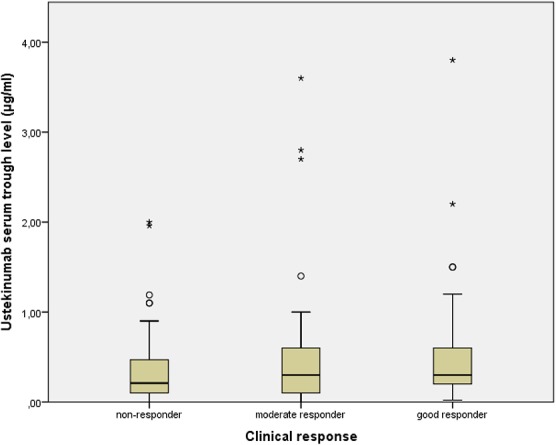
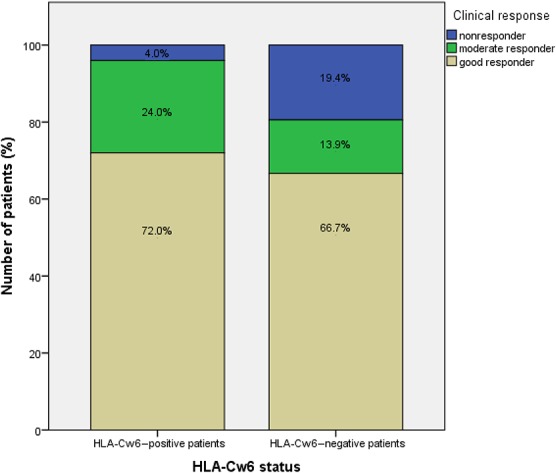
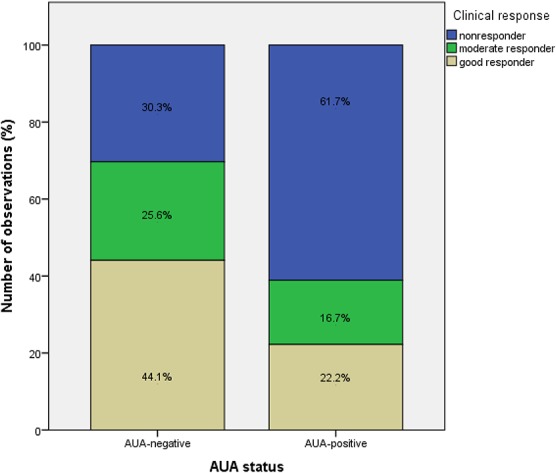
A total of 137 patients with 229 observations for serum concentrations and AUA and 61 observations for HLA-Cw6 status were included. Presence of AUA (prevalence of 8.7%) was significantly associated with a diminished clinical response (P = 0.032). The median ustekinumab trough concentration was 0.3 mcg/mL (<0.02-3.80). No differences in serum concentrations were observed between moderate to good responders and nonresponders (P = 0.948). Serum trough concentrations were not affected by methotrexate comedication. Prevalence of HLA-Cw6 positivity was 41% with no statistically significant difference in clinical response between HLA-Cw6-positive and HLA-Cw6-negative patients (P = 0.164).
The presence of AUA was associated with treatment failure in this patient population; measurement of AUA may therefore be a candidate marker for personalized pharmacotherapy. The clinical utility of ustekinumab serum trough concentrations or HLA-Cw6 status determination remains less clear. Further exploration on the potential of measuring ustekinumab serum concentrations and other biomarkers in predicting therapy outcomes should be encouraged.
乌司奴单抗治疗银屑病目前采用标准剂量方案。然而,一些患者可能从替代剂量方案中获益,这是迈向个体化医学的一步。
为了研究乌司奴单抗血清浓度、抗乌司奴单抗抗体(AUA)和 HLA-Cw6 状态作为优化乌司奴单抗治疗的工具的作用,在比利时的一家学术医院及其附属非学术医院(队列 1)和荷兰的 2 家学术医院(队列 2 和 3)进行了一项多中心前瞻性队列研究。符合条件的患者为斑块型银屑病,接受乌司奴单抗治疗≥16 周。在基线、第 16、28、40、52 周和/或乌司奴单抗治疗≥64 周时采集血清样本和银屑病面积和严重程度指数评分。
共纳入 137 例患者,229 例观察血清浓度和 AUA,61 例观察 HLA-Cw6 状态。AUA 阳性(患病率 8.7%)与临床应答减弱显著相关(P=0.032)。乌司奴单抗谷浓度中位数为 0.3 mcg/mL(<0.02-3.80)。中重度应答者和无应答者之间的血清浓度无差异(P=0.948)。甲氨蝶呤联合治疗不影响血清浓度。HLA-Cw6 阳性率为 41%,HLA-Cw6 阳性和 HLA-Cw6 阴性患者的临床应答无统计学差异(P=0.164)。
在该患者人群中,AUA 的存在与治疗失败相关;因此,AUA 的测定可能是个体化药物治疗的候选标志物。乌司奴单抗血清谷浓度或 HLA-Cw6 状态测定的临床实用性仍不明确。应鼓励进一步探索测定乌司奴单抗血清浓度和其他生物标志物在预测治疗结果方面的潜力。