Xie Jing, Li Ning, Jiang Xiaoyan, Chai Liyin, Chen Jian-Jun, Deng Wuquan
Department of Endocrinology and Nephrology, Chongqing University Central Hospital, Chongqing Emergency Medical Center, Chongqing 400014, People's Republic of China.
Institute of Life Sciences, Chongqing Medical University, Chongqing 400016, People's Republic of China.
Diabetes Metab Syndr Obes. 2019 Apr 17;12:519-526. doi: 10.2147/DMSO.S198154. eCollection 2019.
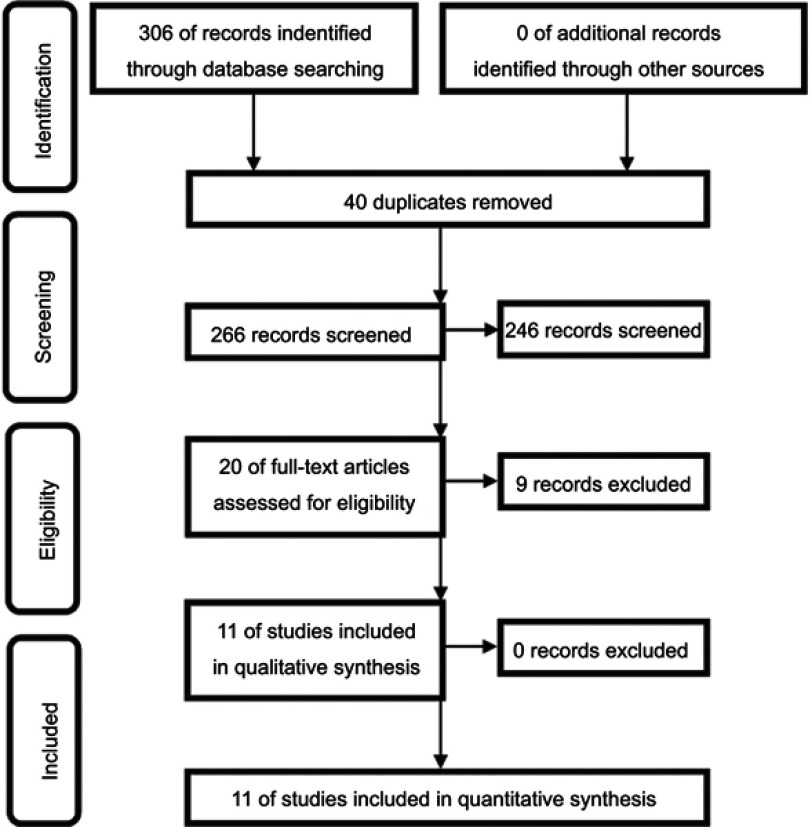
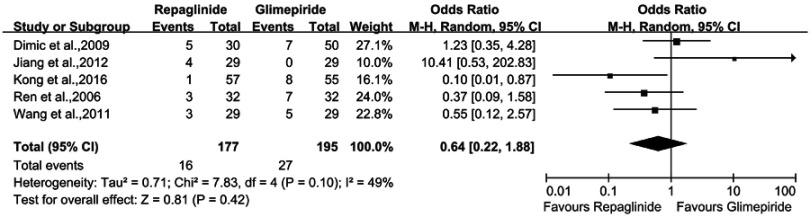
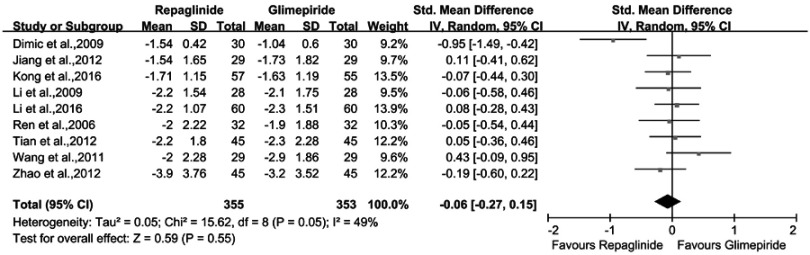
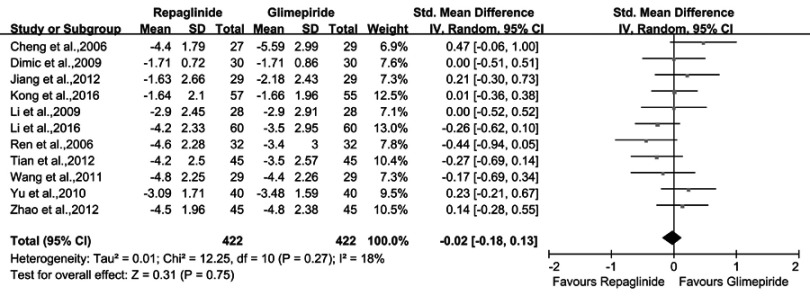
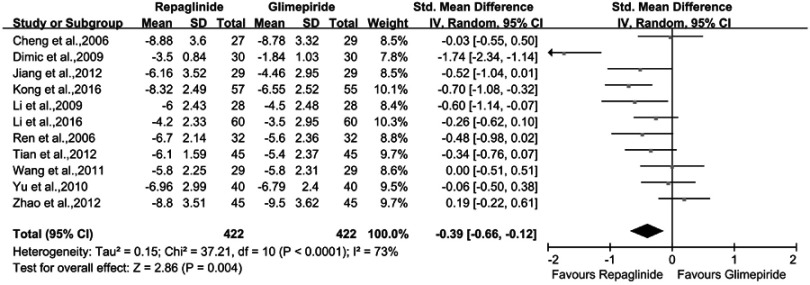
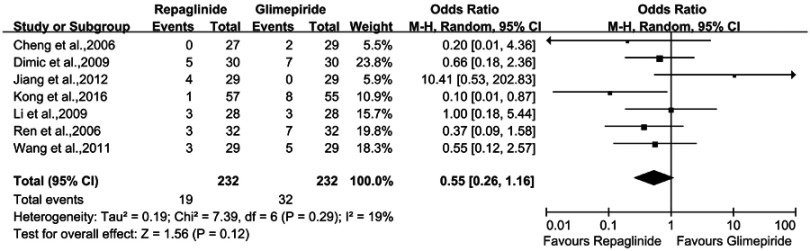
Consistent evidence is still lacking on which one, glimepiride plus metformin or repaglinide plus metformin, is better in treating type 2 diabetes mellitus (T2DM). Therefore, this study was conducted to compare the short-term efficacy and safety of these two methods in treating T2DM. The literature research dating up to August 2018 was conducted in the electronic databases. The randomized controlled trials (RCTs) comparing the short-term (treatment period ≤12 weeks) efficacy and safety of these two methods in treating patients with T2DM were included. No language limitation was used in this study. The decreased hemoglobin A1c (HbA1c), fasting plasma glucose (FPG), and 2h plasma glucose (2hPG) levels were used as the primary outcome to assess the efficacy, and the adverse events and hypoglycemia were used as the secondary outcome to assess the safety. In total, 11 RCTs composed of 844 T2DM patients were included. The results showed that there were no significant differences in decreasing HbA1c and FPG levels between the two methods, but the estimated standardized mean differences favored the repaglinide plus metformin. Meanwhile, the repaglinide plus metformin was significantly more effective in decreasing 2hPG levels than glimepiride plus metformin. In addition, fewer patients reported adverse events and experienced hypoglycemia in the repaglinide plus metformin group. These results indicated that the repaglinide plus metformin might have some advantages over glimepiride plus metformin in the short-term treatment of patients with T2DM, and should be further explored.
对于格列美脲联合二甲双胍和瑞格列奈联合二甲双胍哪一种在治疗2型糖尿病(T2DM)方面效果更好,目前仍缺乏一致的证据。因此,本研究旨在比较这两种方法治疗T2DM的短期疗效和安全性。在电子数据库中进行了截至2018年8月的文献研究。纳入了比较这两种方法治疗T2DM患者短期(治疗期≤12周)疗效和安全性的随机对照试验(RCT)。本研究未设语言限制。血红蛋白A1c(HbA1c)、空腹血糖(FPG)和餐后2小时血糖(2hPG)水平的降低作为评估疗效的主要指标,不良事件和低血糖作为评估安全性的次要指标。总共纳入了11项由844例T2DM患者组成的RCT。结果显示,两种方法在降低HbA1c和FPG水平方面无显著差异,但估计的标准化均值差异有利于瑞格列奈联合二甲双胍。同时,瑞格列奈联合二甲双胍在降低2hPG水平方面比格列美脲联合二甲双胍显著更有效。此外,瑞格列奈联合二甲双胍组报告不良事件和发生低血糖的患者较少。这些结果表明,在T2DM患者的短期治疗中,瑞格列奈联合二甲双胍可能比格列美脲联合二甲双胍具有一些优势,值得进一步探索。