Maurya Niharika, Singh Rinni, Goel Apul, Singhai Atin, Singh Uday Pratap, Agrawal Vinita, Garg Minal
Department of Biochemistry, Lucknow University, Lucknow 226007, India.
Department of Urology, King George Medical University, Lucknow 226003, India.
World J Clin Oncol. 2019 Apr 24;10(4):166-182. doi: 10.5306/wjco.v10.i4.166.
Aberrant activation of phosphorylated form of glycogen synthase kinase-3β [pS9GSK-3β (Serine 9 phosphorylation)] is known to trigger Wnt/β-catenin signal cascade but its clinicohistopathological implications in bladder carcinogenesis remain unknown.
To investigate the diagnostic and prognostic relevance of expressions of pS9GSK-3β, β-catenin and its target genes in the pathobiology of bladder cancer.
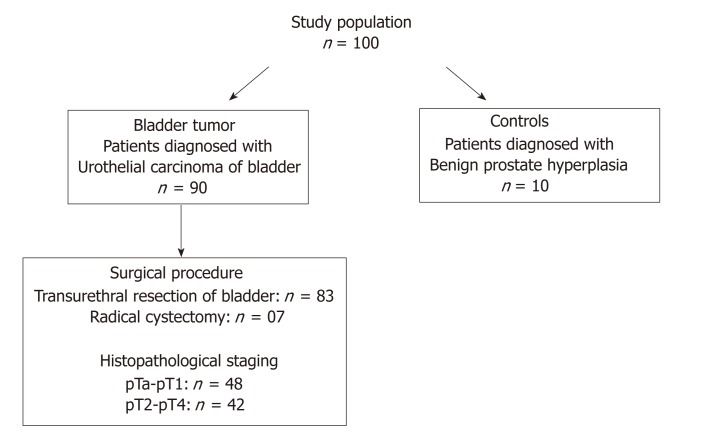
Bladder tumor tissues from ninety patients were analyzed for quantitative expression and cellular localization of pS9GSK-3β by immunohistochemical (IHC) staining. Real time-quantitative polymerase chain reaction and IHC were done to check the expression of β-catenin, Cyclin D1, Snail and Slug at transcriptome and protein level respectively. Clinicohistopathological variables were obtained from histology reports, follow up and OPD visits of patients. Expressions of the markers were statistically correlated with these variables to determine their significance in clinical setting. Results were analysed using SPSS 20.0 software.
Aberrant (low or no membranous/high nuclear/high cytoplasmic) expression of pS9GSK-3β was noted in 51% patients and found to be significantly associated with tumor stage and tumor grade ( = 0.01 and 0.04; Mann Whitney test). Thirty one percent tumors exhibited aberrant co-expression of pS9GSK-3β and β-catenin proteins and showed strong statistical association with tumor stage, tumor type, smoking/tobacco chewing status ( = 0.01, 0.02 and 0.04, Mann-Whitney test) and shorter overall survival probabilities of patients ( = 0.02; Kaplan Meier test). Nuclear immunostaining of Cyclin D1 in tumors with altered pS9GSK-3β/β-catenin showed relevance with tumor stage, grade and type.
β-catenin and pS9GSK-3β proteins are identified as markers of diagnostic/prognostic significance in disease pathogenesis. Observed histopathological association of Cyclin D1 identifies it as marker of potential relevance in tumors with altered pS9GSK-3β/β-catenin.
已知糖原合酶激酶-3β的磷酸化形式[pS9GSK-3β(丝氨酸9磷酸化)]的异常激活会触发Wnt/β-连环蛋白信号级联反应,但其在膀胱癌发生中的临床组织病理学意义仍不清楚。
探讨pS9GSK-3β、β-连环蛋白及其靶基因表达在膀胱癌病理生物学中的诊断和预后相关性。
采用免疫组织化学(IHC)染色分析90例患者膀胱肿瘤组织中pS9GSK-3β的定量表达和细胞定位。分别采用实时定量聚合酶链反应和IHC检测β-连环蛋白、细胞周期蛋白D1、Snail和Slug在转录组和蛋白水平的表达。从患者的组织学报告、随访和门诊就诊中获取临床组织病理学变量。将这些标志物的表达与这些变量进行统计学关联分析,以确定它们在临床环境中的意义。使用SPSS 20.0软件分析结果。
51%的患者存在pS9GSK-3β的异常(低或无膜性/高核/高细胞质)表达,且发现其与肿瘤分期和肿瘤分级显著相关(P = 0.01和0.04;Mann-Whitney检验)。31%的肿瘤表现出pS9GSK-3β和β-连环蛋白蛋白的异常共表达,与肿瘤分期、肿瘤类型、吸烟/咀嚼烟草状况显著相关(P = 0.01、0.02和0.04,Mann-Whitney检验),且患者的总生存概率较低(P = 0.02;Kaplan-Meier检验)。pS9GSK-3β/β-连环蛋白改变的肿瘤中细胞周期蛋白D1的核免疫染色与肿瘤分期、分级和类型相关。
β-连环蛋白和pS9GSK-