School of Public Health, Xinxiang Medical University, Xinxiang, China.
Department of Epidemiology, College of Public Health, Zhengzhou University, Zhengzhou, China.
PLoS One. 2019 May 23;14(5):e0216993. doi: 10.1371/journal.pone.0216993. eCollection 2019.
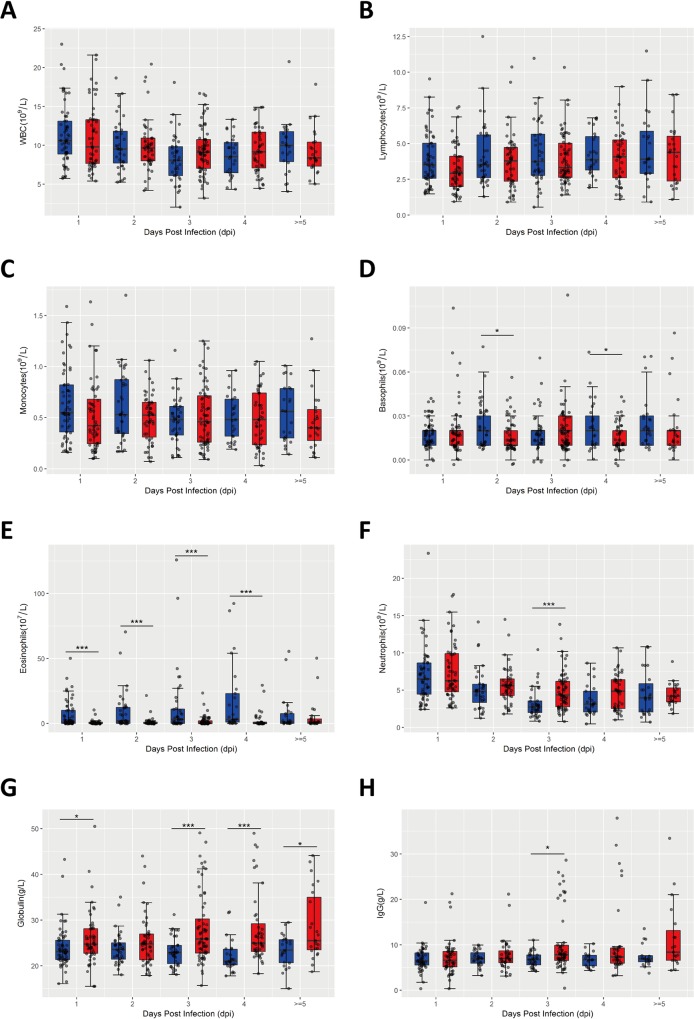
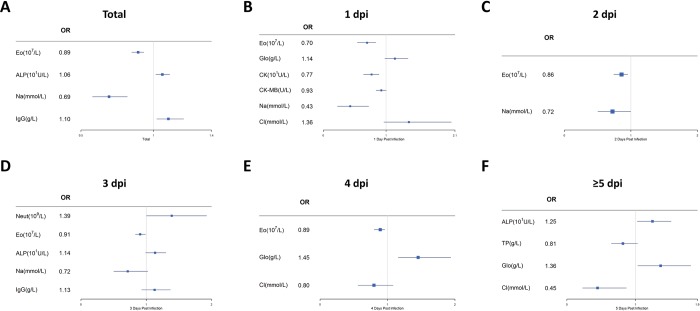
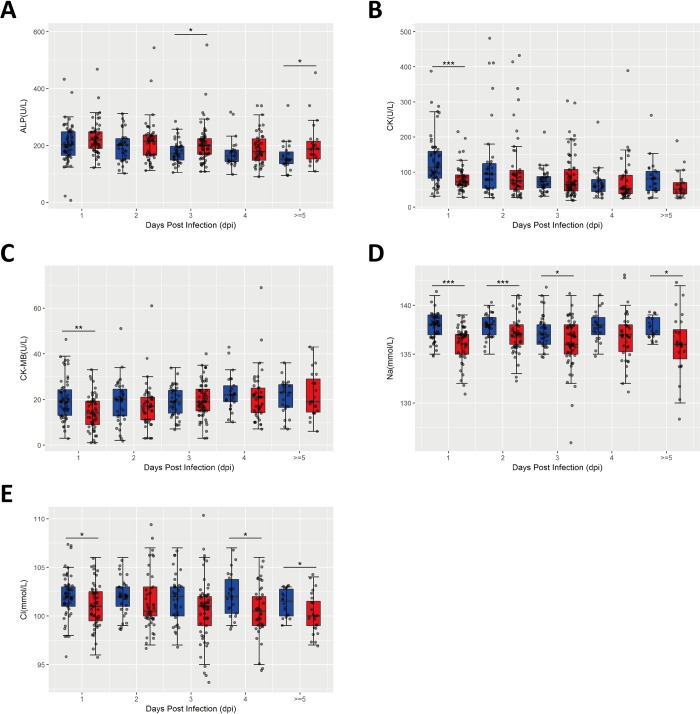
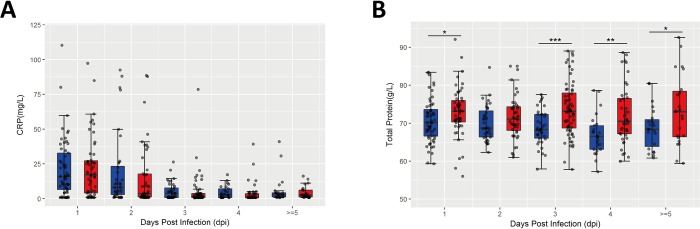
Hand, foot and mouth disease (HFMD) is an infectious disease that affects mostly children. The children with HFMD also have other immune and metabolic disorders. However, the association of these disorders with the severity of HFMD has not yet been determined. In this study, we used a case-control study design to examine the correlation of immune and metabolic disorders with HFMD development in children. 406 mild and severe patients were recruited and divided into different subgroups based on the number of days from the initial onset time to hospitalization (1, 2, 3, 4, and ≥5 days). Logistic regression model was used to define the predictors of severe HFMD. We found that the patients from rural area (OR = 1.76, 95% CI [1.192.63], P = 0.005) or with body temperature of >39°C (OR = 2.14, 95% CI [1.124.12], P = 0.022) exhibited higher risk for severe symptoms. In addition, the risk increased with the rise of body temperature by using a Chis-quare trend test (P = 0.01). We also found that a decreased number of eosinophils was an predictor of severe HFMD at 1, 2, 3,and 4 days post infection (dpi). Decreased levels of Na+, Cl-, and creatine kinase were also predictors at 1 and ≥5 dpi. On the other hand, elevated level of globulin was a predictor for severe HFMD at 4 dpi and ≥5 dpi, and the increased number of neutrophils or increased level of alkaline phosphatase posed risk for severe HFMD at 3 and ≥5 dpi. Our results suggested that rural living, hyperpyrexia, changes in the immune system that include the numbers of eosinophils and neutrophils and the levels of IgG and globulin, and metabolic alterations, such as the levels of alkaline phosphatase, Na+, Cl-, and creatine kinase in peripheral blood are predictors of severe HFMD.
手足口病(HFMD)是一种影响大多数儿童的传染病。患有 HFMD 的儿童还存在其他免疫和代谢紊乱。然而,这些疾病与 HFMD 严重程度的关联尚未确定。在这项研究中,我们使用病例对照研究设计来检查免疫和代谢紊乱与儿童 HFMD 发展之间的相关性。招募了 406 名轻症和重症患者,并根据从发病初始时间到住院的天数(1、2、3、4 和≥5 天)将其分为不同亚组。使用逻辑回归模型定义重症 HFMD 的预测因子。我们发现,来自农村地区的患者(OR=1.76,95%CI[1.192.63],P=0.005)或体温>39°C(OR=2.14,95%CI[1.124.12],P=0.022)的患者患重症症状的风险更高。此外,使用卡方趋势检验(P=0.01)发现,随着体温升高,风险也会增加。我们还发现,在感染后 1、2、3 和 4 天,嗜酸性粒细胞数量减少是重症 HFMD 的预测因子。在感染后 1 和≥5 天,Na+、Cl-和肌酸激酶水平降低也是重症 HFMD 的预测因子。另一方面,在感染后 4 和≥5 天,球蛋白水平升高是重症 HFMD 的预测因子,而在感染后 3 和≥5 天,中性粒细胞数量增加或碱性磷酸酶水平升高会增加患重症 HFMD 的风险。我们的研究结果表明,农村生活、高热、包括嗜酸性粒细胞和中性粒细胞数量以及 IgG 和球蛋白水平在内的免疫系统变化,以及代谢改变,如外周血碱性磷酸酶、Na+、Cl-和肌酸激酶水平,是重症 HFMD 的预测因子。