Pan Qing, Liu Fengfeng, Zhang Juying, Zhao Xing, Hu Yifan, Fan Chaonan, Yang Fan, Chang Zhaorui, Xiao Xiong
Department of Epidemiology and Biostatistics, West China School of Public Health and West China Fourth Hospital, Sichuan University, Chengdu, Sichuan, 610041, PR China.
Division of Infectious Disease & Key Laboratory of Surveillance and Early Warning on Infectious Disease, Chinese Center for Disease Control and Prevention, Beijing, 102206, PR China.
Environ Health Prev Med. 2021 Jan 8;26(1):4. doi: 10.1186/s12199-020-00927-9.
Severe hand-foot-and-mouth disease (HFMD) is a life-threatening contagious disease among young children and infants. Although enterovirus A71 has been well acknowledged to be the dominant cause of severe HFMD, there still remain other unidentified risk factors for severe HFMD. Previous studies mainly focused on identifying the individual-level risk factors from a clinical perspective, while rare studies aimed to clarify the association between regional-level risk factors and severe HFMD, which may be more important from a public health perspective.
We retrieved the clinical HFMD counts between 2008 and 2014 from the Chinese Center for Disease Control and Prevention, which were used to calculated the case-severity rate in 143 prefectural-level cities in mainland China. For each of those 143 cities, we further obtained city-specific characteristics from the China City Statistical Yearbook (social and economic variables) and the national meteorological monitoring system (meteorological variables). A Poisson regression model was then used to estimate the associations between city-specific characteristics (reduced by the principal component analysis to avoid multicollinearity) and the case-severity rate of HFMD. The above analysis was further stratified by age and gender to examine potential modifying effects and vulnerable sub-populations.
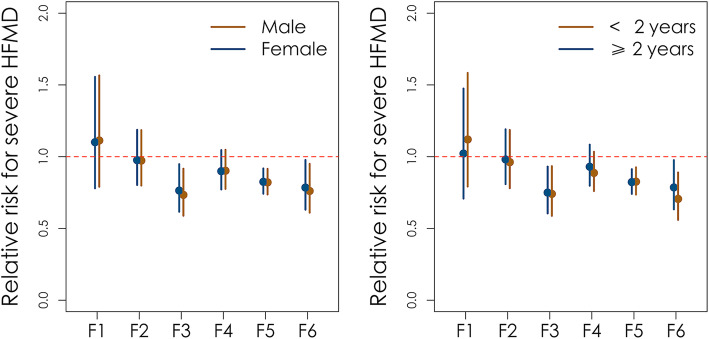
We found that the case-severity rate of HFMD varied dramatically between cities, ranging from 0 to 8.09%. Cities with high case-severity rates were mainly clustered in Central China. By relating the case-severity rate to city-specific characteristics, we found that both the principal component characterized by a high level of social and economic development (RR = 0.823, 95%CI 0.739, 0.916) and another that characterized by warm and humid climate (RR = 0.771, 95%CI 0.619, 0.960) were negatively associated with the case-severity rate of HFMD. These estimations were consistent across age and gender sub-populations.
Except for the type of infected pathogen, the case-severity rate of HFMD was closely related to city development and meteorological factor. These findings suggest that social and environmental factors may also play an important role in the progress of severe HFMD.
重症手足口病(HFMD)是一种威胁幼儿和婴儿生命的传染病。虽然肠道病毒A71已被公认为是重症手足口病的主要病因,但重症手足口病仍存在其他不明风险因素。以往研究主要从临床角度识别个体层面的风险因素,而很少有研究旨在阐明地区层面的风险因素与重症手足口病之间的关联,从公共卫生角度来看,这可能更为重要。
我们从中国疾病预防控制中心检索了2008年至2014年的临床手足口病病例数,用于计算中国大陆143个地级市的病例严重率。对于这143个城市中的每一个,我们进一步从《中国城市统计年鉴》(社会经济变量)和国家气象监测系统(气象变量)中获取特定城市的特征。然后使用泊松回归模型来估计特定城市特征(通过主成分分析进行降维以避免多重共线性)与手足口病病例严重率之间的关联。上述分析按年龄和性别进一步分层,以检查潜在的修正效应和脆弱亚人群。
我们发现,手足口病的病例严重率在不同城市之间差异很大,范围从0到8.09%。病例严重率高的城市主要集中在中国中部地区。通过将病例严重率与特定城市特征相关联,我们发现,以高水平社会经济发展为特征的主成分(RR = 0.823,95%CI 0.739,0.916)和以温暖潮湿气候为特征的另一个主成分(RR = 0.771,95%CI 0.619,0.960)均与手足口病病例严重率呈负相关。这些估计在年龄和性别亚人群中是一致的。
除了感染病原体的类型外,手足口病的病例严重率与城市发展和气象因素密切相关。这些发现表明,社会和环境因素在重症手足口病的进展中也可能发挥重要作用。