Dipartimento di Medicina Specialistica, Diagnostica e Sperimentale - DIMES - Istituto di Ematologia "L. e A. Seràgnoli", University of Bologna, Medical School, via Massarenti, 9, 40138, Bologna, Italy.
Istituto Scientifico Romagnolo per lo Studio e la Cura dei Tumori (IRST) Srl Istituto di Ricovero e Cura a Carattere Scientifico (IRCCS), via Piero Maroncelli 40, 47014, Meldola (FC), Italy.
J Exp Clin Cancer Res. 2019 May 23;38(1):216. doi: 10.1186/s13046-019-1197-9.
Chronic myeloid leukemia (CML) is a myeloproliferative disease caused by the constitutive tyrosine kinase (TK) activity of the BCR-ABL1 fusion protein. Accordingly, TK inhibitors have drastically changed the disease prognosis. However, persistence of the transformed hematopoiesis even in patients who achieved a complete response to TK inhibitors and the disease relapse upon therapy discontinuation represent a major obstacle to CML cure.
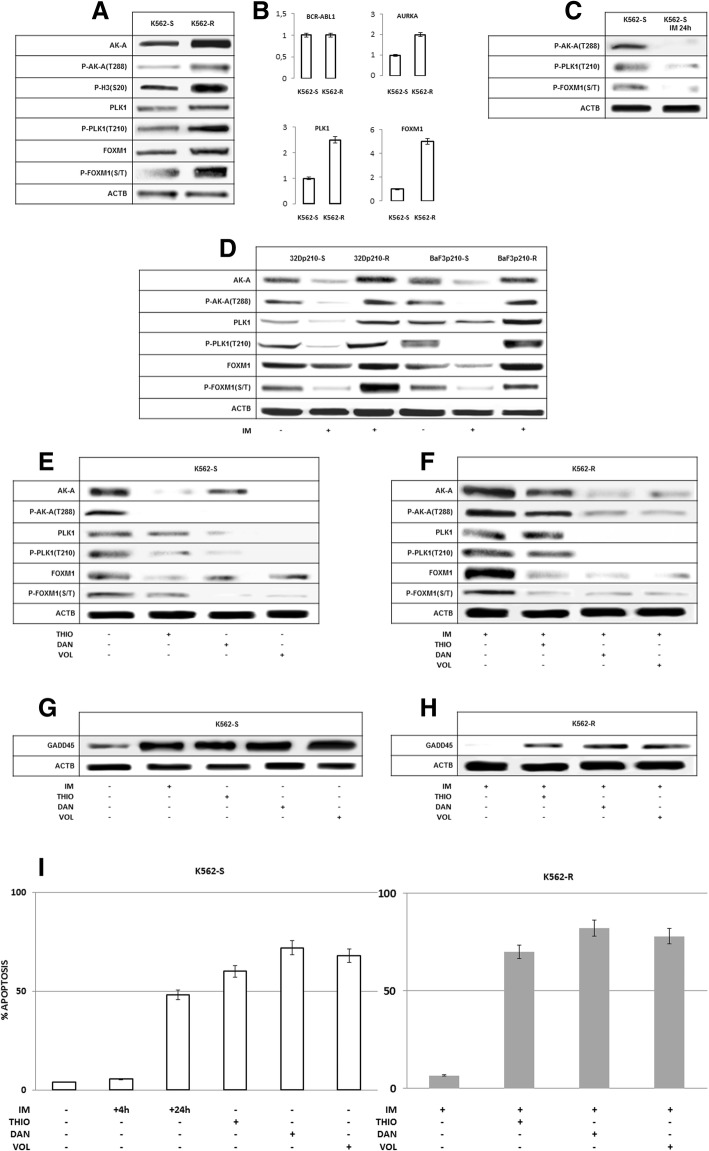
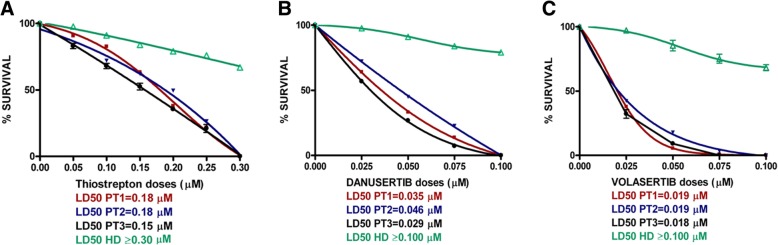
Thiostrepton, Danusertib and Volasertib were used to investigate the effects of FOXM1, AKA and Plk1 inhibition in K562-S and K562-R cells. Apoptotic cell death was quantified by annexin V/propidium iodide staining and flow cytometry. Quantitative reverse transcription (RT)-PCR was used to assess BCR-ABL1, FOXM1, PLK1 and AURKA expression. Protein expression and activation was assessed by Western Blotting (WB). Clonogenic assay were performed to confirm K562-R resistance to Imatinib and to evaluate cells sensitivity to the different drugs.
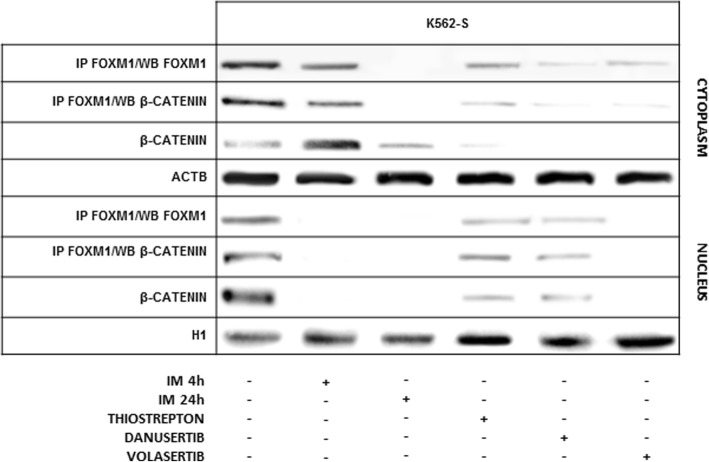
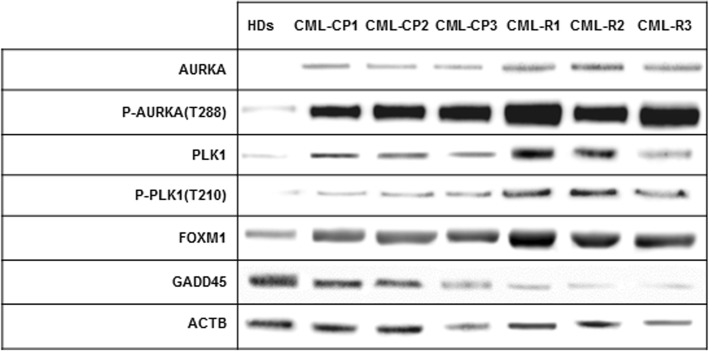
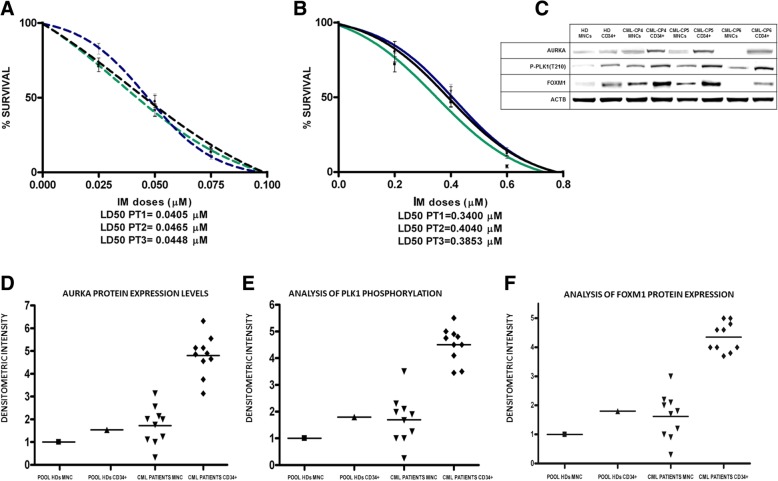
Here we proved that BCR-ABL1 TK-dependent hyper-activation of Aurora kinase A (AURKA)-Polo-like kinase 1 (PLK1)-FOXM1 axis is associated with the outcome of Imatinib (IM) resistance in an experimental model (K562 cell line) and bone marrow hematopoietic cells. Notably, such a biomolecular trait was detected in the putative leukemic stem cell (LSC) compartment characterized by a CD34+ phenotype. Constitutive phosphorylation of FOXM1 associated with BCR-ABL1 TK lets FOXM1 binding with β-catenin enables β-catenin nuclear import and recruitment to T cell factor/lymphoid enhancer-binding factor (TCF/LEF) transcription complex, hence supporting leukemic cell proliferation and survival. Lastly, the inhibition of single components of AURKA-PLK1-FOXM1 axis in response to specific drugs raises the expression of growth factor/DNA damage-inducible gene a (GADD45a), a strong inhibitor of AURKA and, as so, a critical component whose induction may mediate the eradication of leukemic clone.
Our conclusion is that AURKA, PLK1 and FOXM1 inhibition may be considered as a promising therapeutic approach to cure CML.
慢性髓性白血病(CML)是一种由 BCR-ABL1 融合蛋白组成型酪氨酸激酶(TK)活性引起的骨髓增生性疾病。相应地,TK 抑制剂极大地改变了疾病的预后。然而,即使在对 TK 抑制剂完全反应的患者中,转化的造血仍持续存在,并且在停药后疾病复发,这是 CML 治愈的主要障碍。
使用硫链丝菌素、达努塞替布和沃拉司替布来研究 FOXM1、AKA 和 Plk1 抑制在 K562-S 和 K562-R 细胞中的作用。通过 Annexin V/碘化丙啶染色和流式细胞术来量化凋亡细胞死亡。使用定量逆转录(RT)-PCR 来评估 BCR-ABL1、FOXM1、PLK1 和 AURKA 的表达。通过 Western Blotting(WB)来评估蛋白表达和激活。进行集落形成实验以确认 K562-R 对伊马替尼的耐药性,并评估细胞对不同药物的敏感性。
在这里,我们证明 BCR-ABL1 TK 依赖性 Aurora 激酶 A(AURKA)-Polo 样激酶 1(PLK1)-FOXM1 轴的过度激活与实验模型(K562 细胞系)和骨髓造血细胞中伊马替尼(IM)耐药的结果相关。值得注意的是,在以 CD34+ 表型为特征的假定白血病干细胞(LSC)隔室中检测到了这样的生物分子特征。FOXM1 与 BCR-ABL1 TK 的组成性磷酸化相关,允许 FOXM1 与 β-连环蛋白结合,使 β-连环蛋白核内输入并募集到 T 细胞因子/淋巴增强因子结合蛋白(TCF/LEF)转录复合物,从而支持白血病细胞的增殖和存活。最后,针对特定药物抑制 AURKA-PLK1-FOXM1 轴的单个成分会提高生长因子/DNA 损伤诱导基因 a(GADD45a)的表达,GADD45a 是 AURKA 的强抑制剂,因此,诱导 GADD45a 可能是消除白血病克隆的关键因素。
我们的结论是,AURKA、PLK1 和 FOXM1 的抑制可被视为治愈 CML 的一种有前途的治疗方法。