Department of Anesthesiology and Ophthalmology, The Second Affiliated Hospital, Zhejiang University School of Medicine, Hangzhou, China.
Department of Cell Biology, Yale University, New Haven, CT, USA.
Indian J Ophthalmol. 2019 Jun;67(6):922-927. doi: 10.4103/ijo.IJO_1905_18.
This study evaluated the efficacy of retrobulbar ropivacaine plus dexmedetomidine compared with systemic fentanyl in pediatric vitreoretinal (VR) surgery.
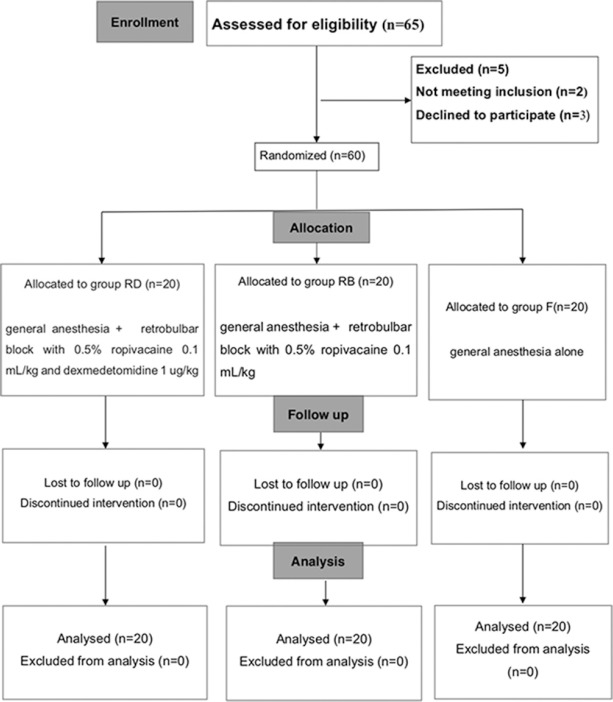
This prospective double-blind, randomized controlled study was performed in 60 children undergoing VR surgery, age from 2 to 7 years. After general anesthesia, the following procedure was administrated: (1) retrobulbar block with 0.5% ropivacaine plus dexmedetomidine 1 μg/kg (group RD, n = 20), (2) retrobulbar block with 0.5% ropivacaine (group RB, n = 20), and (3) control group with general anesthesia only (group F, n = 20). Hemodynamics, postoperative pain scores, anesthetics consumption (remifentanil, propofol, fentanyl), and emergence agitation were recorded.
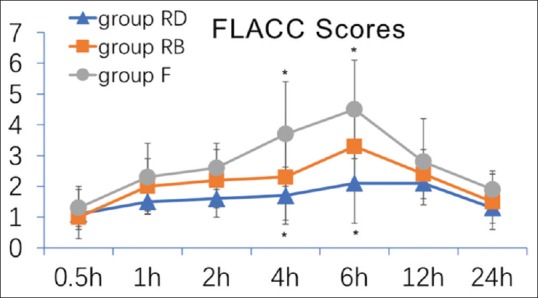
Respiratory depression was observed in 7 of the 20 patients in group F after the laryngeal mask airway was removed in the operating room, compared with none in groups RD and RB. All patients in group F required intraoperative rescue fentanyl (average intraoperative fentanyl consumption, 26.6 ± 12.6 μg per patient). Some rescue fentanyl was required in group RB (three patients required one dose of rescue fentanyl). Patients in group RD required none. Groups RD and RB reported lower pain scores than group F at 4 h postoperatively (RD group: P < 0.001; RB group: P =0.002); pain scores in group RD were lower than that in group F at 6 h postoperatively (P < 0.001).
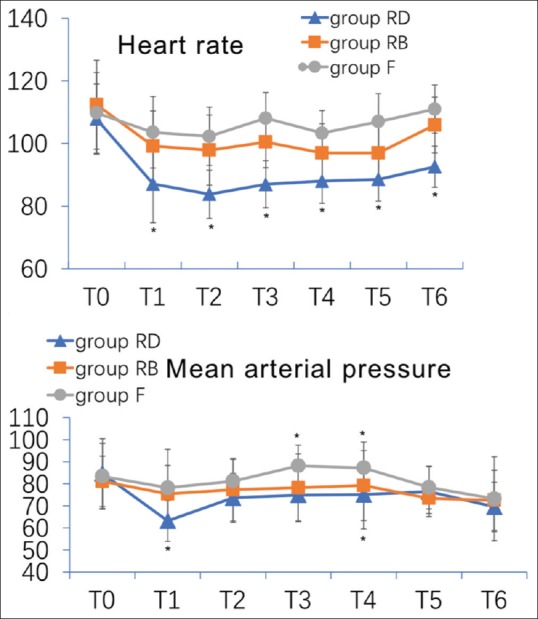
Retrobulbar dexmedetomidine as an adjuvant to ropivacaine is a safe and effective alternative to systemic fentanyl. This regimen provides better pain management, hemodynamic stability, and stress response suppression in pediatric VR surgery.
本研究评估了球后注射罗哌卡因联合右美托咪定与全身注射芬太尼在小儿玻璃体视网膜(VR)手术中的疗效。
这是一项前瞻性、双盲、随机对照研究,纳入了 60 名年龄在 2 至 7 岁之间接受 VR 手术的儿童。全身麻醉后,进行以下操作:(1)0.5%罗哌卡因联合右美托咪定 1μg/kg 行球后阻滞(RD 组,n=20),(2)0.5%罗哌卡因行球后阻滞(RB 组,n=20),(3)仅全身麻醉的对照组(F 组,n=20)。记录血流动力学、术后疼痛评分、麻醉药物用量(瑞芬太尼、丙泊酚、芬太尼)和苏醒期躁动。
在手术室拔除喉罩后,F 组有 7 名患者出现呼吸抑制,而 RD 组和 RB 组均无此现象。所有 F 组患者均需要术中追加芬太尼(平均术中芬太尼用量为 26.6±12.6μg/人)。RB 组有 3 名患者需要追加一剂芬太尼。RD 组无需追加芬太尼。与 F 组相比,RD 组和 RB 组患者在术后 4 小时的疼痛评分较低(RD 组:P<0.001;RB 组:P=0.002);RD 组在术后 6 小时的疼痛评分低于 F 组(P<0.001)。
球后注射右美托咪定作为罗哌卡因的佐剂是小儿 VR 手术中替代全身芬太尼的一种安全有效的方法。该方案可在小儿 VR 手术中提供更好的疼痛管理、血流动力学稳定和应激反应抑制。