Parvaee Pegah, Sarmadian Hossein, Khansarinejad Behzad, Amini Mahmood, Mondanizadeh Mahdieh
Department of Biotechnology and Molecular Medicine, Arak University of Medical Sciences, Arak, Iran. Email:
Infectious Diseases Research Center, Arak University of Medical Sciences, Arak, Iran.
Asian Pac J Cancer Prev. 2019 May 25;20(5):1421-1426. doi: 10.31557/APJCP.2019.20.5.1421.
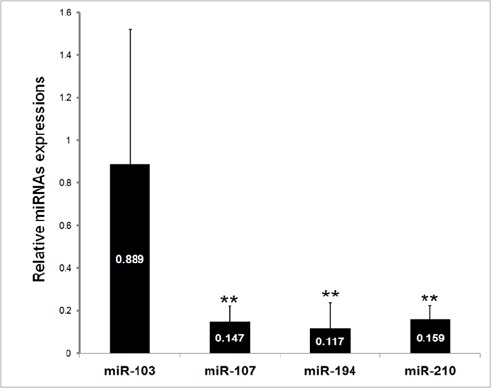
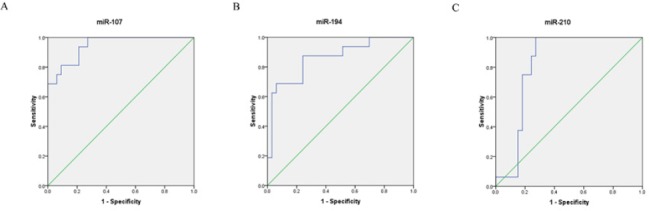
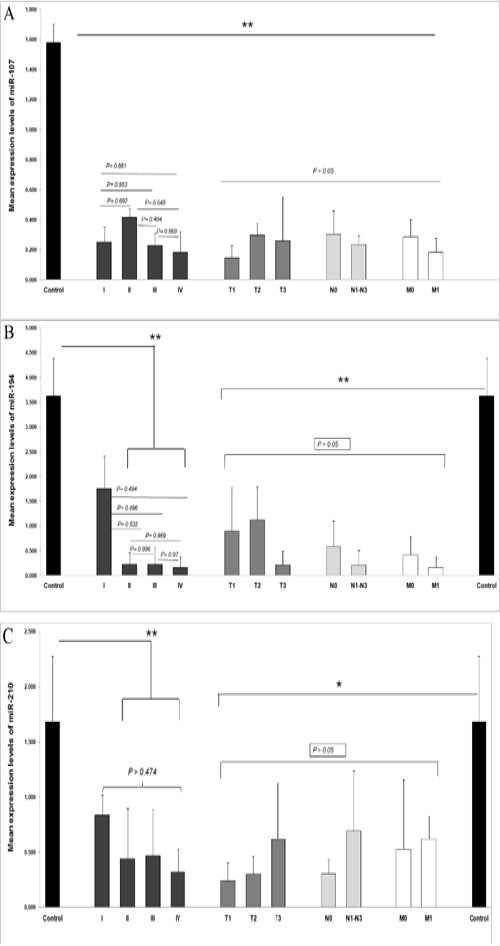
Background: Timely and sensitive diagnosis of gastric cancer is crucial for efficient treatment and survival of the patients. microRNAs have been considered as diagnostic biomarkers in different type of cancers including gastric cancer. In the present study, the expression profile of four microRNAs, miR-103, miR-107, miR-194 and miR-210 were evaluated in patients with intestinal-type of gastric cancer (IGC) in order to assess their diagnosis utility as noninvasive biomarkers. Methods: A total number of 100 plasma samples from patients with gastric cancer and healthy controls were obtained and total RNA was extracted using a commercial monophasic solution of phenol and guanidium thiocyanate. Reverse transcription (RT) reactions were performed by specific stem-loop RT primers and M-MuLV RT-enzyme. The expression patterns of microRNAs were assessed using reverse transcription quantitative real-time PCR (RT-qPCR) method and the expression of SNORD47 RNA was used as the reference for normalization. Results: The results indicate that the plasma levels of miR-107, miR-194, and miR-210 were significantly lower in patients. Receiver operating characteristic (ROC) curve analysis showed that the patients could be distinguished from healthy individuals at the cutoff levels of 0.504, 0.266, and 0.394 of miR-107, miR-194, and miR-210, respectively. On the other hand, the expression levels of these miRNAs were not significantly different in different clinicopathological stages of the disease. Conclusion: These findings suggest that the plasma levels of miR-107, miR-194 and miR-210 were downregulated in patients with ICG and propose these molecules as potential non-invasive biomarkers for detection of IGC.
胃癌的及时和灵敏诊断对于患者的有效治疗和生存至关重要。微小RNA已被视为包括胃癌在内的不同类型癌症的诊断生物标志物。在本研究中,评估了四种微小RNA(miR-103、miR-107、miR-194和miR-210)在肠型胃癌(IGC)患者中的表达谱,以评估它们作为非侵入性生物标志物的诊断效用。方法:从胃癌患者和健康对照中获取了总共100份血浆样本,并使用苯酚和硫氰酸胍的商业单相溶液提取总RNA。通过特异性茎环逆转录引物和M-MuLV逆转录酶进行逆转录(RT)反应。使用逆转录定量实时PCR(RT-qPCR)方法评估微小RNA的表达模式,并将SNORD47 RNA的表达用作标准化参考。结果:结果表明,患者血浆中miR-107、miR-194和miR-210的水平显著降低。受试者工作特征(ROC)曲线分析表明,分别在miR-107、miR-194和miR-210的截断水平为0.504、0.266和0.394时,可以将患者与健康个体区分开来。另一方面,这些微小RNA的表达水平在疾病的不同临床病理阶段没有显著差异。结论:这些发现表明,IGC患者血浆中miR-107、miR-194和miR-210的水平下调,并提出这些分子作为检测IGC的潜在非侵入性生物标志物。