Cen Xiaohong, Zhu Gengzhen, Yang Junjie, Yang Jianjun, Guo Jiayin, Jin Jiabing, Nandakumar Kutty Selva, Yang Wei, Yin Hang, Liu Shuwen, Cheng Kui
Guangdong Provincial Key Laboratory of New Drug Screening and Guangzhou Key Laboratory of Drug Research for Emerging Virus Prevention and Treatment School of Pharmaceutical Sciences Southern Medical University Guangzhou 510515 China.
Department of Thoracic Surgery Nanfang Hospital Southern Medical University Guangzhou 510515 China.
Adv Sci (Weinh). 2019 Mar 27;6(10):1802042. doi: 10.1002/advs.201802042. eCollection 2019 May 17.
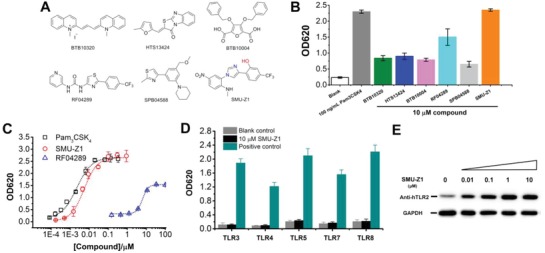
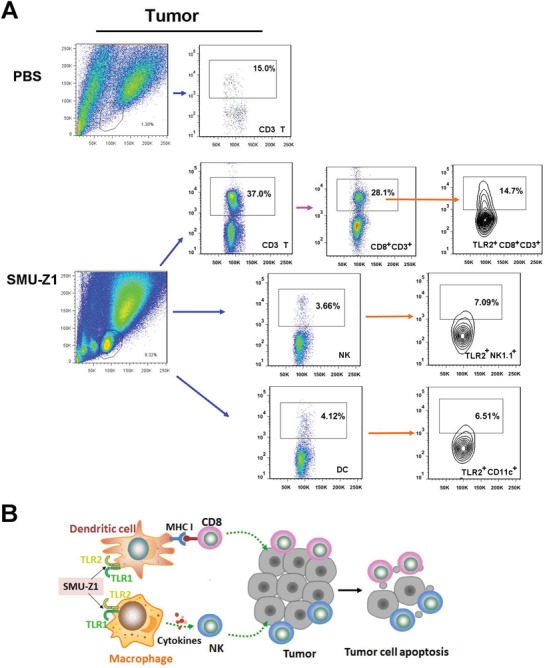
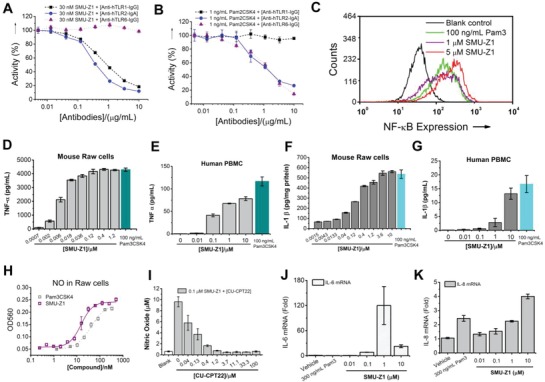
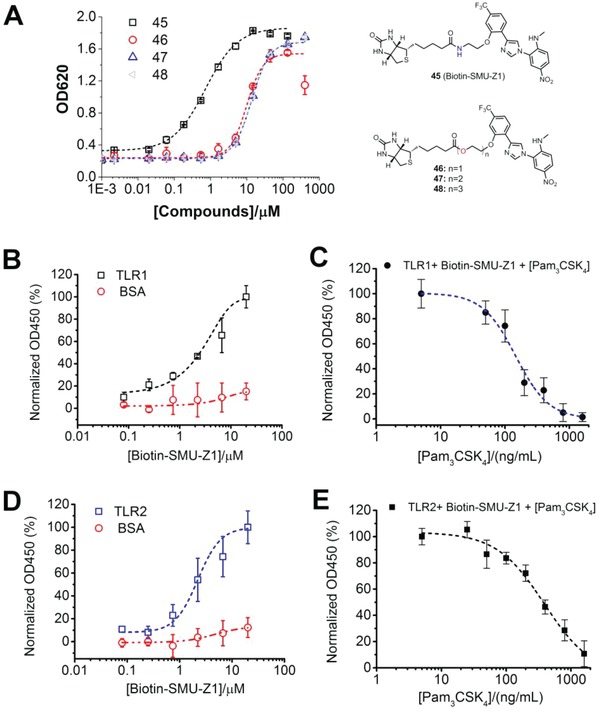
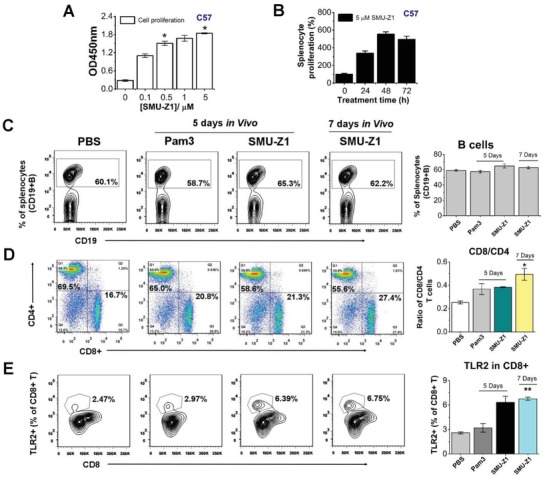
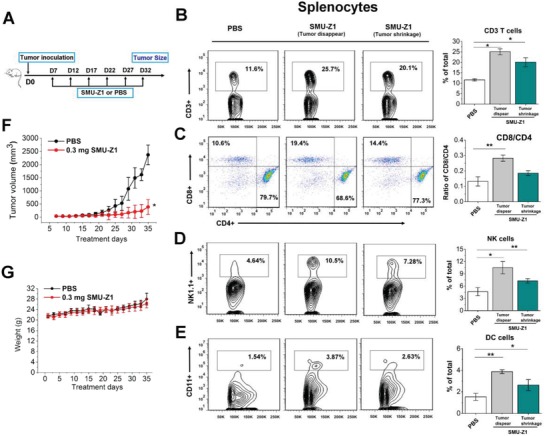
Toll-like receptor 2 (TLR2) expressed on antigen presenting cells evokes a series of critical cytokines, which favor the development of tumor-specific cytotoxic T lymphocytes (CTLs). Therefore, TLR2 represents an attractive cancer immunotherapeutic target. Here, a synthetic library of 14 000 compounds together with a series of newly developed compounds for NF-κB activation using HEK-Blue hTLR2 cells is initially screened. Following further screening in a variety of cells including HEK-Blue hTLRs reporter cells, murine, and human macrophage cell lines, a potent small molecule agonist 23 (SMU-Z1) is identified, which specifically activates TLR2 through its association with TLR1, with a EC of 4.88 ± 0.79 × 10 m. Toxicology studies, proinflammatory cytokines (e.g., TNF-α, IL-1β, IL-6, and nitric oxide) and target-protein based biophysical assays demonstrate the pharmacologically relevant characteristics of SMU-Z1. In addition, SMU-Z1 promotes murine splenocyte proliferation and upregulates the expression of CD8 T cells, NK cells and DCs, which results in a significant antitumor effect in a murine leukemia model. Finally, the induced tumors in three out of seven mice disappear after administration of SMU-Z1. Our studies thus identify a novel and potent TLR1/2 small molecule agonist, which displays promising immune adjuvant properties and antitumor immunity.
抗原呈递细胞上表达的Toll样受体2(TLR2)可引发一系列关键细胞因子,这些细胞因子有利于肿瘤特异性细胞毒性T淋巴细胞(CTL)的发育。因此,TLR2是一个有吸引力的癌症免疫治疗靶点。在此,最初使用HEK-Blue hTLR2细胞对一个包含14000种化合物的合成文库以及一系列新开发的用于激活NF-κB的化合物进行了筛选。在包括HEK-Blue hTLRs报告细胞、小鼠和人类巨噬细胞系在内的多种细胞中进一步筛选后,鉴定出一种强效小分子激动剂23(SMU-Z1),它通过与TLR1结合特异性激活TLR2,其EC为4.88±0.79×10 m。毒理学研究、促炎细胞因子(如TNF-α、IL-1β、IL-6和一氧化氮)以及基于靶蛋白的生物物理分析证明了SMU-Z1的药理学相关特性。此外,SMU-Z1促进小鼠脾细胞增殖并上调CD8 T细胞、NK细胞和DCs的表达,这在小鼠白血病模型中产生了显著的抗肿瘤作用。最后,在七只小鼠中有三只在给予SMU-Z1后肿瘤消失。因此,我们的研究鉴定出一种新型强效TLR1/2小分子激动剂,其具有有前景的免疫佐剂特性和抗肿瘤免疫力。