
基于人工毛细血管网络的体素内不相干运动 MRI 评估:双指数和相位分布模型分析。
Assessment of intravoxel incoherent motion MRI with an artificial capillary network: analysis of biexponential and phase-distribution models.
机构信息
Department of Radiology, University Hospital, LMU Munich, Munich, Germany.
Comprehensive Pneumology Center, German Center for Lung Research, Munich, Germany.
出版信息
Magn Reson Med. 2019 Oct;82(4):1373-1384. doi: 10.1002/mrm.27816. Epub 2019 May 26.
PURPOSE
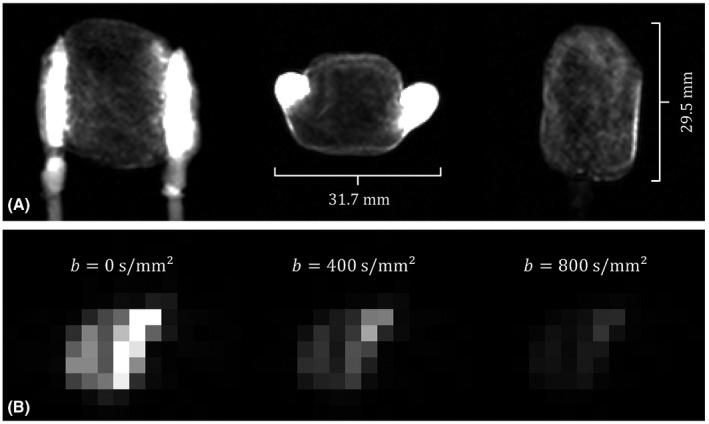
To systematically analyze intravoxel incoherent motion (IVIM) MRI in a perfusable capillary phantom closely matching the geometry of capillary beds in vivo and to compare the validity of the biexponential pseudo-diffusion and the recently introduced phase-distribution IVIM model.
METHODS
IVIM-MRI was performed at 12 different flow rates ( ) in a capillary phantom using 4 different DW-MRI sequences (2 with monopolar and 2 with flow-compensated diffusion-gradient schemes, with up to values between and ). Resulting parameters from the assessed IVIM models were compared to results from optical microscopy.
RESULTS
The acquired data were best described by a static and a flowing compartment modeled by the phase-distribution approach. The estimated signal fraction of the flowing compartment stayed approximately constant over the applied flow rates, with an average of in excellent agreement with optical microscopy ( ). The estimated average particle flow speeds showed a highly significant linear correlation to the applied flow. The estimated capillary segment length of approximately agreed well with optical microscopy measurements. Using the biexponential model, the signal fraction was substantially underestimated and displayed a strong dependence on the applied flow rate.
CONCLUSION
The constructed phantom facilitated the detailed investigation of IVIM-MRI methods. The results demonstrate that the phase-distribution method is capable of accurately characterizing fluid flow inside a capillary network. Parameters estimated using the biexponential model, specifically the perfusion fraction , showed a substantial bias because the model assumptions were not met by the underlying flow pattern.
目的
系统分析与活体毛细血管床几何形状相匹配的可灌注毛细血管体模中的体素内不相干运动(IVIM)MRI,并比较双指数伪扩散和最近引入的相位分布 IVIM 模型的有效性。
方法
在毛细血管体模中使用 4 种不同的 DW-MRI 序列(2 种单极扩散梯度方案和 2 种流动补偿扩散梯度方案),在 12 个不同的流速( )下进行 IVIM-MRI。比较评估 IVIM 模型的结果参数与光学显微镜的结果。
结果
所采集的数据最好用相位分布方法模拟的静态和流动隔室来描述。流动隔室的估计信号分数 大约在整个应用流速范围内保持不变,平均为 ,与光学显微镜( )非常吻合。估计的平均粒子流速 与施加的流速呈高度显著的线性相关。估计的毛细血管段长度约为 ,与光学显微镜测量值吻合良好。使用双指数模型,信号分数 被大大低估,并且对应用流速具有强烈的依赖性。
结论
所构建的体模有助于对 IVIM-MRI 方法进行详细研究。结果表明,相位分布方法能够准确地描述毛细血管网络内的流体流动。使用双指数模型估计的参数,特别是灌注分数 ,存在很大的偏差,因为模型假设不符合基础流动模式。




 Zotero 插件