Weidner Magdalena T, Lardenoije Roy, Eijssen Lars, Mogavero Floriana, De Groodt Lilian P M T, Popp Sandy, Palme Rupert, Förstner Konrad U, Strekalova Tatyana, Steinbusch Harry W M, Schmitt-Böhrer Angelika G, Glennon Jeffrey C, Waider Jonas, van den Hove Daniel L A, Lesch Klaus-Peter
Department of Psychiatry and Neuropsychology, School for Mental Health and Neuroscience (MHeNs), Maastricht University, Maastricht, Netherlands.
Division of Molecular Psychiatry, Laboratory of Translational Neuroscience, Center of Mental Health, Department of Psychiatry, University of Würzburg, Würzburg, Germany.
Front Neurosci. 2019 May 10;13:460. doi: 10.3389/fnins.2019.00460. eCollection 2019.
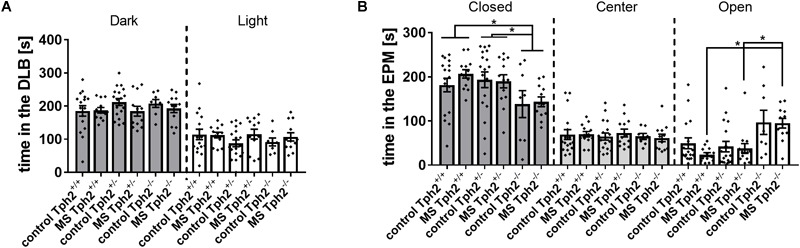
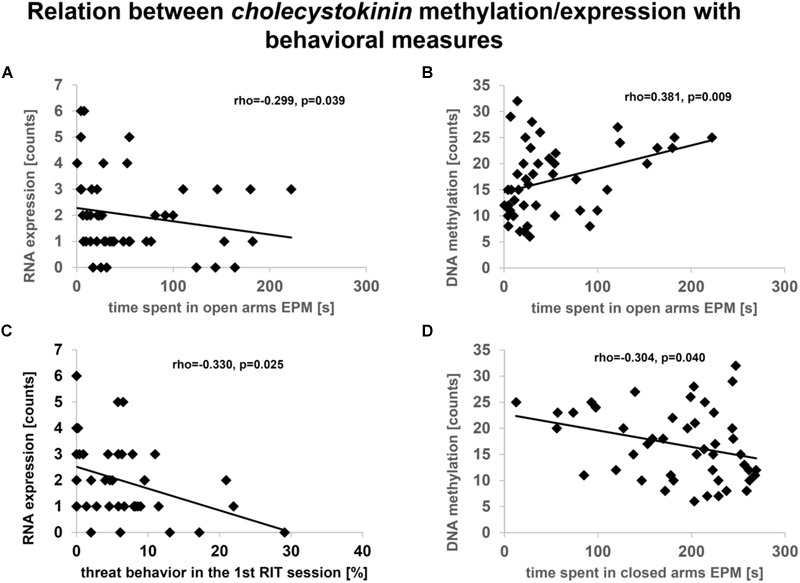
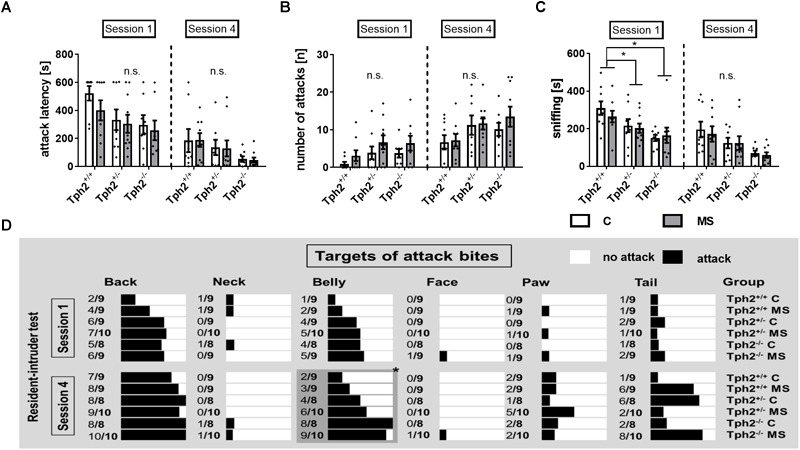
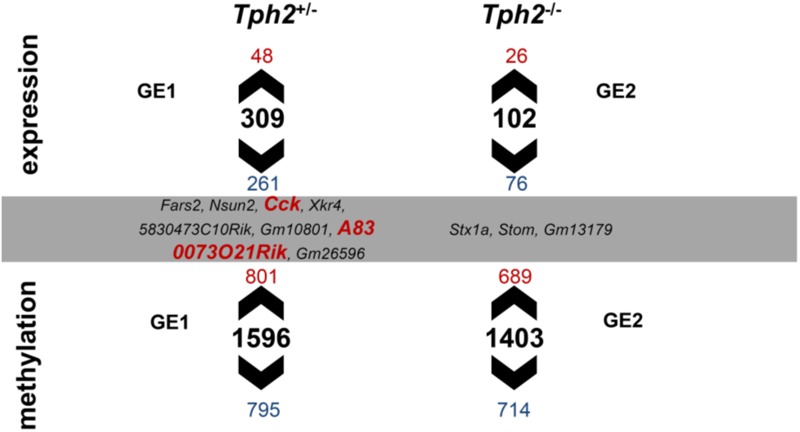
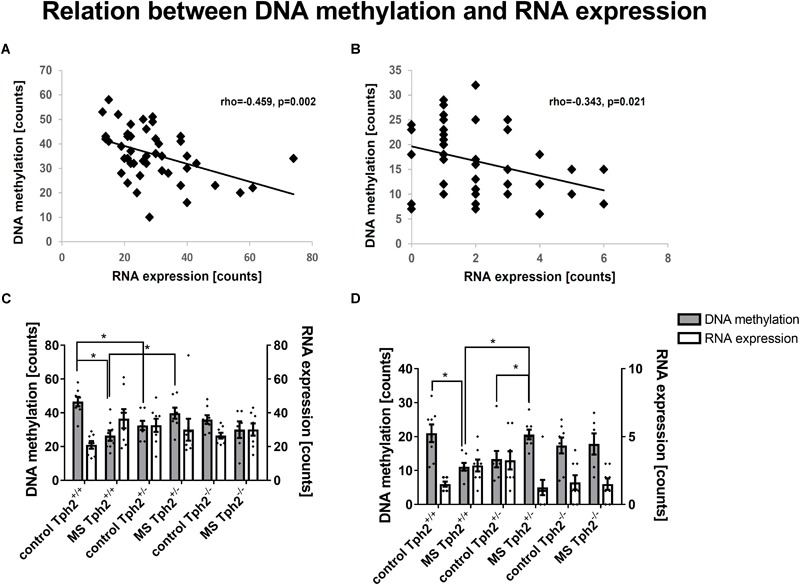
Converging evidence suggests a role of serotonin (5-hydroxytryptamine, 5-HT) and tryptophan hydroxylase 2 (TPH2), the rate-limiting enzyme of 5-HT synthesis in the brain, in modulating long-term, neurobiological effects of early-life adversity. Here, we aimed at further elucidating the molecular mechanisms underlying this interaction, and its consequences for socio-emotional behaviors, with a focus on anxiety and social interaction. In this study, adult, male null mutant ( ) and heterozygous ( ) mice, and their wildtype littermates ( ) were exposed to neonatal, maternal separation (MS) and screened for behavioral changes, followed by genome-wide RNA expression and DNA methylation profiling. In mice, brain 5-HT deficiency profoundly affected socio-emotional behaviors, i.e., decreased avoidance of the aversive open arms in the elevated plus-maze (EPM) as well as decreased prosocial and increased rule breaking behavior in the resident-intruder test when compared to their wildtype littermates. mice showed an ambiguous profile with context-dependent, behavioral responses. In the EPM they showed similar avoidance of the open arm but decreased prosocial and increased rule breaking behavior in the resident-intruder test when compared to their wildtype littermates. Notably, MS effects on behavior were subtle and depended on the genotype, in particular increasing the observed avoidance of EPM open arms in wildtype and mice when compared to their littermates. On the genomic level, the interaction of genotype with MS differentially affected the expression of numerous genes, of which a subset showed an overlap with DNA methylation profiles at corresponding loci. Remarkably, changes in methylation nearby and expression of the gene encoding cholecystokinin, which were inversely correlated to each other, were associated with variations in anxiety-related phenotypes. In conclusion, next to various behavioral alterations, we identified gene expression and DNA methylation profiles to be associated with TPH2 inactivation and its interaction with MS, suggesting a gene-by-environment interaction-dependent, modulatory function of brain 5-HT availability.
越来越多的证据表明,血清素(5-羟色胺,5-HT)和色氨酸羟化酶2(TPH2,大脑中5-HT合成的限速酶)在调节早期生活逆境的长期神经生物学效应中发挥作用。在此,我们旨在进一步阐明这种相互作用背后的分子机制及其对社会情感行为的影响,重点关注焦虑和社会互动。在本研究中,成年雄性纯合突变体( )和杂合子( )小鼠及其野生型同窝小鼠( )接受新生期母婴分离(MS)处理,并对行为变化进行筛选,随后进行全基因组RNA表达和DNA甲基化分析。在 小鼠中,与野生型同窝小鼠相比,大脑5-HT缺乏严重影响社会情感行为,即在高架十字迷宫(EPM)中对厌恶开放臂的回避减少,以及在定居者-入侵者试验中亲社会行为减少和违规行为增加。 小鼠表现出与环境相关的行为反应的模糊特征。在EPM中,与野生型同窝小鼠相比,它们对开放臂的回避相似,但在定居者-入侵者试验中亲社会行为减少和违规行为增加。值得注意的是,MS对行为的影响很微妙,并且取决于 基因型,特别是与它们的 同窝小鼠相比,野生型和 小鼠中观察到的对EPM开放臂的回避增加。在基因组水平上, 基因型与MS的相互作用差异影响众多基因的表达,其中一部分基因在相应位点与DNA甲基化图谱存在重叠。值得注意的是,胆囊收缩素编码基因附近的甲基化变化和表达变化相互呈负相关,与焦虑相关表型的变化有关。总之,除了各种行为改变外,我们还确定基因表达和DNA甲基化图谱与TPH2失活及其与MS的相互作用有关,表明大脑5-HT可用性存在基因-环境相互作用依赖性调节功能。