Department of Veterinary Pathobiology, Center for Veterinary Health Sciences, Oklahoma State University, Stillwater, OK, United States.
Front Immunol. 2019 May 7;10:1008. doi: 10.3389/fimmu.2019.01008. eCollection 2019.
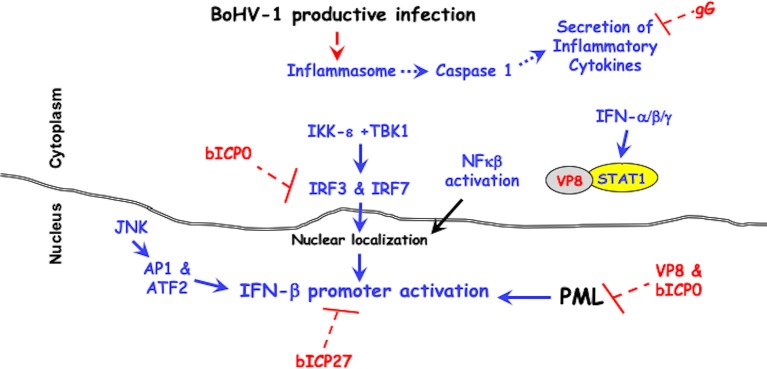
Infection of cattle by bovine herpesvirus 1 (BoHV-1) can culminate in upper respiratory tract disorders, conjunctivitis, or genital disorders. Infection also consistently leads to transient immune-suppression. BoHV-1 is the number one infectious agent in cattle that is associated with abortions in cattle. BoHV-1, as other α-herpesvirinae subfamily members, establishes latency in sensory neurons. Stressful stimuli, mimicked by the synthetic corticosteroid dexamethasone, consistently induce reactivation from latency in latently infected calves and rabbits. Increased corticosteroid levels due to stress have a two-pronged effect on reactivation from latency by: (1) directly stimulating viral gene expression and replication, and (2) impairing antiviral immune responses, thus enhancing virus spread and transmission. BoHV-1 encodes several proteins, bICP0, bICP27, gG, UL49.5, and VP8, which interfere with key antiviral innate immune responses in the absence of other viral genes. Furthermore, the ability of BoHV-1 to infect lymphocytes and induce apoptosis, in particular CD4+ T cells, has negative impacts on immune responses during acute infection. BoHV-1 induced immune-suppression can initiate the poly-microbial disorder known as bovine respiratory disease complex, which costs the US cattle industry more than one billion dollars annually. Furthermore, interfering with antiviral responses may promote viral spread to ovaries and the developing fetus, thus enhancing reproductive issues associated with BoHV-1 infection of cows or pregnant cows. The focus of this review is to describe the known mechanisms, direct and indirect, by which BoHV-1 interferes with antiviral immune responses during the course of infection.
牛疱疹病毒 1 型(BoHV-1)感染可导致牛上呼吸道疾病、结膜炎或生殖器疾病。感染还会导致短暂的免疫抑制。BoHV-1 是与牛流产相关的头号传染性病原体。BoHV-1 与其他α疱疹病毒亚科成员一样,在感觉神经元中建立潜伏。应激刺激物,如合成皮质类固醇地塞米松,可以模拟潜伏感染的小牛和兔子的潜伏性病毒再激活。应激导致的皮质类固醇水平升高对潜伏性病毒再激活有双重作用:(1)直接刺激病毒基因表达和复制,(2)损害抗病毒免疫反应,从而增强病毒的传播和传播。BoHV-1 编码几种蛋白质,包括 bICP0、bICP27、gG、UL49.5 和 VP8,这些蛋白质在没有其他病毒基因的情况下干扰关键的抗病毒先天免疫反应。此外,BoHV-1 感染淋巴细胞并诱导细胞凋亡,特别是 CD4+T 细胞,这对急性感染期间的免疫反应产生负面影响。BoHV-1 诱导的免疫抑制可引发多微生物疾病,即牛呼吸道疾病综合征,这给美国养牛业每年造成超过 10 亿美元的损失。此外,干扰抗病毒反应可能会促进病毒向卵巢和发育中的胎儿传播,从而加剧与 BoHV-1 感染奶牛或怀孕奶牛相关的生殖问题。本综述的重点是描述 BoHV-1 在感染过程中直接和间接干扰抗病毒免疫反应的已知机制。