Simon Bianca, Harrer Dennis C, Schuler-Thurner Beatrice, Schuler Gerold, Uslu Ugur
Department of Dermatology, Friedrich-Alexander-Universität Erlangen-Nürnberg (FAU), Universitätsklinikum Erlangen, 91054 Erlangen, Germany.
Division of Genetics, Department of Biology, Friedrich-Alexander-Universität Erlangen-Nürnberg (FAU), 91058 Erlangen, Germany.
Cancers (Basel). 2019 May 20;11(5):696. doi: 10.3390/cancers11050696.
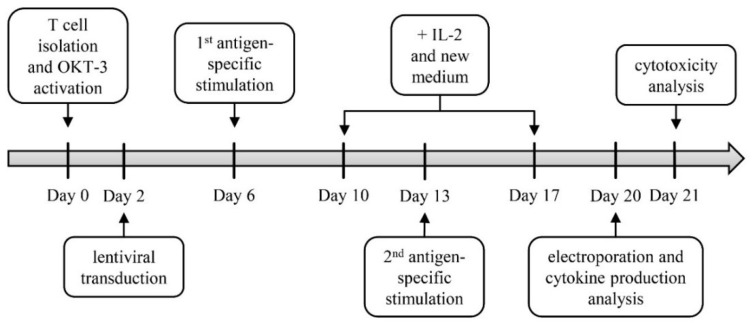
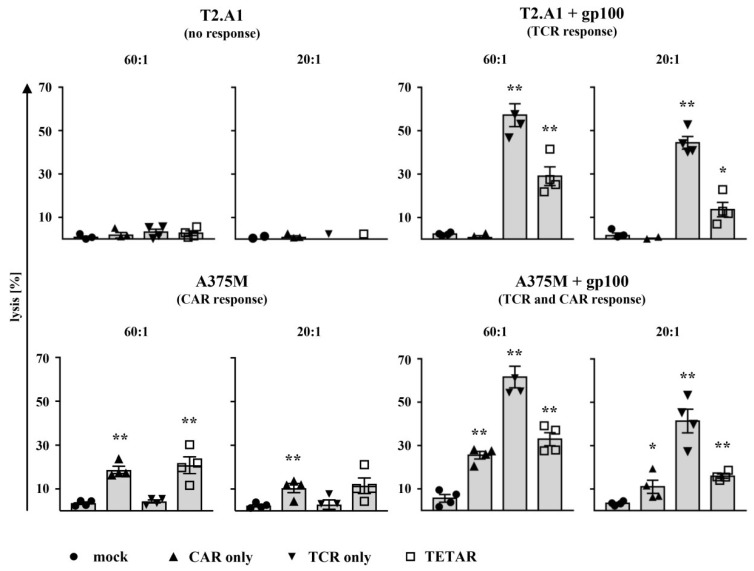
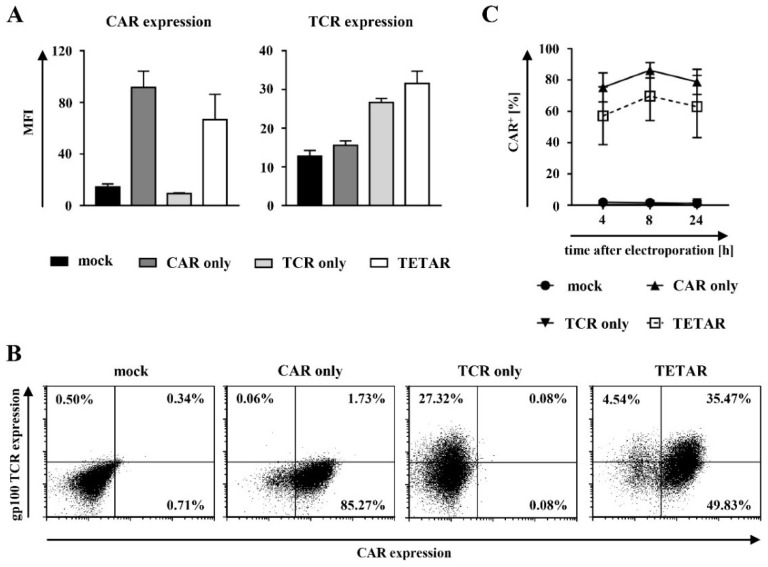
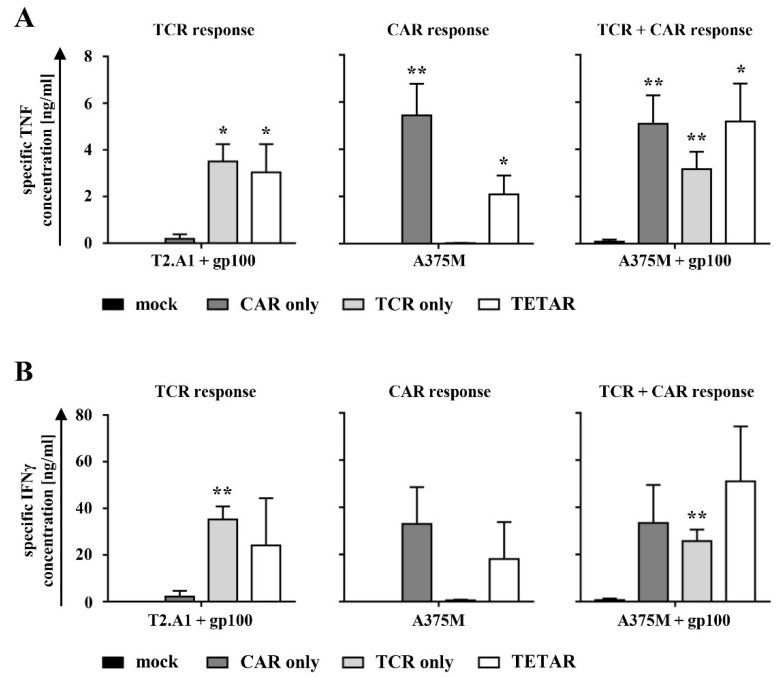
Tumor cells can develop immune escape mechanisms to bypass T cell recognition, e.g., antigen loss or downregulation of the antigen presenting machinery, which represents a major challenge in adoptive T cell therapy. To counteract these mechanisms, we transferred not only one, but two receptors into the same T cell to generate T cells expressing two additional receptors (TETARs). We generated these TETARs by lentiviral transduction of a gp100-specific T cell receptor (TCR) and subsequent electroporation of mRNA encoding a second-generation CSPG4-specific chimeric antigen receptor (CAR). Following pilot experiments to optimize the combined DNA- and RNA-based receptor transfer, the functionality of TETARs was compared to T cells either transfected with the TCR only or the CAR only. After transfection, TETARs clearly expressed both introduced receptors on their cell surface. When stimulated with tumor cells expressing either one of the antigens or both, TETARs were able to secrete cytokines and showed cytotoxicity. The confirmation that two antigen-specific receptors can be functionally combined using two different methods to introduce each receptor into the same T cell opens new possibilities and opportunities in cancer immunotherapy. For further evaluation, the use of these TETARs in appropriate animal models will be the next step towards a potential clinical use in cancer patients.
肿瘤细胞可发展免疫逃逸机制以绕过T细胞识别,例如抗原丢失或抗原呈递机制的下调,这是过继性T细胞疗法面临的一项重大挑战。为对抗这些机制,我们不仅将一种受体,而是将两种受体转入同一T细胞,以生成表达两种额外受体的T细胞(TETAR)。我们通过慢病毒转导gp100特异性T细胞受体(TCR)并随后电穿孔编码第二代CSPG4特异性嵌合抗原受体(CAR)的mRNA来生成这些TETAR。在进行优化基于DNA和RNA的受体联合转移的预实验后,将TETAR的功能与仅转染TCR或仅转染CAR的T细胞进行了比较。转染后,TETAR在其细胞表面明显表达两种导入的受体。当用表达任一抗原或两种抗原的肿瘤细胞刺激时,TETAR能够分泌细胞因子并表现出细胞毒性。确认可以使用两种不同方法将两种抗原特异性受体功能性地组合到同一T细胞中,这为癌症免疫治疗开辟了新的可能性和机会。为进行进一步评估,在合适的动物模型中使用这些TETAR将是迈向癌症患者潜在临床应用的下一步。