• 文献检索
  • 文档翻译
  • 深度研究
  • 学术资讯
  • Suppr Zotero 插件Zotero 插件
  • 邀请有礼
  • 套餐&价格
  • 历史记录
应用&插件
Suppr Zotero 插件Zotero 插件浏览器插件Mac 客户端Windows 客户端微信小程序
定价
高级版会员购买积分包购买API积分包
服务
文献检索文档翻译深度研究API 文档MCP 服务
关于我们
关于 Suppr公司介绍联系我们用户协议隐私条款
关注我们

Suppr 超能文献

核心技术专利:CN118964589B侵权必究
粤ICP备2023148730 号-1Suppr @ 2026

文献检索

告别复杂PubMed语法,用中文像聊天一样搜索,搜遍4000万医学文献。AI智能推荐,让科研检索更轻松。

立即免费搜索

文件翻译

保留排版,准确专业,支持PDF/Word/PPT等文件格式,支持 12+语言互译。

免费翻译文档

深度研究

AI帮你快速写综述,25分钟生成高质量综述,智能提取关键信息,辅助科研写作。

立即免费体验

双靶点 CD19/CD20 CAR 慢病毒载体驱动白血病细胞系的靶抗原调节和非靶抗原调节。

A tandem CD19/CD20 CAR lentiviral vector drives on-target and off-target antigen modulation in leukemia cell lines.

机构信息

Lentigen Technology, Inc., 910 Clopper Rd., Gaithersburg, MD 20878 USA.

Miltenyi Biotec GmbH, Bergisch Gladbach, Germany.

出版信息

J Immunother Cancer. 2017 May 16;5:42. doi: 10.1186/s40425-017-0246-1. eCollection 2017.

DOI:10.1186/s40425-017-0246-1
PMID:28515942
原文链接:https://pmc.ncbi.nlm.nih.gov/articles/PMC5433150/
Abstract

BACKGROUND

Clinical success with chimeric antigen receptor (CAR)- based immunotherapy for leukemia has been accompanied by the associated finding that antigen-escape variants of the disease are responsible for relapse. To target hematologic malignancies with a chimeric antigen receptor (CAR) that targets two antigens with a single vector, and thus potentially lessen the chance of leukemic escape mutations, a tandem-CAR approach was investigated.

METHODS

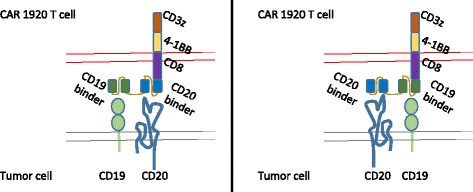
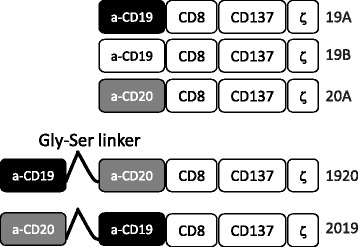
Antigen binding domains from the FMC63 (anti-CD19) and Leu16 (anti-CD20) antibodies were linked in differing configurations to transmembrane and T cell signaling domains to create tandem-CARs. Expression on the surface of primary human T cells was induced by transduction with a single lentiviral vector (LV) encoding the tandem-CAR. Tandem-CARs were compared to single antigen targeting CARs in vitro and in vivo, and to an admixture of transduced cells expressing each CAR in vivo in immunodeficient (NSG) disease-bearing mice.

RESULTS

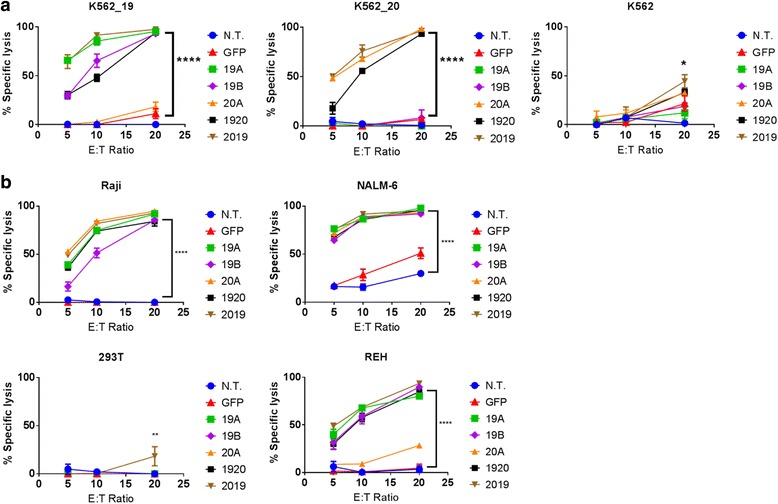
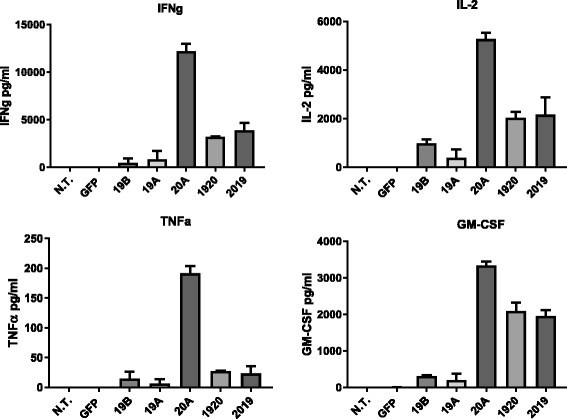
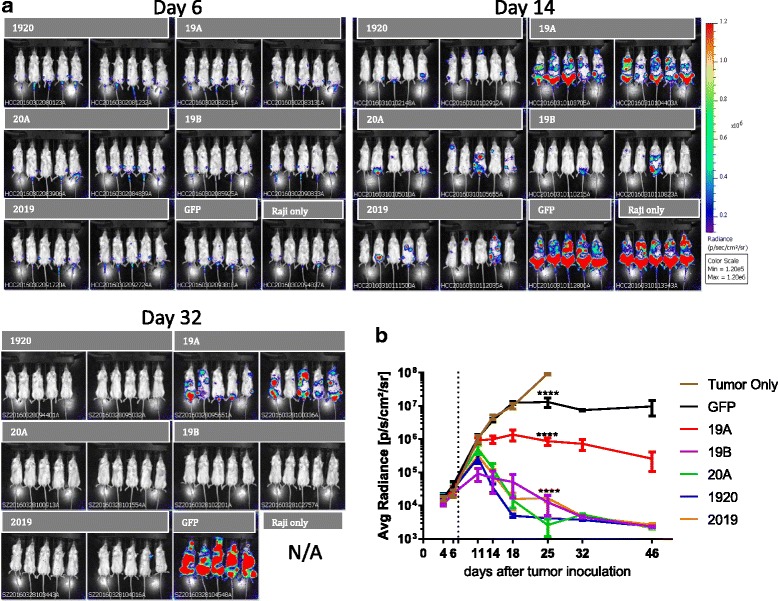
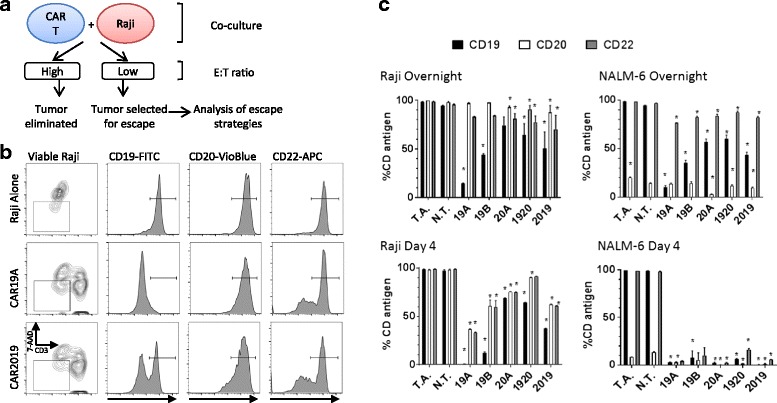
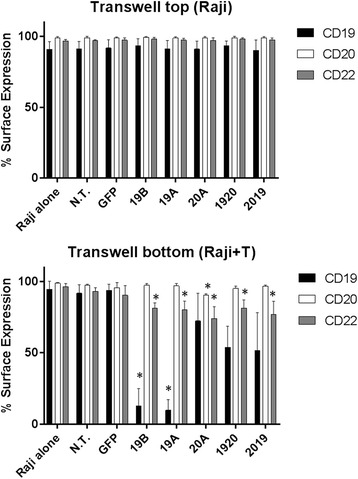
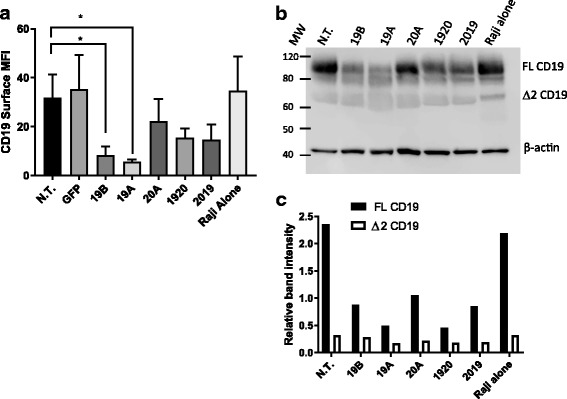
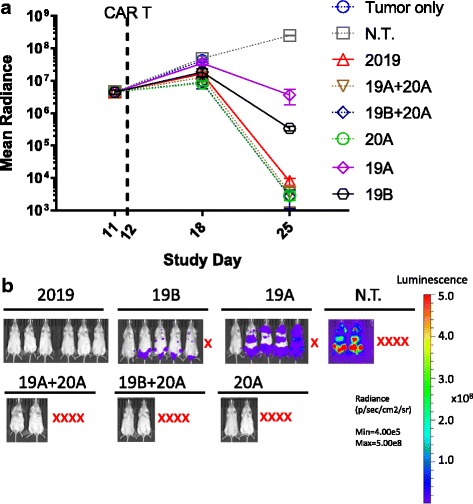
Tandem constructs efficient killed the Raji leukemia cell line both in vitro and in vivo. Tandem CARs generated less cytokine than the CD20 CAR, but similar to CD19 CARs, on their own. In co-culture experiments at low effector to target ratios with both single- and tandem- CAR-T cells, a rapid down-modulation of full-length CD19 expression was seen on leukemia targets. There also was a partial down-modulation of CD22, and to a lesser degree, of CD20. Our data also highlight the extreme sensitivity of the NALM-6 cell line to general lymphocyte-mediated cytotoxicity. While single and tandem constructs were effective in vivo in a standard setting, in a high-disease burden setting, the tandem CAR proved both effective and less toxic than an admixture of transduced T cell populations expressing single CARs.

CONCLUSION

Tandem CARs are equally effective in standard disease models to single antigen specificity CARs, and may be both more effective and less toxic in a higher disease burden setting. This may be due to optimized cell killing with more moderate cytokine production. The rapid co-modulation of CD19, CD20, and CD22 may account for the ability to rapidly evolve escape mutants by selecting for leukemic clones that not require these target antigens for continued expansion.

摘要

背景

嵌合抗原受体 (CAR) 为基础的免疫疗法治疗白血病取得了临床成功,但随之而来的是发现疾病的抗原逃逸变体是导致复发的原因。为了用一种嵌合抗原受体 (CAR) 靶向两种抗原,从而有可能减少白血病逃逸突变的机会,研究了串联 CAR 方法。

方法

将 FMC63(抗 CD19)和 Leu16(抗 CD20)抗体的抗原结合域以不同的构型连接到跨膜和 T 细胞信号域,以创建串联-CAR。通过转导单个编码串联-CAR 的慢病毒载体 (LV) 诱导原发性人 T 细胞表面表达。在体外和体内将串联-CAR 与单抗原靶向 CAR 进行比较,并在免疫缺陷 (NSG) 荷瘤小鼠体内与表达每种 CAR 的转导细胞混合物进行比较。

结果

串联结构在体外和体内都有效地杀死了 Raji 白血病细胞系。与 CD20 CAR 相比,串联 CAR 本身产生的细胞因子较少,但与 CD19 CAR 相似。在与单和串联-CAR-T 细胞以低效应器与靶标比例的共培养实验中,白血病靶标上的全长 CD19 表达迅速下调。CD22 也有部分下调,程度较轻的是 CD20。我们的数据还突出了 NALM-6 细胞系对一般淋巴细胞介导的细胞毒性的极端敏感性。虽然单和串联构建物在标准设置中在体内有效,但在高疾病负担设置中,串联 CAR 既有效又比表达单 CAR 的转导 T 细胞群体混合物毒性更小。

结论

串联 CAR 在标准疾病模型中与单抗原特异性 CAR 同样有效,在更高疾病负担的情况下可能更有效且毒性更小。这可能是由于更适度的细胞因子产生导致优化的细胞杀伤。CD19、CD20 和 CD22 的快速共调节可能解释了为什么通过选择不需要这些靶抗原继续扩增的白血病克隆,能够快速进化逃逸突变体。
https://cdn.ncbi.nlm.nih.gov/pmc/blobs/7ee3/5433150/890daa86b656/40425_2017_246_Fig11_HTML.jpg
https://cdn.ncbi.nlm.nih.gov/pmc/blobs/7ee3/5433150/2d6e947bf83c/40425_2017_246_Fig1_HTML.jpg
https://cdn.ncbi.nlm.nih.gov/pmc/blobs/7ee3/5433150/13c71115ca23/40425_2017_246_Fig2_HTML.jpg
https://cdn.ncbi.nlm.nih.gov/pmc/blobs/7ee3/5433150/50b445b56e5d/40425_2017_246_Fig3_HTML.jpg
https://cdn.ncbi.nlm.nih.gov/pmc/blobs/7ee3/5433150/dea32ba98a81/40425_2017_246_Fig4_HTML.jpg
https://cdn.ncbi.nlm.nih.gov/pmc/blobs/7ee3/5433150/f8348645faa8/40425_2017_246_Fig5_HTML.jpg
https://cdn.ncbi.nlm.nih.gov/pmc/blobs/7ee3/5433150/7248c21c90e2/40425_2017_246_Fig6_HTML.jpg
https://cdn.ncbi.nlm.nih.gov/pmc/blobs/7ee3/5433150/3a2b639428fd/40425_2017_246_Fig7_HTML.jpg
https://cdn.ncbi.nlm.nih.gov/pmc/blobs/7ee3/5433150/8759443e93f1/40425_2017_246_Fig8_HTML.jpg
https://cdn.ncbi.nlm.nih.gov/pmc/blobs/7ee3/5433150/bb0d2bf0cb73/40425_2017_246_Fig9_HTML.jpg
https://cdn.ncbi.nlm.nih.gov/pmc/blobs/7ee3/5433150/cba31fccfe55/40425_2017_246_Fig10_HTML.jpg
https://cdn.ncbi.nlm.nih.gov/pmc/blobs/7ee3/5433150/890daa86b656/40425_2017_246_Fig11_HTML.jpg
https://cdn.ncbi.nlm.nih.gov/pmc/blobs/7ee3/5433150/2d6e947bf83c/40425_2017_246_Fig1_HTML.jpg
https://cdn.ncbi.nlm.nih.gov/pmc/blobs/7ee3/5433150/13c71115ca23/40425_2017_246_Fig2_HTML.jpg
https://cdn.ncbi.nlm.nih.gov/pmc/blobs/7ee3/5433150/50b445b56e5d/40425_2017_246_Fig3_HTML.jpg
https://cdn.ncbi.nlm.nih.gov/pmc/blobs/7ee3/5433150/dea32ba98a81/40425_2017_246_Fig4_HTML.jpg
https://cdn.ncbi.nlm.nih.gov/pmc/blobs/7ee3/5433150/f8348645faa8/40425_2017_246_Fig5_HTML.jpg
https://cdn.ncbi.nlm.nih.gov/pmc/blobs/7ee3/5433150/7248c21c90e2/40425_2017_246_Fig6_HTML.jpg
https://cdn.ncbi.nlm.nih.gov/pmc/blobs/7ee3/5433150/3a2b639428fd/40425_2017_246_Fig7_HTML.jpg
https://cdn.ncbi.nlm.nih.gov/pmc/blobs/7ee3/5433150/8759443e93f1/40425_2017_246_Fig8_HTML.jpg
https://cdn.ncbi.nlm.nih.gov/pmc/blobs/7ee3/5433150/bb0d2bf0cb73/40425_2017_246_Fig9_HTML.jpg
https://cdn.ncbi.nlm.nih.gov/pmc/blobs/7ee3/5433150/cba31fccfe55/40425_2017_246_Fig10_HTML.jpg
https://cdn.ncbi.nlm.nih.gov/pmc/blobs/7ee3/5433150/890daa86b656/40425_2017_246_Fig11_HTML.jpg

相似文献

1
A tandem CD19/CD20 CAR lentiviral vector drives on-target and off-target antigen modulation in leukemia cell lines.双靶点 CD19/CD20 CAR 慢病毒载体驱动白血病细胞系的靶抗原调节和非靶抗原调节。
J Immunother Cancer. 2017 May 16;5:42. doi: 10.1186/s40425-017-0246-1. eCollection 2017.
2
T Cells Expressing CD19/CD20 Bispecific Chimeric Antigen Receptors Prevent Antigen Escape by Malignant B Cells.表达 CD19/CD20 双特异性嵌合抗原受体的 T 细胞可防止恶性 B 细胞发生抗原逃逸。
Cancer Immunol Res. 2016 Jun;4(6):498-508. doi: 10.1158/2326-6066.CIR-15-0231. Epub 2016 Apr 8.
3
Development of a compact bidirectional promoter-driven dual chimeric antigen receptor (CAR) construct targeting CD19 and CD20 in the Sleeping Beauty (SB) transposon system.开发一种紧凑的双向启动子驱动的双嵌合抗原受体(CAR)构建体,靶向 Sleeping Beauty(SB)转座子系统中的 CD19 和 CD20。
J Immunother Cancer. 2024 Apr 27;12(4):e008555. doi: 10.1136/jitc-2023-008555.
4
CD20-CD19 Bispecific CAR T Cells for the Treatment of B-Cell Malignancies.CD20-CD19 双特异性 CAR T 细胞治疗 B 细胞恶性肿瘤。
Hum Gene Ther. 2017 Dec;28(12):1147-1157. doi: 10.1089/hum.2017.126.
5
Construction of a new anti-CD19 chimeric antigen receptor and the anti-leukemia function study of the transduced T cells.新型抗CD19嵌合抗原受体的构建及转导T细胞的抗白血病功能研究
Oncotarget. 2016 Mar 1;7(9):10638-49. doi: 10.18632/oncotarget.7079.
6
Function of Novel Anti-CD19 Chimeric Antigen Receptors with Human Variable Regions Is Affected by Hinge and Transmembrane Domains.新型含人源可变区的抗 CD19 嵌合抗原受体的功能受铰链和跨膜结构域影响。
Mol Ther. 2017 Nov 1;25(11):2452-2465. doi: 10.1016/j.ymthe.2017.07.013. Epub 2017 Jul 27.
7
CD19/CD20 dual-targeted chimeric antigen receptor-engineered natural killer cells exhibit improved cytotoxicity against acute lymphoblastic leukemia.CD19/CD20 双靶点嵌合抗原受体工程化自然杀伤细胞对急性淋巴细胞白血病显示出增强的细胞毒性。
J Transl Med. 2024 Mar 13;22(1):274. doi: 10.1186/s12967-024-04990-6.
8
Fully human CD19-specific chimeric antigen receptors for T-cell therapy.用于T细胞治疗的全人源CD19特异性嵌合抗原受体。
Leukemia. 2017 Oct;31(10):2191-2199. doi: 10.1038/leu.2017.57. Epub 2017 Feb 16.
9
High Cytotoxic Efficiency of Lentivirally and Alpharetrovirally Engineered CD19-Specific Chimeric Antigen Receptor Natural Killer Cells Against Acute Lymphoblastic Leukemia.慢病毒和阿尔法逆转录病毒工程化 CD19 特异性嵌合抗原受体自然杀伤细胞对急性淋巴细胞白血病的高效细胞毒性。
Front Immunol. 2020 Jan 24;10:3123. doi: 10.3389/fimmu.2019.03123. eCollection 2019.
10
Treatment of advanced leukemia in mice with mRNA engineered T cells.用 mRNA 工程化 T 细胞治疗小鼠晚期白血病。
Hum Gene Ther. 2011 Dec;22(12):1575-86. doi: 10.1089/hum.2011.070. Epub 2011 Sep 23.

引用本文的文献

1
Optimal pairing of binder and co-stimulatory domains improves dual CART cell efficacy.结合域与共刺激域的最佳配对可提高双特异性嵌合抗原受体(CART)细胞的疗效。
Mol Ther. 2025 Aug 5. doi: 10.1016/j.ymthe.2025.08.002.
2
CD19-ReTARG: A Novel Fusion Protein for Physiological Engagement of Anti-CMV Cytotoxic T Cells Against CD19-Expressing Malignancies.CD19靶向重定向:一种用于抗巨细胞病毒细胞毒性T细胞生理性靶向表达CD19的恶性肿瘤的新型融合蛋白。
Cancers (Basel). 2025 Jul 10;17(14):2300. doi: 10.3390/cancers17142300.
3
Transduction of γδ T cells with Baboon envelope pseudotyped lentiviral vector encoding chimeric antigen receptors for translational and clinical applications.

本文引用的文献

1
Dual CD19 and CD123 targeting prevents antigen-loss relapses after CD19-directed immunotherapies.双重靶向CD19和CD123可预防CD19导向免疫疗法后的抗原丢失复发。
J Clin Invest. 2016 Oct 3;126(10):3814-3826. doi: 10.1172/JCI87366. Epub 2016 Aug 29.
2
CD19 CAR immune pressure induces B-precursor acute lymphoblastic leukaemia lineage switch exposing inherent leukaemic plasticity.CD19 CAR 免疫压力诱导 B 前体细胞急性淋巴细胞白血病谱系转换,揭示内在白血病可塑性。
Nat Commun. 2016 Jul 27;7:12320. doi: 10.1038/ncomms12320.
3
CD19 chimeric antigen receptor (CD19 CAR)-redirected adoptive T-cell immunotherapy for the treatment of relapsed or refractory B-cell Non-Hodgkin's Lymphomas.
用编码嵌合抗原受体的狒狒包膜假型慢病毒载体转导γδ T细胞,用于转化研究和临床应用。
Front Immunol. 2025 Jun 6;16:1548630. doi: 10.3389/fimmu.2025.1548630. eCollection 2025.
4
An optimizing lentiviral titer determination assay based on Raji cells.一种基于Raji细胞的优化慢病毒滴度测定方法。
Am J Transl Res. 2025 May 15;17(5):3939-3950. doi: 10.62347/ZTKM3637. eCollection 2025.
5
Efficacy and safety of CD19 combined with CD22 or CD20 chimeric antigen receptor T-cell therapy for hematological malignancies.CD19联合CD22或CD20嵌合抗原受体T细胞疗法治疗血液系统恶性肿瘤的疗效和安全性。
Front Immunol. 2025 May 13;16:1577360. doi: 10.3389/fimmu.2025.1577360. eCollection 2025.
6
Tandem CAR T-cells targeting CD19 and NKG2DL can overcome CD19 antigen escape in B-ALL.靶向CD19和自然杀伤细胞激活配体(NKG2DL)的串联嵌合抗原受体(CAR)T细胞可克服B细胞急性淋巴细胞白血病(B-ALL)中的CD19抗原逃逸。
Front Immunol. 2025 May 9;16:1557405. doi: 10.3389/fimmu.2025.1557405. eCollection 2025.
7
Case Report: Bispecific CD20/CD30-targeted chimeric antigen receptor T-cell therapy for non-Hodgkin's lymphoma.病例报告:双特异性CD20/CD30靶向嵌合抗原受体T细胞疗法治疗非霍奇金淋巴瘤
Front Immunol. 2025 May 8;16:1567149. doi: 10.3389/fimmu.2025.1567149. eCollection 2025.
8
CAR-T Cell Therapy: Managing Side Effects and Overcoming Challenges.嵌合抗原受体T细胞疗法:管理副作用与克服挑战
Adv Biomed Res. 2025 Apr 30;14:38. doi: 10.4103/abr.abr_531_23. eCollection 2025.
9
SynNotch CAR-T cell, when synthetic biology and immunology meet again.合成Notch嵌合抗原受体T细胞,当合成生物学与免疫学再度相遇时。
Front Immunol. 2025 Apr 16;16:1545270. doi: 10.3389/fimmu.2025.1545270. eCollection 2025.
10
Strategies to overcome tumour relapse caused by antigen escape after CAR T therapy.克服CAR-T疗法后因抗原逃逸导致肿瘤复发的策略。
Mol Cancer. 2025 Apr 28;24(1):126. doi: 10.1186/s12943-025-02334-6.
用于治疗复发或难治性B细胞非霍奇金淋巴瘤的CD19嵌合抗原受体(CD19 CAR)重定向过继性T细胞免疫疗法。
Am J Cancer Res. 2016 Jan 15;6(2):403-24. eCollection 2016.
4
T Cells Expressing CD19/CD20 Bispecific Chimeric Antigen Receptors Prevent Antigen Escape by Malignant B Cells.表达 CD19/CD20 双特异性嵌合抗原受体的 T 细胞可防止恶性 B 细胞发生抗原逃逸。
Cancer Immunol Res. 2016 Jun;4(6):498-508. doi: 10.1158/2326-6066.CIR-15-0231. Epub 2016 Apr 8.
5
Acquisition of a CD19-negative myeloid phenotype allows immune escape of MLL-rearranged B-ALL from CD19 CAR-T-cell therapy.获得CD19阴性髓系表型可使MLL重排的B细胞急性淋巴细胞白血病从CD19嵌合抗原受体T细胞疗法中实现免疫逃逸。
Blood. 2016 May 19;127(20):2406-10. doi: 10.1182/blood-2015-08-665547. Epub 2016 Feb 23.
6
Convergence of Acquired Mutations and Alternative Splicing of CD19 Enables Resistance to CART-19 Immunotherapy.获得性突变与CD19可变剪接的趋同导致对CART-19免疫疗法产生抗性。
Cancer Discov. 2015 Dec;5(12):1282-95. doi: 10.1158/2159-8290.CD-15-1020. Epub 2015 Oct 29.
7
T cells expressing CD19 chimeric antigen receptors for acute lymphoblastic leukaemia in children and young adults: a phase 1 dose-escalation trial.用于治疗儿童和青年急性淋巴细胞白血病的表达CD19嵌合抗原受体的T细胞:一项1期剂量递增试验
Lancet. 2015 Feb 7;385(9967):517-528. doi: 10.1016/S0140-6736(14)61403-3. Epub 2014 Oct 13.
8
Kinetics of tumor destruction by chimeric antigen receptor-modified T cells.嵌合抗原受体修饰 T 细胞介导的肿瘤破坏动力学。
Mol Ther. 2014 Mar;22(3):623-633. doi: 10.1038/mt.2013.262. Epub 2013 Nov 28.
9
TanCAR: A Novel Bispecific Chimeric Antigen Receptor for Cancer Immunotherapy.TanCAR:用于癌症免疫治疗的新型双特异性嵌合抗原受体。
Mol Ther Nucleic Acids. 2013 Jul 9;2(7):e105. doi: 10.1038/mtna.2013.32.
10
Receptor affinity and extracellular domain modifications affect tumor recognition by ROR1-specific chimeric antigen receptor T cells.受体亲和力和细胞外结构域修饰影响 ROR1 特异性嵌合抗原受体 T 细胞对肿瘤的识别。
Clin Cancer Res. 2013 Jun 15;19(12):3153-64. doi: 10.1158/1078-0432.CCR-13-0330. Epub 2013 Apr 25.