Lee Ji-Su, Kwak Geon, Kim Hye Jin, Park Hwan-Tae, Choi Byung-Ok, Hong Young Bin
Department of Health Sciences and Technology, SAIHST, Sungkyunkwan University, Seoul 06351, Korea.
Department of Physiology, College of Medicine, Dong-A University, Busan 49201, Korea.
Exp Neurobiol. 2019 Apr;28(2):279-288. doi: 10.5607/en.2019.28.2.279. Epub 2019 Apr 30.
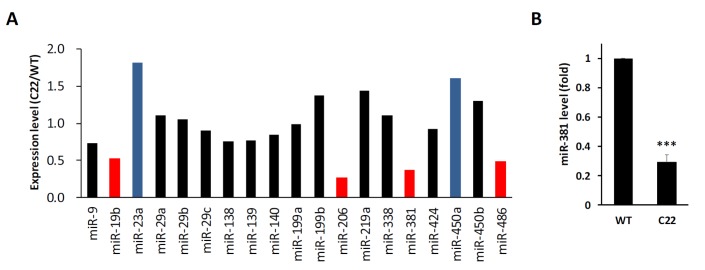
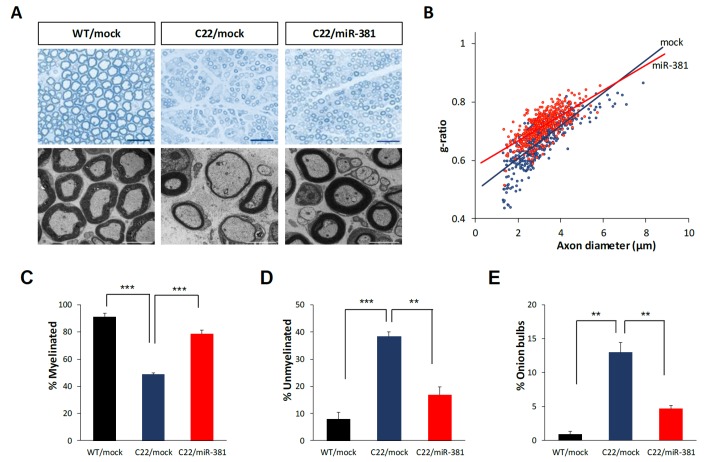
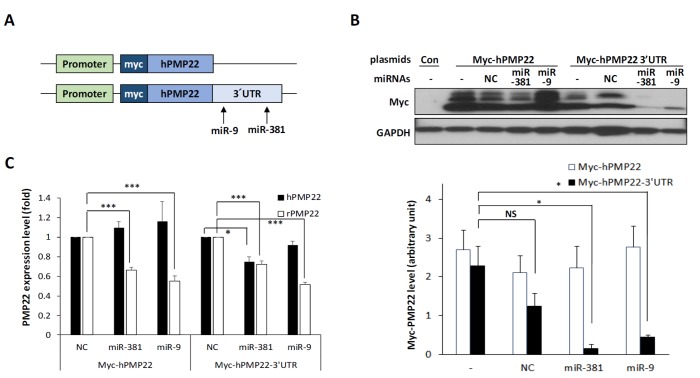
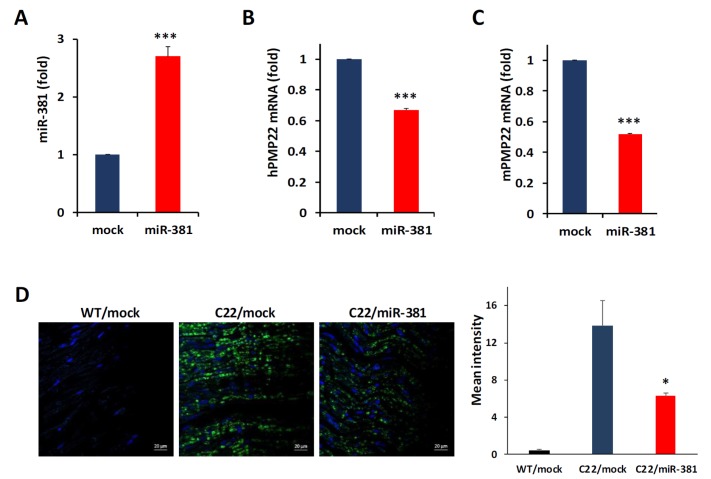
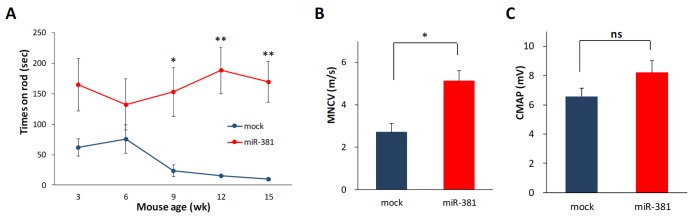
Charcot-Marie Tooth disease type 1A (CMT1A), the major type of CMT, is caused by duplication of peripheral myelin protein 22 () gene whose overexpression causes structural and functional abnormalities in myelination. We investigated whether miRNA-mediated regulation of PMP22 expression could reduce the expression level of PMP22, thereby alleviating the demyelinating neuropathic phenotype of CMT1A. We found that several miRNAs were down-regulated in C22 mouse, a CMT1A mouse model. Among them, miR-381 could target 3' untranslated region (3'UTR) of in vitro based on Western botting and quantitative Real Time-PCR (qRT-PCR) results. In vivo efficacy of miR-381 was assessed by administration of LV-miR-381, an miR-381 expressing lentiviral vector, into the sciatic nerve of C22 mice by a single injection at postnatal day 6 (p6). Administration of LV-miR-381 reduced expression level of PMP22 along with elevated level of miR-381 in the sciatic nerve. Rotarod performance analysis revealed that locomotor coordination of LV-miR-381 administered C22 mice was significantly enhanced from 8 weeks post administration. Electrophysiologically, increased motor nerve conduction velocity was observed in treated mice. Histologically, toluidine blue staining and electron microscopy revealed that structural abnormalities of myelination were improved in sciatic nerves of LV-miR-381 treated mice. Therefore, delivery of miR-381 ameliorated the phenotype of peripheral neuropathy in CMT1A mouse model by down-regulating expression. These data suggest that miRNA can be used as a potent therapeutic strategy to control diseases with copy number variations such as CMT1A.
1A型夏科-马里-图斯病(CMT1A)是CMT的主要类型,由外周髓鞘蛋白22(PMP22)基因重复所致,该基因的过表达会导致髓鞘形成出现结构和功能异常。我们研究了miRNA介导的PMP22表达调控是否能够降低PMP22的表达水平,从而减轻CMT1A的脱髓鞘神经病变表型。我们发现,在CMT1A小鼠模型C22小鼠中,几种miRNA表达下调。其中,基于蛋白质免疫印迹法和定量实时聚合酶链反应(qRT-PCR)结果,miR-381在体外可靶向PMP22的3'非翻译区(3'UTR)。通过在出生后第6天(p6)单次注射表达miR-381的慢病毒载体LV-miR-381至C22小鼠的坐骨神经中,评估miR-381在体内的疗效。给予LV-miR-381可降低坐骨神经中PMP22的表达水平,同时提高miR-381的水平。转棒试验分析显示,给予LV-miR-381的C22小鼠从给药后8周起运动协调性显著增强。在电生理方面,观察到治疗小鼠的运动神经传导速度增加。在组织学上,甲苯胺蓝染色和电子显微镜检查显示,给予LV-miR-381治疗的小鼠坐骨神经中髓鞘形成的结构异常得到改善。因此,通过下调PMP22表达,递送miR-381可改善CMT1A小鼠模型的周围神经病变表型。这些数据表明,miRNA可作为一种有效的治疗策略,用于控制如CMT1A这种具有拷贝数变异的疾病。