Attarian Shahram, Vallat Jean-Michel, Magy Laurent, Funalot Benoît, Gonnaud Pierre-Marie, Lacour Arnaud, Péréon Yann, Dubourg Odile, Pouget Jean, Micallef Joëlle, Franques Jérôme, Lefebvre Marie-Noëlle, Ghorab Karima, Al-Moussawi Mahmoud, Tiffreau Vincent, Preudhomme Marguerite, Magot Armelle, Leclair-Visonneau Laurène, Stojkovic Tanya, Bossi Laura, Lehert Philippe, Gilbert Walter, Bertrand Viviane, Mandel Jonas, Milet Aude, Hajj Rodolphe, Boudiaf Lamia, Scart-Grès Catherine, Nabirotchkin Serguei, Guedj Mickael, Chumakov Ilya, Cohen Daniel
Orphanet J Rare Dis. 2014 Dec 18;9:199. doi: 10.1186/s13023-014-0199-0.
Charcot-Marie-Tooth type 1A disease (CMT1A) is a rare orphan inherited neuropathy caused by an autosomal dominant duplication of a gene encoding for the structural myelin protein PMP22, which induces abnormal Schwann cell differentiation and dysmyelination, eventually leading to axonal suffering then loss and muscle wasting. We favour the idea that diseases can be more efficiently treated when targeting multiple disease-relevant pathways. In CMT1A patients, we therefore tested the potential of PXT3003, a low-dose combination of three already approved compounds (baclofen, naltrexone and sorbitol). Our study conceptually builds on preclinical experiments highlighting a pleiotropic mechanism of action that includes downregulation of PMP22. The primary objective was to assess safety and tolerability of PXT3003. The secondary objective aimed at an exploratory analysis of efficacy of PXT3003 in CMT1A, to be used for designing next clinical development stages (Phase 2b/3).
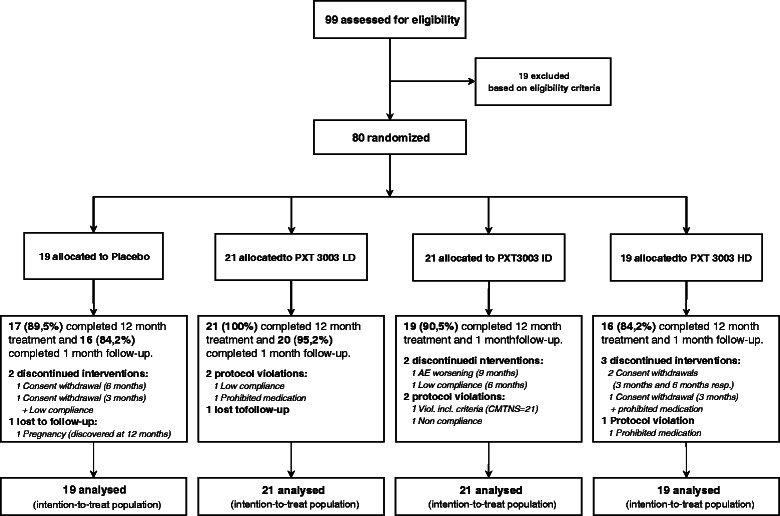
80 adult patients with mild-to-moderate CMT1A received in double-blind for 1 year Placebo or one of the three increasing doses of PXT3003 tested, in four equal groups. Safety and tolerability were assessed with the incidence of related adverse events. Efficacy was assessed using the Charcot-Marie-Tooth Neuropathy Score (CMTNS) and the Overall Neuropathy Limitations Scale (ONLS) as main endpoints, as well as various clinical and electrophysiological outcomes.
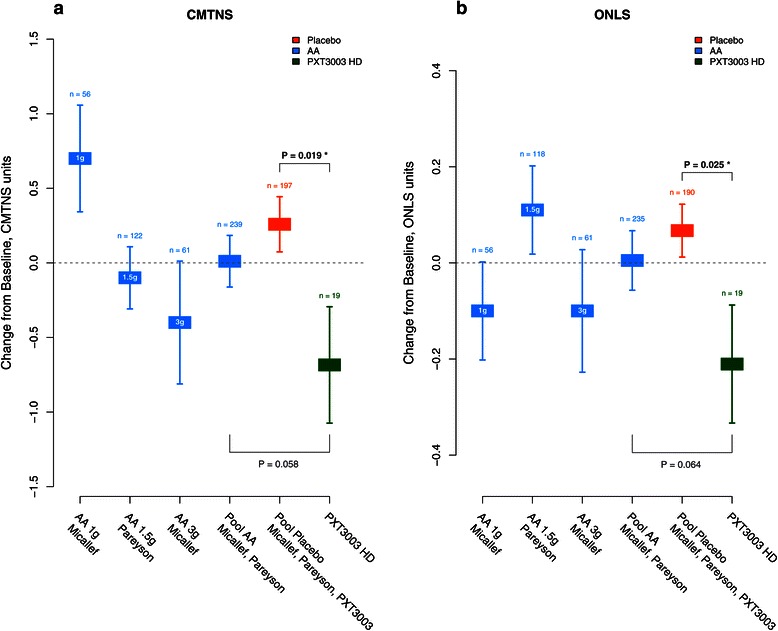
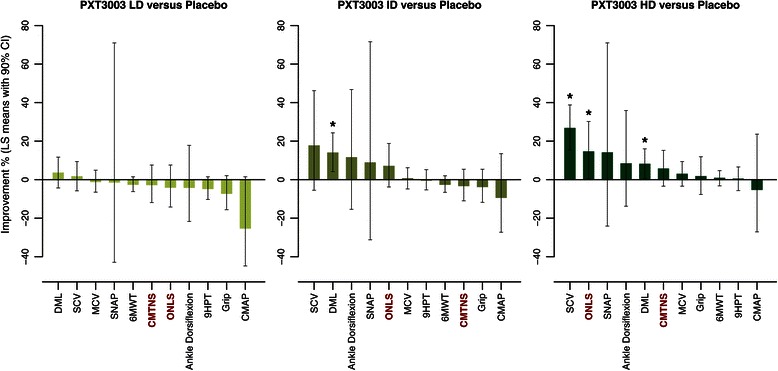
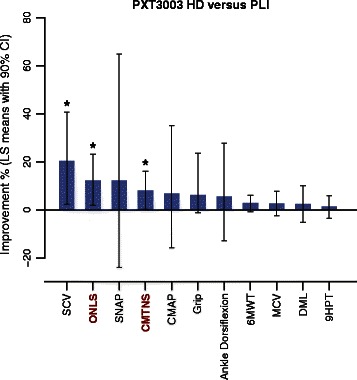
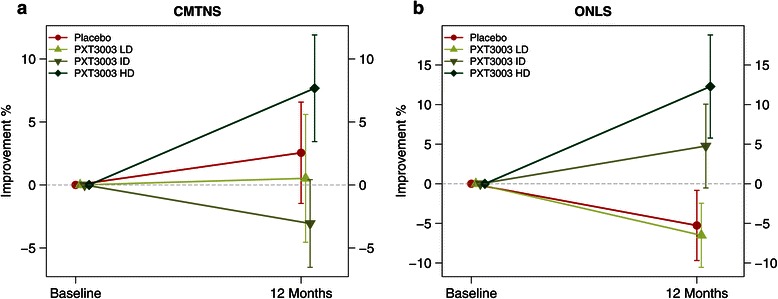
This trial confirmed the safety and tolerability of PXT3003. The highest dose (HD) showed consistent evidence of improvement beyond stabilization. CMTNS and ONLS, with a significant improvement of respectively of 8% (0.4% - 16.2%) and 12.1% (2% - 23.2%) in the HD group versus the pool of all other groups, appear to be the most sensitive clinical endpoints to treatment despite their quasi-stability over one year under Placebo. Patients who did not deteriorate over one year were significantly more frequent in the HD group.
These results confirm that PXT3003 deserves further investigation in adults and could greatly benefit CMT1A-diagnosed children, usually less affected than adults.
EudraCT Number: 2010-023097-40. ClinicalTrials.gov Identifier: NCT01401257. The Committee for Orphan Medicinal Products issued in February 2014 a positive opinion on the application for orphan designation for PXT3003 (EMA/OD/193/13).
1A型夏科-马里-图斯病(CMT1A)是一种罕见的孤儿遗传性神经病变,由编码结构性髓磷脂蛋白PMP22的基因常染色体显性重复所致,该重复会导致施万细胞分化异常和髓鞘形成障碍,最终致使轴突受损、继而丧失,以及肌肉萎缩。我们支持这样一种观点,即针对多种与疾病相关的途径进行治疗,疾病可能会得到更有效的治疗。因此,在CMT1A患者中,我们测试了PXT3003(三种已获批化合物——巴氯芬、纳曲酮和山梨醇的低剂量组合)的潜力。我们的研究在概念上基于临床前实验,这些实验突出了一种多效性作用机制,其中包括PMP22的下调。主要目标是评估PXT3003的安全性和耐受性。次要目标旨在对PXT3003在CMT1A中的疗效进行探索性分析,以便用于设计下一阶段的临床开发(2b/3期)。
80名轻度至中度CMT1A成年患者被随机分为四组,双盲接受为期1年的安慰剂或三种递增剂量的PXT3003之一的治疗。通过相关不良事件的发生率评估安全性和耐受性。使用夏科-马里-图斯神经病评分(CMTNS)和总体神经病变限制量表(ONLS)作为主要终点,以及各种临床和电生理结果评估疗效。
该试验证实了PXT3003的安全性和耐受性。最高剂量组(HD)显示出除病情稳定之外持续改善的证据。与所有其他组的总和相比,HD组的CMTNS和ONLS分别有显著改善,分别为8%(0.4% - 16.2%)和12.1%(2% - 23.2%),尽管在安慰剂治疗下这两个指标在一年中基本稳定,但它们似乎是对治疗最敏感的临床终点。HD组中在一年内病情未恶化的患者明显更多。
这些结果证实PXT3003值得在成人中进一步研究,并且可能会使通常比成人受影响小的CMT1A确诊儿童受益匪浅。
欧盟临床试验注册号:2010-023097-40。ClinicalTrials.gov标识符:NCT01401257。孤儿药品委员会于2014年2月对PXT3003的孤儿药指定申请发布了积极意见(EMA/OD/193/13)。