Laboratory of Investigative Dermatology, Rockefeller University, New York, New York.
The Hansjörg Wyss Department of Plastic Surgery, Department of Cell Biology, New York University, New York, New York.
Exp Dermatol. 2019 Aug;28(8):886-891. doi: 10.1111/exd.13978. Epub 2019 Jul 3.
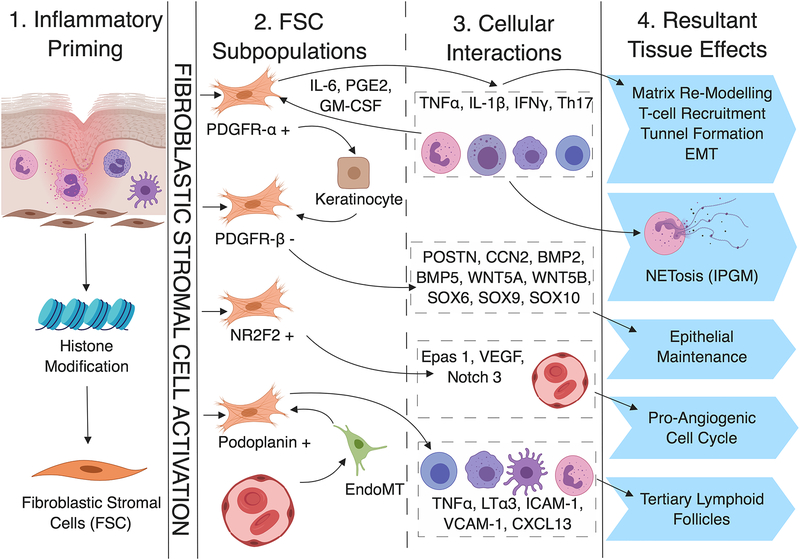
The precise pathogenic mechanisms in the development, persistence and worsening of hidradenitis suppurativa (HS) remain ill-defined. This chronic inflammatory dermatosis displays a strong Th1 and Th17 inflammatory signature with elevated levels of TNF-α, IL-1β, IL-17 and IFNγ in lesional and perilesional tissue. HS significantly differs to other chronic inflammatory dermatoses due to the development of hypertrophic scarring and dermal tunnels. The development of scarring and tunnels suggests that fibroblastic stromal cells (including myofibroblasts, fibroblasts, pericytes etc) may be involved in the development and progression of disease. Heterogeneous populations of fibroblasts have been identified in other inflammatory disorders and malignancy which contribute to inflammation and present novel therapeutic targets for fibrotic disorders. Findings in HS are consistent with these fibroblast subpopulations and may contribute to tunnel formation, aggressive squamous cell carcinoma and the phenotypic presentation of familial HS variants. We describe the existing knowledge regarding these mechanistic pathways and methods to confirm their involvement in the pathogenesis of HS.
化脓性汗腺炎(HS)在发展、持续和恶化过程中的精确发病机制仍不清楚。这种慢性炎症性皮肤病表现出强烈的 Th1 和 Th17 炎症特征,在病变和病变周围组织中 TNF-α、IL-1β、IL-17 和 IFNγ 水平升高。由于形成了肥大性瘢痕和皮肤隧道,HS 与其他慢性炎症性皮肤病明显不同。瘢痕和隧道的形成表明成纤维细胞基质细胞(包括肌成纤维细胞、成纤维细胞、周细胞等)可能参与疾病的发生和发展。在其他炎症性疾病和恶性肿瘤中已经鉴定出异质的成纤维细胞群体,这些群体有助于炎症的发生,并为纤维化疾病提供了新的治疗靶点。HS 的发现与这些成纤维细胞亚群一致,可能有助于隧道形成、侵袭性鳞状细胞癌和家族性 HS 变体的表型表现。我们描述了关于这些机制途径的现有知识,并介绍了证实它们参与 HS 发病机制的方法。