Department of Stereotactic and Functional Neurosurgery, Neurocenter - University Medical Center, Breisacher Straße 64, 79106, Freiburg i.Br., Germany.
Medical Faculty, Freiburg University, Freiburg, Germany.
Acta Neurochir (Wien). 2019 Aug;161(8):1559-1569. doi: 10.1007/s00701-019-03947-9. Epub 2019 May 30.
Growing interest exists for superolateral medial forebrain bundle (slMFB) deep brain stimulation (DBS) in psychiatric disorders. The surgical approach warrants tractographic rendition. Commercial stereotactic planning systems use deterministic tractography which suffers from inherent limitations, is dependent on manual interaction (ROI definition), and has to be regarded as subjective. We aimed to develop an objective but patient-specific tracking of the slMFB which at the same time allows the use of a commercial surgical planning system in the context of deep brain stimulation.
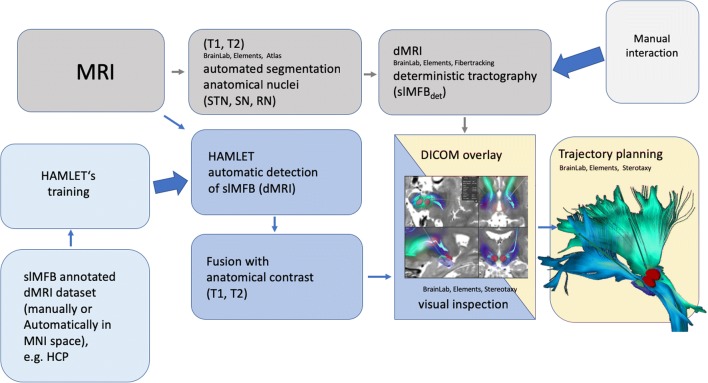
The HAMLET (Hierarchical Harmonic Filters for Learning Tracts from Diffusion MRI) machine learning approach was introduced into the standardized workflow of slMFB DBS tractographic planning on the basis of patient-specific dMRI. Rendition of the slMFB with HAMLET serves as an objective comparison for the refinement of the deterministic tracking procedure. Our application focuses on the tractographic planning of DBS (N = 8) for major depression and OCD.
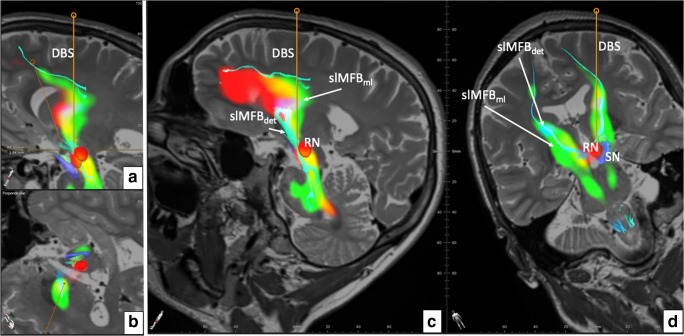
Previous results have shown that only fibers belonging to the ventral tegmental area to prefrontal/orbitofrontal axis should be targeted. With the proposed technique, the deterministic tracking approach, that serves as the surgical planning data, can be refined, over-sprouting fibers are eliminated, bundle thickness is reduced in the target region, and thereby probably a more accurate targeting is facilitated. The HAMLET-driven method is meant to achieve a more objective surgical fiber display of the slMFB with deterministic tractography.
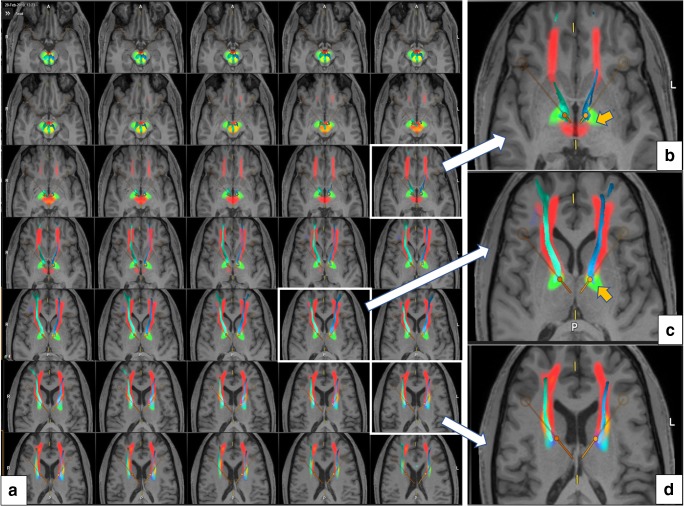
The approach allows overlying the results of patient-specific planning from two different approaches (manual deterministic and machine learning HAMLET). HAMLET shows the slMFB as a volume and thus serves as an objective tracking corridor. It helps to refine results from deterministic tracking in the surgical workspace without interfering with any part of the standard software solution. We have now included this workflow in our daily clinical experimental work on slMFB DBS for psychiatric indications.
在精神疾病中,对超外侧内侧额束(slMFB)深部脑刺激(DBS)的兴趣日益浓厚。手术入路需要进行轨迹描绘。商业立体定向规划系统使用确定性轨迹描绘,存在固有局限性,依赖于手动交互(ROI 定义),并且被认为是主观的。我们的目标是开发一种客观的,但针对患者的 slMFB 跟踪方法,同时允许在深部脑刺激的背景下使用商业手术规划系统。
基于患者特定的 dMRI,将 HAMLET(用于从弥散 MRI 中学习轨迹的分层谐波滤波器)机器学习方法引入 slMFB DBS 轨迹规划的标准化工作流程中。使用 HAMLET 呈现 slMFB 可作为确定性跟踪过程改进的客观比较。我们的应用重点是 DBS(N=8)治疗重度抑郁症和强迫症的轨迹规划。
先前的结果表明,只有属于腹侧被盖区到前额叶/眶额区的纤维才应作为靶点。使用该技术,可以改进作为手术规划数据的确定性跟踪方法,消除过度发芽的纤维,减少目标区域内束的厚度,从而可能更准确地靶向。HAMLET 驱动的方法旨在实现更客观的 slMFB 手术纤维显示,采用确定性轨迹描绘。
该方法允许覆盖两种不同方法(手动确定性和机器学习 HAMLET)的患者特定规划结果。HAMLET 以体积的形式呈现 slMFB,因此可作为客观的跟踪通道。它有助于在不干扰标准软件解决方案任何部分的情况下,在手术工作空间中改进确定性跟踪的结果。我们现在已经将此工作流程纳入我们在精神科适应证的 slMFB DBS 的日常临床实验工作中。