Krasowski Matthew D, Lawrence Janna C, Briggs Angela S, Ford Bradley A
Department of Pathology, University of Iowa Hospitals and Clinics, Iowa City, IA, USA.
Hardin Library for The Health Sciences, University of Iowa, Iowa City, IA, USA.
J Pathol Inform. 2019 May 6;10:16. doi: 10.4103/jpi.jpi_12_19. eCollection 2019.
Professionals and trainees in the medical and scientific fields may receive high e-mail volumes for conferences and journals. In this report, we analyze the amount and characteristics of unsolicited e-mails for journals, conferences, and webinars received by faculty and trainees in a pathology department at an academic medical center.
With informed consent, we analyzed 7 consecutive days of e-mails from faculty and trainees who voluntarily participated in the study and saved unsolicited e-mails from their institutional e-mail address (including junk e-mail folder) for medical/scientific journals, conferences, and webinars. All e-mails were examined for characteristics such as reply receipts, domain name, and spam likelihood. Journal e-mails were specifically analyzed for claims in the message body (for example, peer review, indexing in databases/resources, rapid publication) and actual inclusion in recognized journal databases/resources.
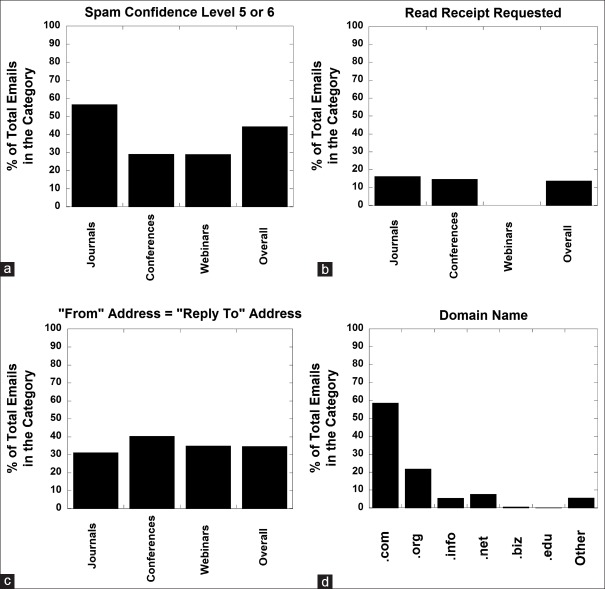
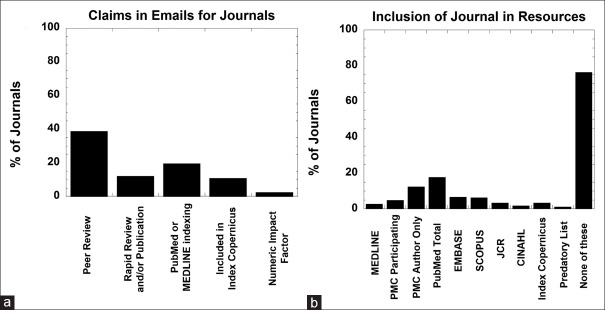
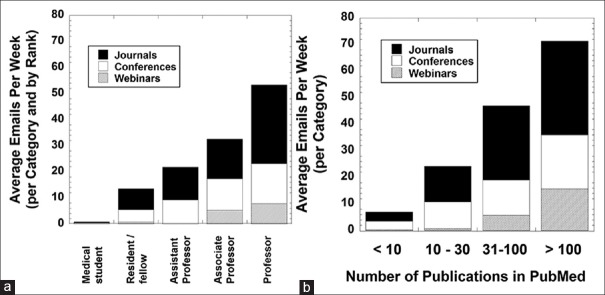
A total of 17 faculty (4 assistant, 4 associate, and 9 full professors) and 9 trainees (5 medical students, 2 pathology residents, and 2 pathology fellows) completed the study. A total of 755 e-mails met study criteria (417 e-mails from 328 unique journals, 244 for conferences, and 94 for webinars). Overall, 44.4% of e-mails were flagged as potential spam by the institutional default settings, and 13.8% requested reply receipts. The highest burden of e-mails in 7 days was by associate and full professors (maximum 158 or approximately 8200 per year), although some trainees and assistant professors had over 30 e-mails in 7 days (approximately 1560 per year). Common characteristics of journal e-mails were mention of "peer review" in the message body and low rates of inclusion in recognized journal databases/resources, with 76.4% not found in any of 9 journal databases/resources. The location for conferences in e-mails included 31 different countries, with the most common being the United States (33.2%), Italy (9.8%), China (4.9%), United Kingdom (4.9%), and Canada (4.5%).
The present study in an academic pathology department shows a high burden of unsolicited e-mails for medical/scientific journals, conferences, and webinars, especially to associate and full professors. We also demonstrate that some pathology trainees and junior faculty are receiving an estimated 1500 unsolicited e-mails per year.
医学和科学领域的专业人员及实习生可能会收到大量关于会议和期刊的电子邮件。在本报告中,我们分析了一所学术医疗中心病理科教员和实习生收到的关于期刊、会议及网络研讨会的非 solicited 电子邮件的数量和特征。
在获得知情同意后,我们分析了连续7天来自自愿参与研究的教员和实习生的电子邮件,他们从其机构电子邮件地址(包括垃圾邮件文件夹)中保存了关于医学/科学期刊、会议及网络研讨会的非 solicited 电子邮件。检查所有电子邮件的特征,如回复回执、域名和垃圾邮件可能性。特别分析期刊电子邮件在邮件正文中的声明(例如同行评审、在数据库/资源中索引、快速发表)以及在公认期刊数据库/资源中的实际收录情况。
共有17名教员(4名助理教授、4名副教授和9名正教授)和9名实习生(5名医学生、2名病理住院医师和2名病理研究员)完成了研究。共有755封电子邮件符合研究标准(来自328种不同期刊的417封电子邮件、244封会议邮件和94封网络研讨会邮件)。总体而言,44.4%的电子邮件被机构默认设置标记为潜在垃圾邮件,13.8%的邮件要求回复回执。7天内电子邮件负担最重的是副教授和正教授(最多158封或每年约8200封),不过一些实习生和助理教授在7天内也收到了30多封电子邮件(每年约1560封)。期刊电子邮件的常见特征是在邮件正文中提及“同行评审”,且在公认期刊数据库/资源中的收录率较低,76.4%未在9种期刊数据库/资源中的任何一种中找到。电子邮件中会议举办地点包括31个不同国家,最常见的是美国(33.2%)、意大利(9.8%)、中国(4.9%)、英国(4.9%)和加拿大(4.5%)。
本项在学术病理科开展的研究表明,医学/科学期刊、会议及网络研讨会的非 solicited 电子邮件负担很重,尤其是对副教授和正教授而言。我们还证明,一些病理科实习生和初级教员每年收到约1500封非 solicited 电子邮件。