1Department of Physics, Gakushuin University, 1-5-1 Mejiro, Toshima-ku, Tokyo, 171-8588 Japan.
2Department of Physics, Tohoku University, Sendai, 980-8578 Japan.
Commun Biol. 2019 May 24;2:199. doi: 10.1038/s42003-019-0422-6. eCollection 2019.
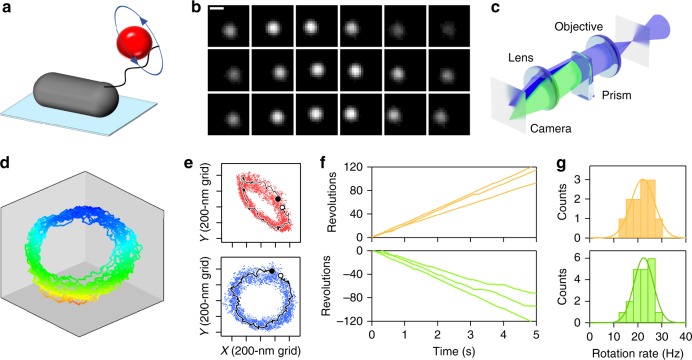
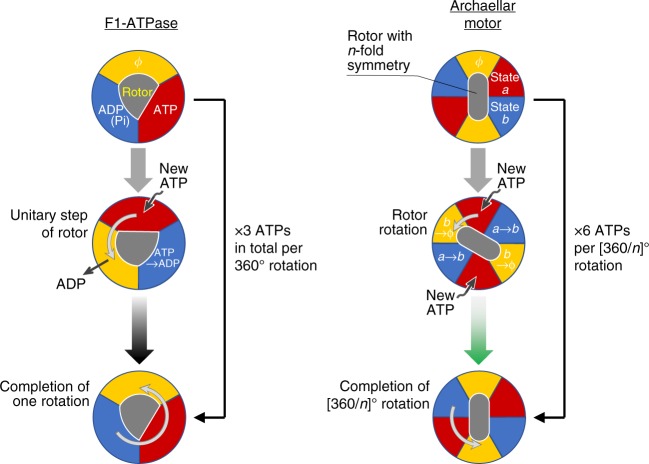
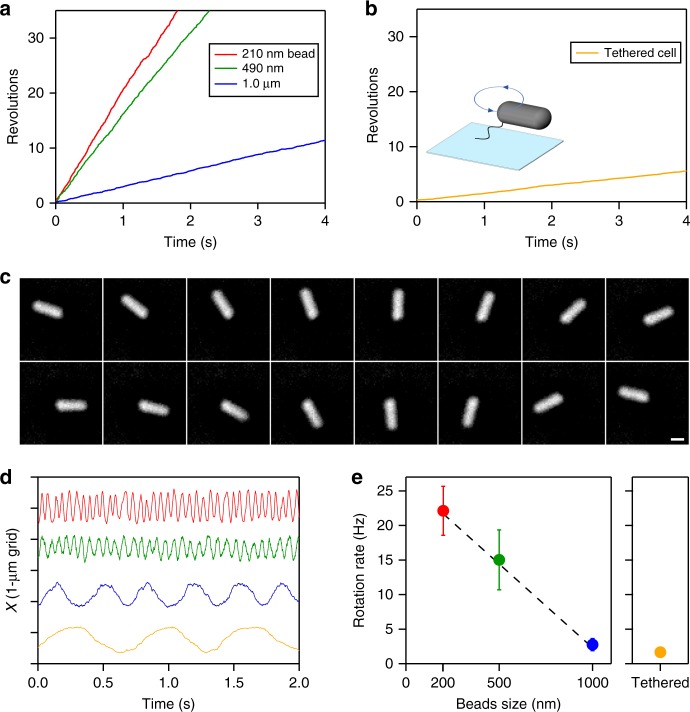
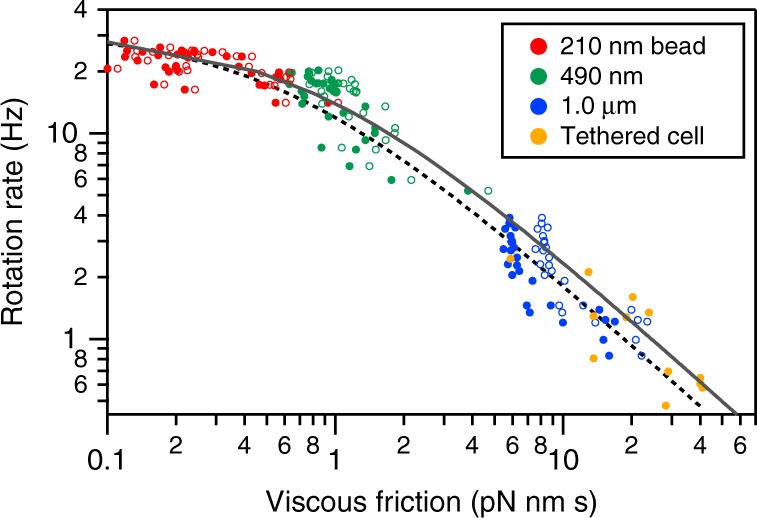
It is unknown how the archaellum-the rotary propeller used by Archaea for motility-works. To further understand the molecular mechanism by which the hexameric ATPase motor protein FlaI drives rotation of the membrane-embedded archaellar motor, we determined motor torque by imposition of various loads on archaella. Markers of different sizes were attached to single archaella, and their trajectories were quantified using three-dimensional tracking and high-speed recording. We show that rotation slows as the viscous drag of markers increases, but torque remains constant at 160 pN·nm independent of rotation speed. Notably, the estimated work done in a single rotation is twice the expected energy that would come from hydrolysis of six ATP molecules in the hexamer, indicating that more ATP molecules are required for one rotation of archaellum. To reconcile the apparent contradiction, we suggest a new and general model for the mechanism of ATP-driven rotary motors.
目前尚不清楚古菌用于运动的旋转推进器——菌毛的工作原理。为了进一步了解六聚体 ATP 酶马达蛋白 FlaI 驱动膜嵌入菌毛马达旋转的分子机制,我们通过对菌毛施加各种负载来确定马达扭矩。将不同大小的标记物附着在单个菌毛上,并使用三维跟踪和高速记录来量化它们的轨迹。我们表明,随着标记物的粘性阻力增加,旋转速度会减慢,但扭矩保持不变,在 160 pN·nm 时独立于旋转速度。值得注意的是,在单个旋转过程中所做的功估计是六聚体中六个 ATP 分子水解所产生的预期能量的两倍,这表明一个菌毛的旋转需要更多的 ATP 分子。为了解决这个明显的矛盾,我们提出了一种新的、通用的 ATP 驱动旋转马达机制模型。