Department of Immunology, Genetics and Pathology, Science for Life Laboratory, Uppsala University, Sweden.
Department of General Surgery and Surgical Oncology, University of Siena, Italy; Department of Surgical Oncology, Gdansk Medical University, Gdansk, Poland.
EBioMedicine. 2019 Jun;44:322-333. doi: 10.1016/j.ebiom.2019.05.044. Epub 2019 May 28.
Gastric cancer (GC) is the third leading cause of cancer death. Early detection is a key factor to reduce its mortality.
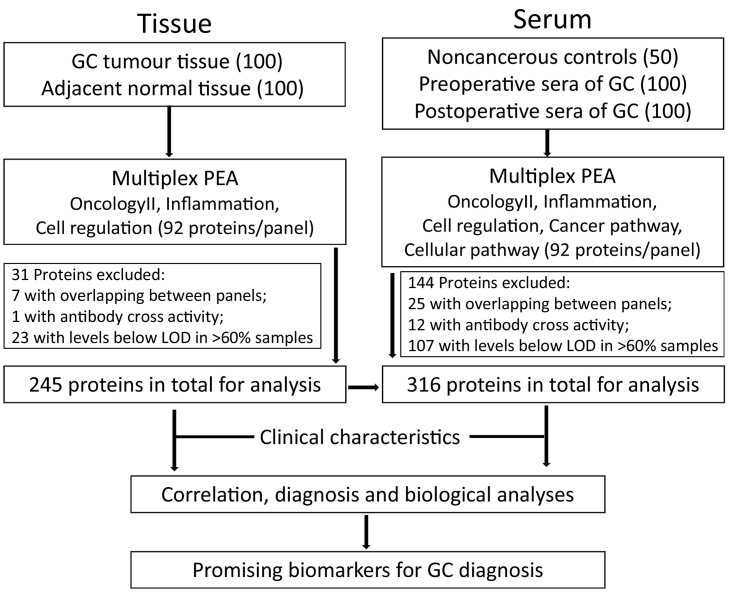
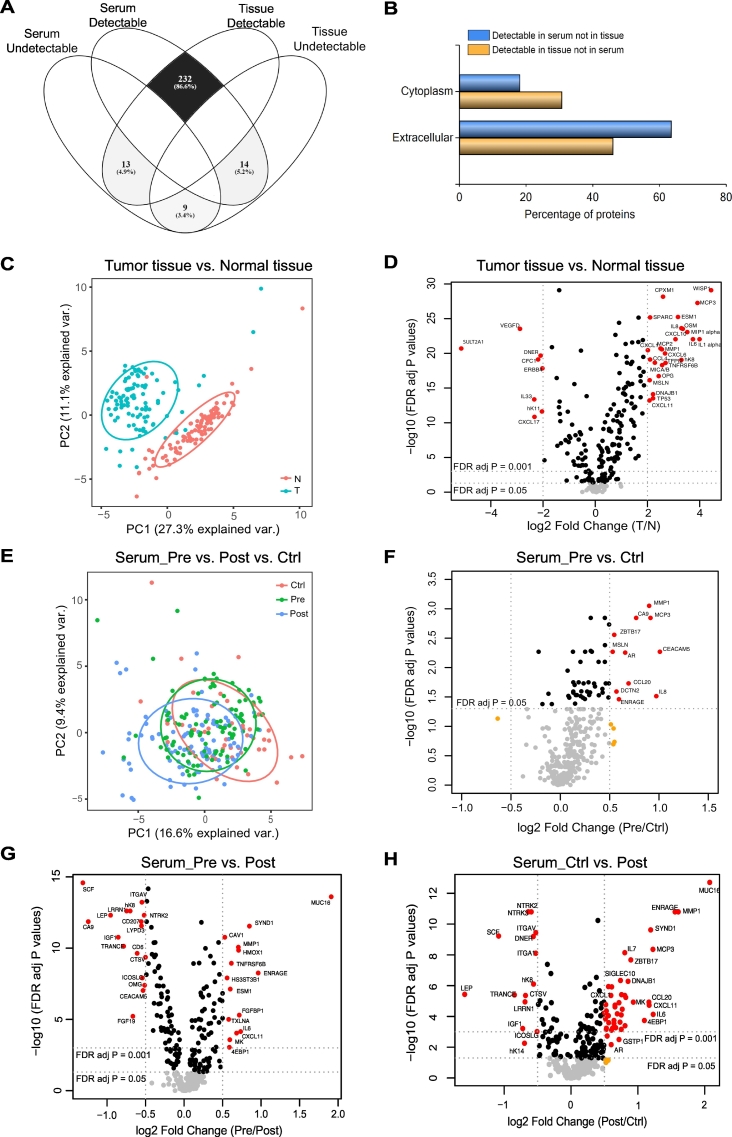
We retrospectively collected pre- and postoperative serum samples as well as tumour tissues and adjacent normal tissues from 100 GC patients. Serum samples from non-cancerous patients were served as controls (n = 50). A high-throughput protein detection technology, multiplex proximity extension assays (PEA), was applied to measure levels of over 300 proteins. Alteration of each protein was analysed by univariate analysis. Elastic-net logistic regression was performed to select serum proteins into the diagnostic model.
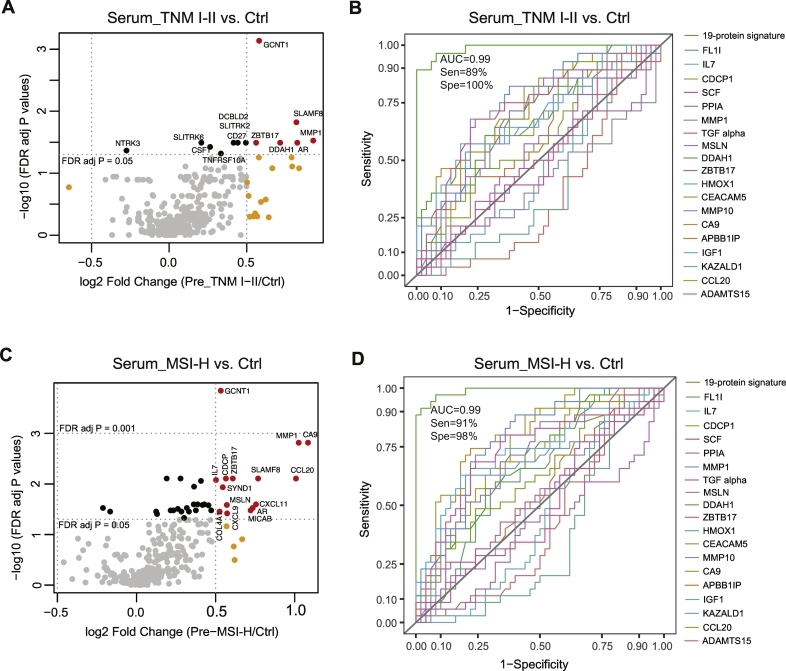
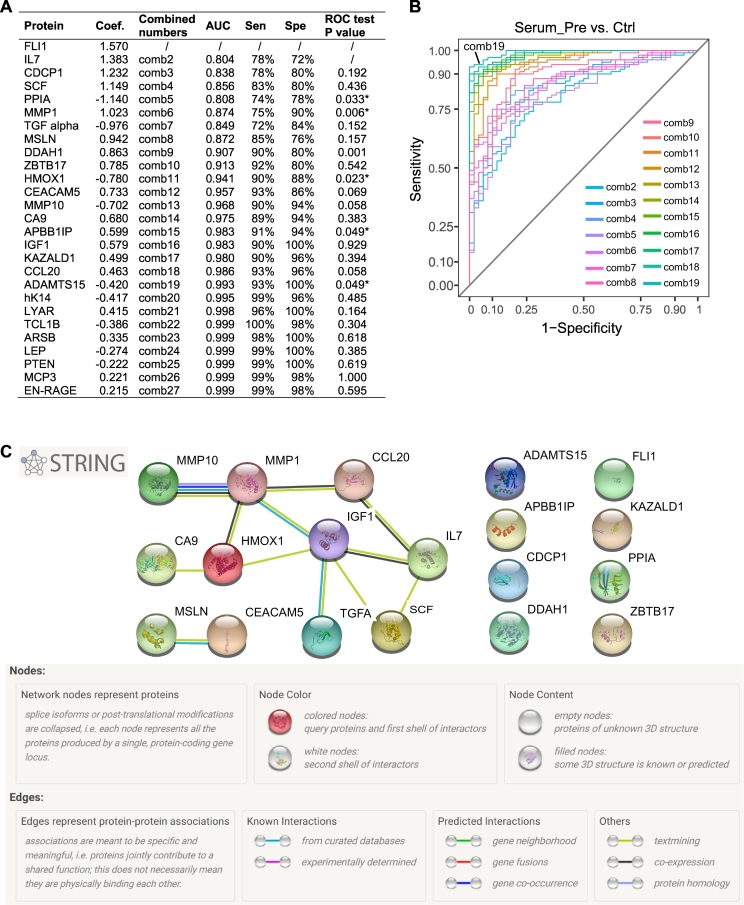
We identified 19 serum proteins (CEACAM5, CA9, MSLN, CCL20, SCF, TGF-alpha, MMP-1, MMP-10, IGF-1, CDCP1, PPIA, DDAH-1, HMOX-1, FLI1, IL-7, ZBTB-17, APBB1IP, KAZALD-1, and ADAMTS-15) that together distinguish GC cases from controls with a diagnostic sensitivity of 93%, specificity of 100%, and area under receiver operating characteristic curve (AUC) of 0·99 (95% CI: 0·98-1). Moreover, the 19-serum protein signature provided an increased diagnostic capacity in patients at TNM I-II stage (sensitivity 89%, specificity 100%, AUC 0·99) and in patients with high microsatellite instability (MSI) (91%, 98%, and 0·99) compared to individual proteins. These promising results will inspire a large-scale independent cohort study to be pursued for validating the proposed protein signature.
Based on targeted proteomics and elastic-net logistic regression, we identified a 19-serum protein signature which could contribute to clinical GC diagnosis, especially for patients at early stage and those with high MSI. FUND: This study was supported by a European H2020-Marie Skłodowska-Curie Innovative Training Networks grant (316,929, GastricGlycoExplorer). Funder had no influence on trial design, data evaluation, and interpretation.
胃癌(GC)是癌症死亡的第三大主要原因。早期发现是降低死亡率的关键因素。
我们回顾性地收集了 100 名 GC 患者的术前和术后血清样本以及肿瘤组织和相邻正常组织。非癌症患者的血清样本作为对照(n=50)。我们应用高通量蛋白检测技术,多重邻近延伸分析(PEA)来测量 300 多种蛋白质的水平。通过单变量分析来分析每种蛋白质的变化。弹性网络逻辑回归用于将血清蛋白选入诊断模型。
我们鉴定了 19 种血清蛋白(CEACAM5、CA9、MSLN、CCL20、SCF、TGF-α、MMP-1、MMP-10、IGF-1、CDCP1、PPIA、DDAH-1、HMOX-1、FLI1、IL-7、ZBTB-17、APBB1IP、KAZALD-1 和 ADAMTS-15),这些蛋白共同将 GC 病例与对照区分开来,诊断的灵敏度为 93%,特异性为 100%,受试者工作特征曲线(ROC)下面积(AUC)为 0.99(95%CI:0.98-1)。此外,与单个蛋白相比,19 种血清蛋白标志物在 TNM I-II 期患者(灵敏度 89%,特异性 100%,AUC 0.99)和高微卫星不稳定性(MSI)患者(91%,98%和 0.99)中提供了更高的诊断能力。这些有前景的结果将激励进行大规模的独立队列研究,以验证所提出的蛋白质标志物。
基于靶向蛋白质组学和弹性网络逻辑回归,我们鉴定了一种 19 种血清蛋白标志物,可有助于临床 GC 诊断,特别是对早期患者和高 MSI 患者。
这项研究得到了欧洲 H2020-Marie Skłodowska-Curie 创新培训网络资助(316,929,GastricGlycoExplorer)。资助者对试验设计、数据评估和解释没有影响。