Department of Otolaryngology/Head and Neck Surgery, Section Ear and Hearing, VU University Medical Center, Amsterdam, Netherlands.
Amsterdam Public Health research institute, Amsterdam, Netherlands.
Eur J Pediatr. 2019 Aug;178(8):1195-1205. doi: 10.1007/s00431-019-03379-8. Epub 2019 May 31.
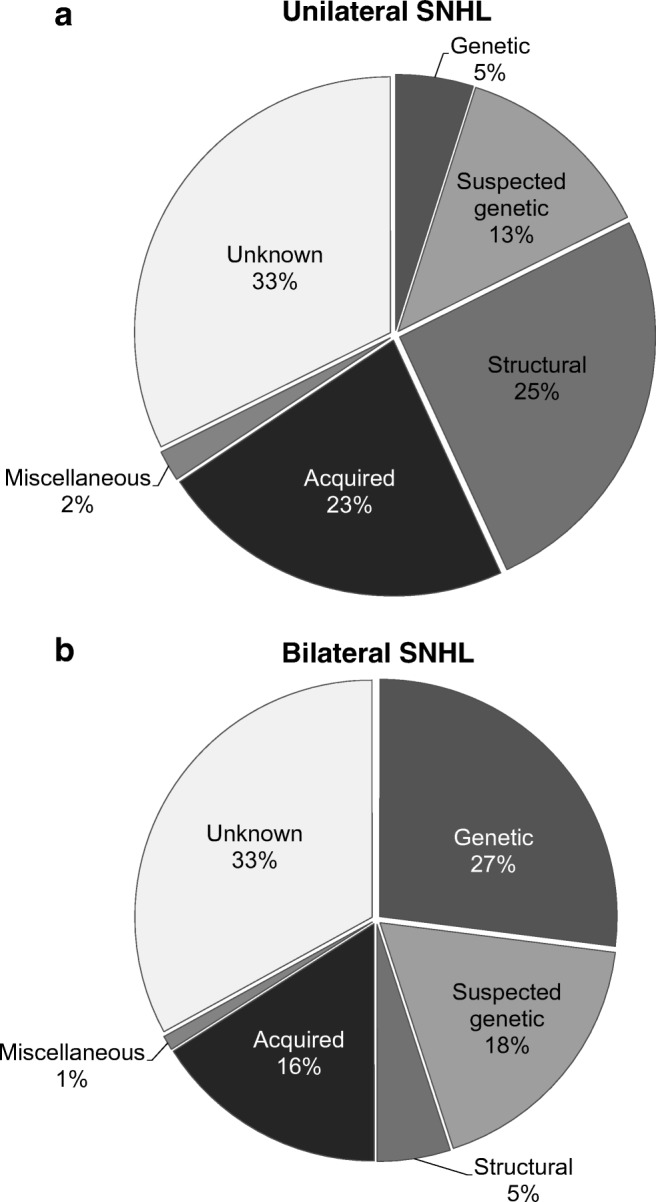
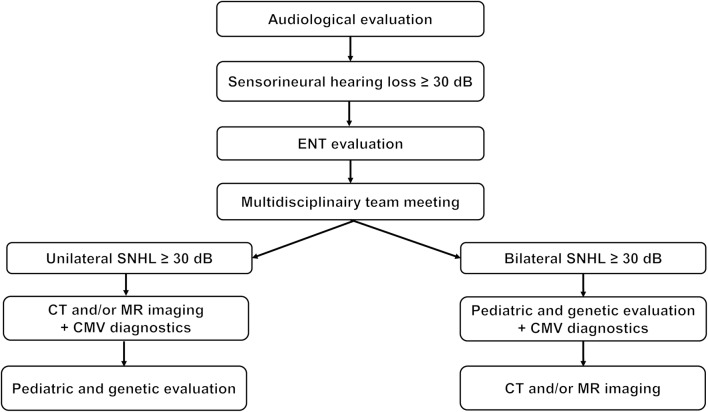
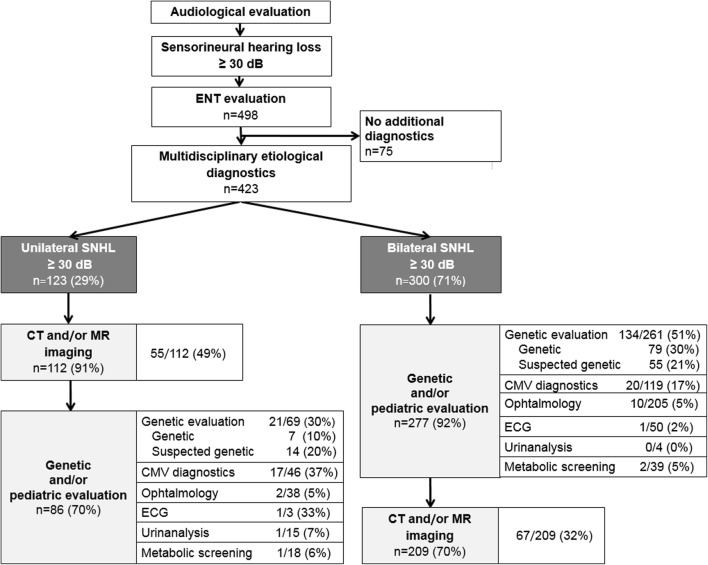
This study aims to evaluate the etiology of pediatric sensorineural hearing loss (SNHL). A total of 423 children with SNHL were evaluated, with the focus on the determination of causative genetic and acquired etiologies of uni- and bilateral SNHL in relation to age at diagnosis and severity of the hearing loss. We found that a stepwise diagnostic approach comprising of imaging, genetic, and/or pediatric evaluation identified a cause for SNHL in 67% of the children. The most common causative finding in children with bilateral SNHL was causative gene variants (26%), and in children with unilateral SNHL, a structural anomaly of the temporal bone (27%). The probability of finding an etiologic diagnosis is significantly higher in children under the age of 1 year and children with profound SNHL.Conclusions: With our stepwise diagnostic approach, we found a diagnostic yield of 67%. Bilateral SNHL often has a genetic cause, whereas in unilateral SNHL structural abnormalities of the labyrinth are the dominant etiologic factor. The diagnostic yield is associated with the age at detection and severity of hearing loss: the highest proportion of causative abnormalities is found in children with a young age at detection or a profound hearing loss. What is Known: • Congenital sensorineural hearing loss is one of the most common congenital disorders • Determination of the cause is important for adequate management and prognosis and may include radiology, serology, and DNA analysis What is New: • Using a stepwise diagnostic approach, causative abnormalities are found in 67% both in uni- and bilateral SNHL, with the highest diagnostic yield in very young children and those suffering from profound hearing loss • Bilateral SNHL often has a genetic cause, whereas in unilateral SNHL structural abnormalities of the labyrinth are the dominant etiologic factor.
本研究旨在评估儿童感音神经性听力损失(SNHL)的病因。共评估了 423 名 SNHL 患儿,重点是确定与诊断时年龄和听力损失严重程度相关的单侧和双侧 SNHL 的遗传和获得性病因。我们发现,包括影像学、遗传学和/或儿科评估在内的逐步诊断方法可确定 67%患儿的 SNHL 病因。双侧 SNHL 患儿最常见的病因是致病基因突变(26%),单侧 SNHL 患儿则是颞骨结构异常(27%)。在年龄小于 1 岁的儿童和极重度听力损失的儿童中,找到病因诊断的可能性显著更高。结论:通过我们的逐步诊断方法,我们发现诊断率为 67%。双侧 SNHL 通常具有遗传原因,而单侧 SNHL 中,迷路的结构异常是主要的病因因素。诊断率与检测时的年龄和听力损失的严重程度相关:在检测年龄较小或听力损失较重的儿童中,发现病因异常的比例最高。已知:•先天性感音神经性听力损失是最常见的先天性疾病之一•确定病因对于适当的管理和预后很重要,可能包括放射学、血清学和 DNA 分析。新发现:•使用逐步诊断方法,单侧和双侧 SNHL 中均可发现 67%的病因异常,在非常年幼的儿童和极重度听力损失的儿童中诊断率最高。•双侧 SNHL 通常具有遗传原因,而单侧 SNHL 中迷路的结构异常是主要的病因因素。