Department of Molecular Biosciences, The University of Texas at Austin, Austin, TX 78712, USA; Center for Systems and Synthetic Biology, The University of Texas at Austin, Austin, TX 78712, USA.
Department of Molecular Biosciences, The University of Texas at Austin, Austin, TX 78712, USA; Howard Hughes Medical Institute, The University of Texas at Austin, Austin, TX 78712, USA.
Mol Cell. 2019 Jul 11;75(1):145-153.e5. doi: 10.1016/j.molcel.2019.05.005. Epub 2019 May 29.
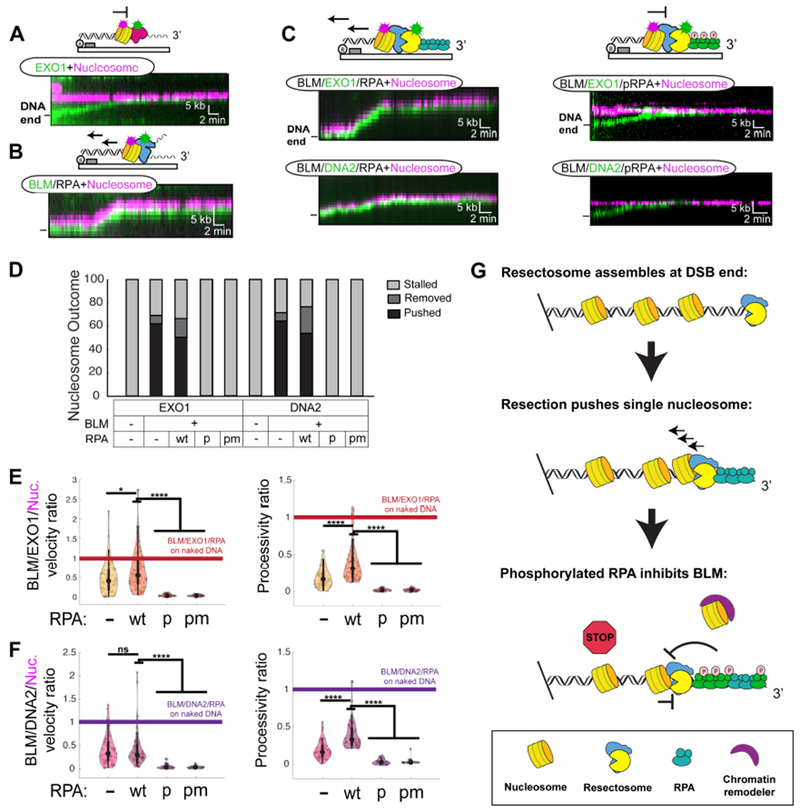
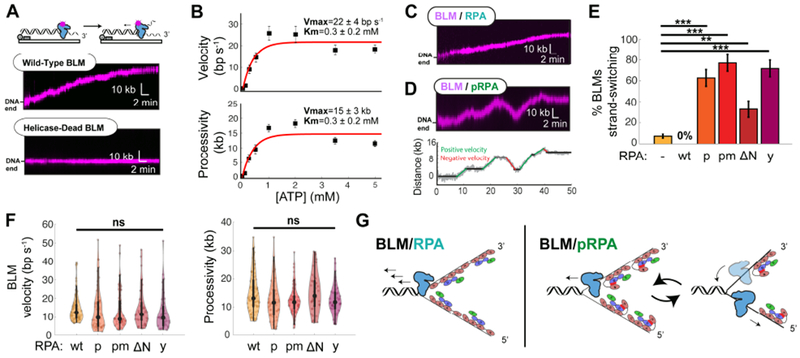
Genetic recombination in all kingdoms of life initiates when helicases and nucleases process (resect) the free DNA ends to expose single-stranded DNA (ssDNA) overhangs. Resection regulation in bacteria is programmed by a DNA sequence, but a general mechanism limiting resection in eukaryotes has remained elusive. Using single-molecule imaging of reconstituted human DNA repair factors, we identify phosphorylated RPA (pRPA) as a negative resection regulator. Bloom's syndrome (BLM) helicase together with exonuclease 1 (EXO1) and DNA2 nucleases catalyze kilobase-length DNA resection on nucleosome-coated DNA. The resulting ssDNA is rapidly bound by RPA, which further stimulates DNA resection. RPA is phosphorylated during resection as part of the DNA damage response (DDR). Remarkably, pRPA inhibits DNA resection in cellular assays and in vitro via inhibition of BLM helicase. pRPA suppresses BLM initiation at DNA ends and promotes the intrinsic helicase strand-switching activity. These findings establish that pRPA provides a feedback loop between DNA resection and the DDR.
在所有生命领域的遗传重组中,解旋酶和核酸酶都会对游离 DNA 末端进行加工(切除),从而暴露出单链 DNA(ssDNA)突出端。细菌中的切除调控由 DNA 序列编程,但在真核生物中限制切除的一般机制仍然难以捉摸。通过对重组人 DNA 修复因子的单分子成像,我们发现磷酸化 RPA(pRPA)是一种负切除调节因子。布鲁姆综合征(BLM)解旋酶与核酸外切酶 1(EXO1)和 DNA2 核酸酶一起,在核小体覆盖的 DNA 上催化千碱基长度的 DNA 切除。由此产生的 ssDNA 会被 RPA 迅速结合,从而进一步刺激 DNA 切除。在 DNA 损伤反应(DDR)中,RPA 在切除过程中被磷酸化。值得注意的是,pRPA 通过抑制 BLM 解旋酶在细胞测定和体外抑制 DNA 切除。pRPA 抑制 DNA 末端的 BLM 起始,并促进内在解旋酶链转换活性。这些发现确立了 pRPA 在 DNA 切除和 DDR 之间提供了一个反馈回路。