1 Institute of Ecology and Evolution, University of Bern , 3012 Bern , Switzerland.
2 Department of Integrative Biology, University of Texas at Austin , Austin, TX 78712 , USA.
Philos Trans R Soc Lond B Biol Sci. 2019 Jul 22;374(1777):20180241. doi: 10.1098/rstb.2018.0241. Epub 2019 Jun 3.
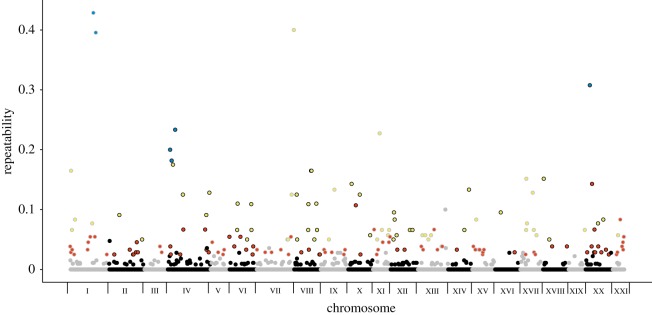
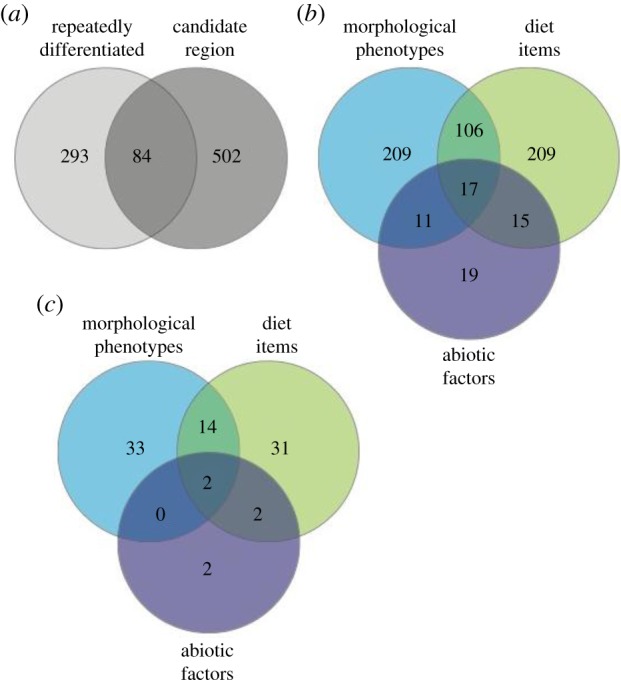
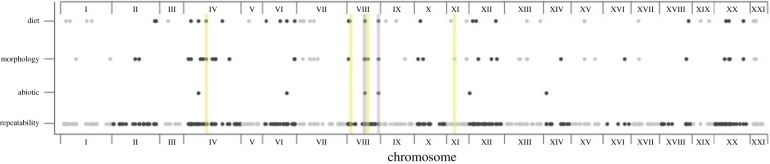
The repeated evolution of similar phenotypes in independent populations (i.e. parallel or convergent evolution) provides an opportunity to identify genetic and ecological factors that influence the process of adaptation. Threespine stickleback fish ( Gasterosteus aculeatus) are an excellent model for such studies, as they have repeatedly adapted to divergent habitats across the Northern hemisphere. Here, we use genomic, ecological and morphological data from 16 independent pairs of stickleback populations adapted to divergent lake and stream habitats. We combine a population genomic approach to identify regions of the genome that are likely under selection in these divergent habitats with an association mapping approach to identify regions of the genome that underlie variation in ecological factors and morphological traits. Over 37% of genomic windows are repeatedly differentiated across lake-stream pairs. Similarly, many genomic windows are associated with variation in abiotic factors, diet items and morphological phenotypes. Both the highly differentiated windows and candidate trait windows are non-randomly distributed across the genome and show some overlap. However, the overlap is not significant on a genome-wide scale. Together, our data suggest that adaptation to divergent food resources and predation regimes are drivers of differentiation in lake-stream stickleback, but that additional ecological factors are also important. This article is part of the theme issue 'Convergent evolution in the genomics era: new insights and directions'.
在独立种群中重复出现的相似表型(即平行或趋同进化)为识别影响适应过程的遗传和生态因素提供了机会。三刺鱼(Gasterosteus aculeatus)是此类研究的绝佳模型,因为它们已经在北半球的不同栖息地中多次适应。在这里,我们使用来自 16 对独立的三刺鱼种群的基因组、生态和形态数据,这些种群适应于不同的湖泊和溪流栖息地。我们结合群体基因组学方法来识别这些不同栖息地中可能受到选择的基因组区域,以及关联图谱方法来识别导致生态因子和形态特征变异的基因组区域。超过 37%的基因组窗口在湖泊-溪流对之间重复分化。同样,许多基因组窗口与非生物因子、饮食项目和形态表型的变异有关。高度分化的窗口和候选性状窗口在基因组中是非随机分布的,并且存在一些重叠。然而,在全基因组范围内,这种重叠并不显著。总之,我们的数据表明,对不同食物资源和捕食者的适应是导致湖泊-溪流三刺鱼分化的驱动因素,但其他生态因素也很重要。本文是主题为“基因组时代的趋同进化:新的见解和方向”的一部分。