Vincent-Höper Sylvie, Stein Maie
Department of Work and Organizational Psychology, Universität Hamburg, Hamburg, Germany.
Front Psychol. 2019 May 17;10:1049. doi: 10.3389/fpsyg.2019.01049. eCollection 2019.
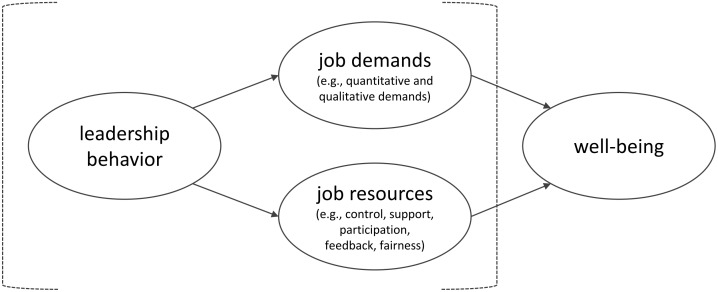
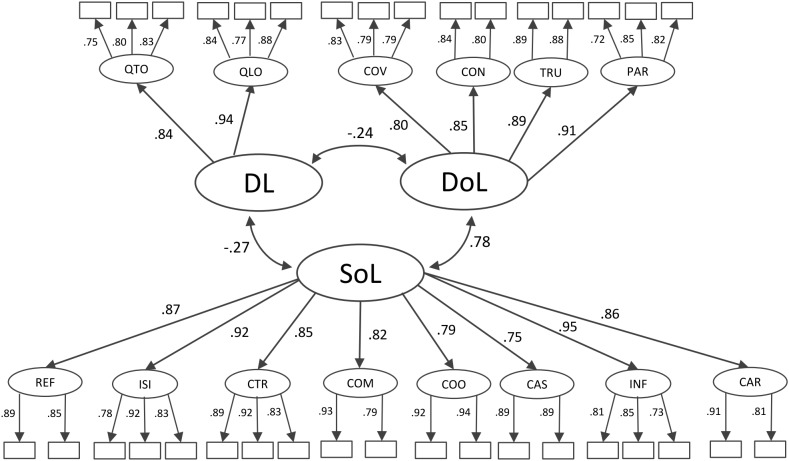
In this article, we draw upon the notion that employees' work characteristics are an important pathway through which leaders influence employee well-being and propose a theoretical framework that integrates perspectives on leadership, occupational stress, and job design. Based on this integrative approach, we developed the health- and development-promoting leadership behavior questionnaire (HDLBQ) for assessing job demands emanating from and job resources provided through the leader. Validation of the measure in German, French, and English using an overall sample of 2,934 employees demonstrated adequate psychometric properties. An examination of the factorial structure revealed three higher-order factors: demanding, development-oriented, and support-oriented leadership. Multigroup confirmatory factor analysis indicated structural equivalence across the three language versions of the HDLBQ. Correlations with employee well-being were moderate, and the HDLBQ explained unique variance in employee well-being beyond that explained by transformational leadership. Suggestions for applications of the HDLBQ and approaches to enhance employee well-being at the workplace are discussed.
在本文中,我们借鉴了这样一种观点,即员工的工作特征是领导者影响员工幸福感的重要途径,并提出了一个整合领导力、职业压力和工作设计观点的理论框架。基于这种综合方法,我们开发了促进健康与发展的领导行为问卷(HDLBQ),用于评估源自领导者的工作需求和领导者提供的工作资源。使用2934名员工的总体样本对该量表进行德语、法语和英语的验证,结果表明其具有足够的心理测量学特性。对因子结构的检验揭示了三个高阶因子:要求型、发展导向型和支持导向型领导。多组验证性因子分析表明HDLBQ的三个语言版本具有结构等效性。与员工幸福感的相关性适中,并且HDLBQ解释了员工幸福感中超出变革型领导所解释的独特方差。本文还讨论了HDLBQ的应用建议以及提高工作场所员工幸福感的方法。