Huang Kun, Luo Yue-Bei, Yang Huan
Neurology Department, Xiangya Hospital, Central South University, Changsha, China.
Division of Neurogenetics, Center for Neurological Diseases and Cancer, Nagoya University Graduate School of Medicine, Nagoya, Japan.
Front Neurol. 2019 May 17;10:516. doi: 10.3389/fneur.2019.00516. eCollection 2019.
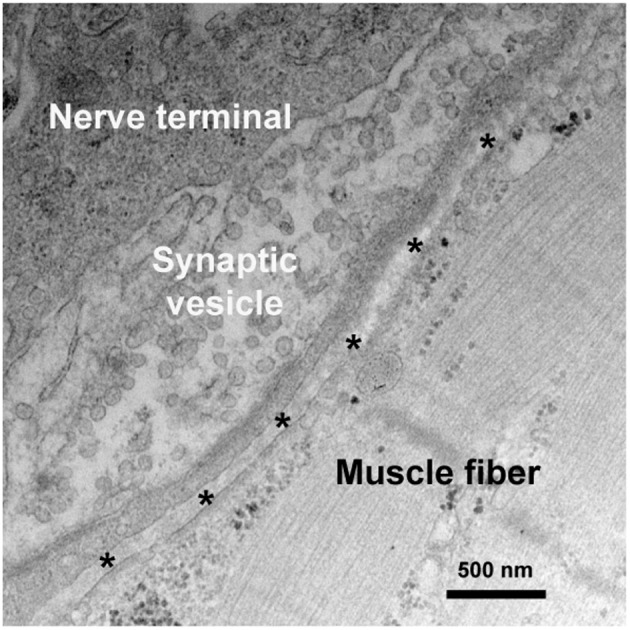
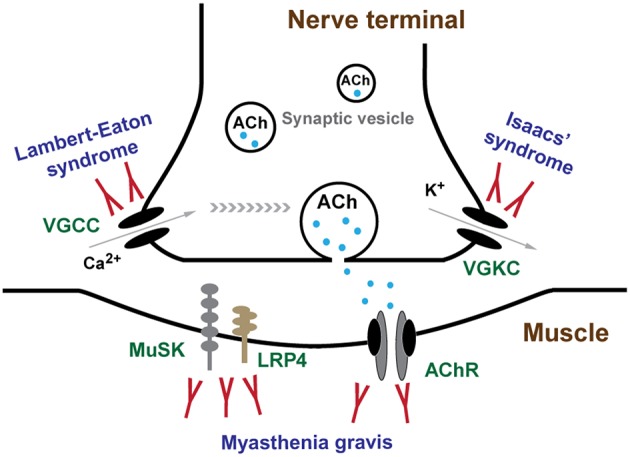
The neuromuscular junction, also called myoneural junction, is a site of chemical communication between a nerve fiber and a muscle cell. There are many types of channels at neuromuscular junction that play indispensable roles in neuromuscular signal transmission, such as voltage-gated calcium channels and voltage-gated potassium channels on presynaptic membrane, and acetylcholine receptors on post-synaptic membrane. Over the last two decades, our understanding of the role that autoantibodies play in neuromuscular junction disorders has been greatly improved. Antibodies against these channels cause a heterogeneous group of diseases, such as Lambert-Eaton syndrome, Isaacs' syndrome and myasthenia gravis. Lambert-Eaton syndrome is characterized by late onset of fatigue, skeletal muscle weakness, and autonomic symptoms. Patients with Isaacs' syndrome demonstrate muscle cramps and fasciculation. Myasthenia gravis is the most common autoimmune neuromuscular junction channelopathy characterized by fluctuation of muscle weakness. All these disorders have a high risk of tumor. Although these channelopathies share some common features, they differ for clinical features, antibodies profile, neurophysiological features, and treatments. The purpose of this review is to give a comprehensive insight on recent advances in autoimmune channelopathies at the neuromuscular junction.
神经肌肉接头,也称为肌神经接头,是神经纤维与肌肉细胞之间进行化学通讯的部位。神经肌肉接头上存在多种类型的通道,它们在神经肌肉信号传递中发挥着不可或缺的作用,例如突触前膜上的电压门控钙通道和电压门控钾通道,以及突触后膜上的乙酰胆碱受体。在过去的二十年里,我们对自身抗体在神经肌肉接头疾病中所起作用的理解有了很大的提高。针对这些通道的抗体可引发一系列不同的疾病,如兰伯特-伊顿综合征、艾萨克斯综合征和重症肌无力。兰伯特-伊顿综合征的特征是疲劳出现较晚、骨骼肌无力和自主神经症状。艾萨克斯综合征患者表现为肌肉痉挛和肌束震颤。重症肌无力是最常见的自身免疫性神经肌肉接头通道病,其特征是肌无力波动。所有这些疾病都有很高的肿瘤风险。尽管这些通道病有一些共同特征,但它们在临床特征、抗体谱、神经生理特征和治疗方法上存在差异。这篇综述的目的是全面深入地了解神经肌肉接头自身免疫性通道病的最新进展。